Introduction: If I Were Neither Jewish Nor Israeli Back to contents
I am Jewish and Israeli-born, the son of European Jewish refugees who survived the Holocaust, and a former soldier in the Israel Defense Forces. I do not approach this history from the outside. I grew up inside Israel’s national narrative, inherited its fears, and participated in the system I am now asking myself and others to examine.
This is not an attempt to solve the Israeli-Palestinian conflict. I have become skeptical of arguments that begin with a preferred solution and then select the history, facts, and morality needed to justify it.
Nor is this a balanced history of the conflict in the conventional sense. It does not attempt to give equal space to every act of violence, every failure of leadership, or every grievance held by both peoples. Its focus is Israel because Israel is the country that formed me, the national story I once believed, the military in which I served, and the system from which my family benefited. Palestinians, Hamas, Arab governments, and Palestinian leaders also bear responsibility for violence, injustice, corruption, and failed opportunities, and I address some of that where it is necessary. But this is primarily a reckoning with my own history and with what has been done in the name of the country and people to which I belong.
I am attempting to step outside my identity and look at the conflict from a moral distance. That does not mean pretending that power and responsibility are evenly distributed. It means applying the same moral standards to everyone while examining most closely the actions for which I have the greatest knowledge and personal responsibility. If I were neither Jewish nor Israeli, with no inherited history, fear, or personal interest to defend, how would I judge what has happened to Jews and Palestinians, and what is happening today?
Several distinctions are important from the outset.
Judaism is an ancient religion whose roots reach back more than 3,000 years. For many Jews, Jewish identity is also cultural, ethnic, historical, and connected to a sense of peoplehood.
Palestinian identity is a national, cultural, and historical identity, not a religion or political organization. Palestinian society includes Muslims, Christians, secular people, Bedouin communities, and others. Most Palestinians are Muslim, but Palestinian identity is not synonymous with Islam.
Palestinian identity developed as a modern national identity, but the people from whom it emerged did not suddenly appear in the twentieth century. Generations lived, worked, raised families, and built communities there, identifying through their cities, villages, regions, religions, and families and, increasingly, as Arabs of Palestine and Palestinians. The fact that the terminology evolved does not negate Palestinian peoplehood, just as the evolution of other national identities does not negate the people or communities from which they arose.
Zionism is a modern Jewish nationalist movement that emerged in Europe in the late nineteenth century and became formally organized at the First Zionist Congress in 1897. It centers on Jewish self-determination in the land of Israel and Palestine and on the creation and continued existence of Israel as a Jewish state. Some Zionists support a Jewish-majority Israel alongside an independent Palestinian state and equal civil rights for all citizens. Other Zionist currents support Israeli sovereignty over all or much of the territory between the Jordan River and the Mediterranean Sea and oppose a two-state solution.
For centuries, Jews ended Passover seders and Yom Kippur services with the words, “Next year in Jerusalem.” The prayer did not originally express a modern political program or a desire to occupy territory. It carried memory, exile, religious longing, and the hope of returning to a place deeply rooted in Jewish identity.
Jewish communities also maintained a continuous, though often small and changing, presence in the land across the centuries, particularly in Jerusalem, Safed, Tiberias, and Hebron.
After centuries of persecution, expulsions, pogroms, and finally the Holocaust, that ancient longing became inseparable from the desperate need for safety. Zionism did not create the Jewish connection to the land. It transformed an ancient religious and historical attachment, intensified by repeated suffering, into a modern political and territorial project.
That emotional force must be understood. For many Jews, Israel is not experienced as an ordinary country. It is understood as the answer to centuries of vulnerability and the promise that Jews will never again be defenseless.
But understanding that history does not mean that every action taken in its name is justified. Jewish suffering explains the longing for safety. It cannot give Jews a greater right to safety, freedom, home, or belonging than Palestinians.
Jews in Israel and elsewhere hold a wide range of views. Some are Zionists and some are not. They also differ widely in how they support or criticize Israeli governments, Israeli policies, and the treatment of Palestinians.
Palestinian identity should not be equated with Hamas, the Palestinian Authority, the Palestine Liberation Organization, or the actions of particular Palestinian leaders or armed groups.
By the same principle, Israelis should not be equated with the actions of their government, and Jews throughout the world should never be held collectively responsible for the conduct of the Israeli state. Moral responsibility belongs to governments, institutions, organizations, leaders, and individuals for the choices they actually make.
None of this makes the history simple. Jews carry centuries of persecution, exile, dispossession, and genocide. Palestinians carry displacement, occupation, statelessness, loss, and daily insecurity. In Gaza, Amnesty International in 2024 and the UN Independent International Commission of Inquiry in 2025 concluded that Israel had committed genocide against Palestinians. These are findings by those bodies, not a final court judgment. [66] I do not have to diminish either history to say something basic: one people's suffering cannot make the other people's suffering acceptable.
I do not know whether the answer is two states, one state, a confederation, or something else. I am not pretending I can solve that. But not knowing the final solution cannot be a reason to avoid judging what is happening now.
For me it comes down to this: Jewish safety cannot depend on Palestinians losing their homes, freedom, or political rights. Palestinian freedom cannot depend on denying Jews safety or a place to belong. Any future worth having has to protect both.
What changed my mind was not one book or one argument. It was my own family's story, Israeli records about what happened to Palestinians in 1948, and things I saw myself in Israel and during my military service. Then I began comparing those memories with what is documented today in the West Bank, Gaza, Israel, and the wider region. The story I had believed most of my life no longer held together.
Not in My Name Back to contents
I am Jewish and was born and raised in Israel. That is part of who I am, but it does not give Israel permission to speak or act in my name. I reject the dispossession and denial of rights described in this essay, both in Israel’s past and in what it continues to do today. My connection to Israel makes it more necessary for me to say this clearly.
There is a painful irony in watching a state founded in part to provide refuge for Jews pursue policies that risk making Jews less safe. Jews everywhere are not responsible for Israel’s actions, and nothing excuses antisemitism. But when Israel invokes our shared identity to defend its conduct, I feel a responsibility to challenge that claim and press for change.
I am not distancing myself from being Jewish. I am refusing to let Jewish identity become a justification for injustice. Palestinian lives, freedom, and dignity matter in their own right, regardless of the consequences for Jews. This essay is my effort to confront what I once accepted, make clear where I stand, and explain why I can no longer remain silent.
1. The Conversation That Stayed With Me Back to contents
This essay grew out of a civil and valuable conversation with a thoughtful, American-educated Israeli doctor living in Area C of the West Bank. I respected her intelligence and sincerity. Yet she was convinced that Israel had the right to build towns and expand Jewish settlements there, and understood the Oslo Accords as validating that right.
What the Oslo Accords Did and Did Not Authorize Back to contents
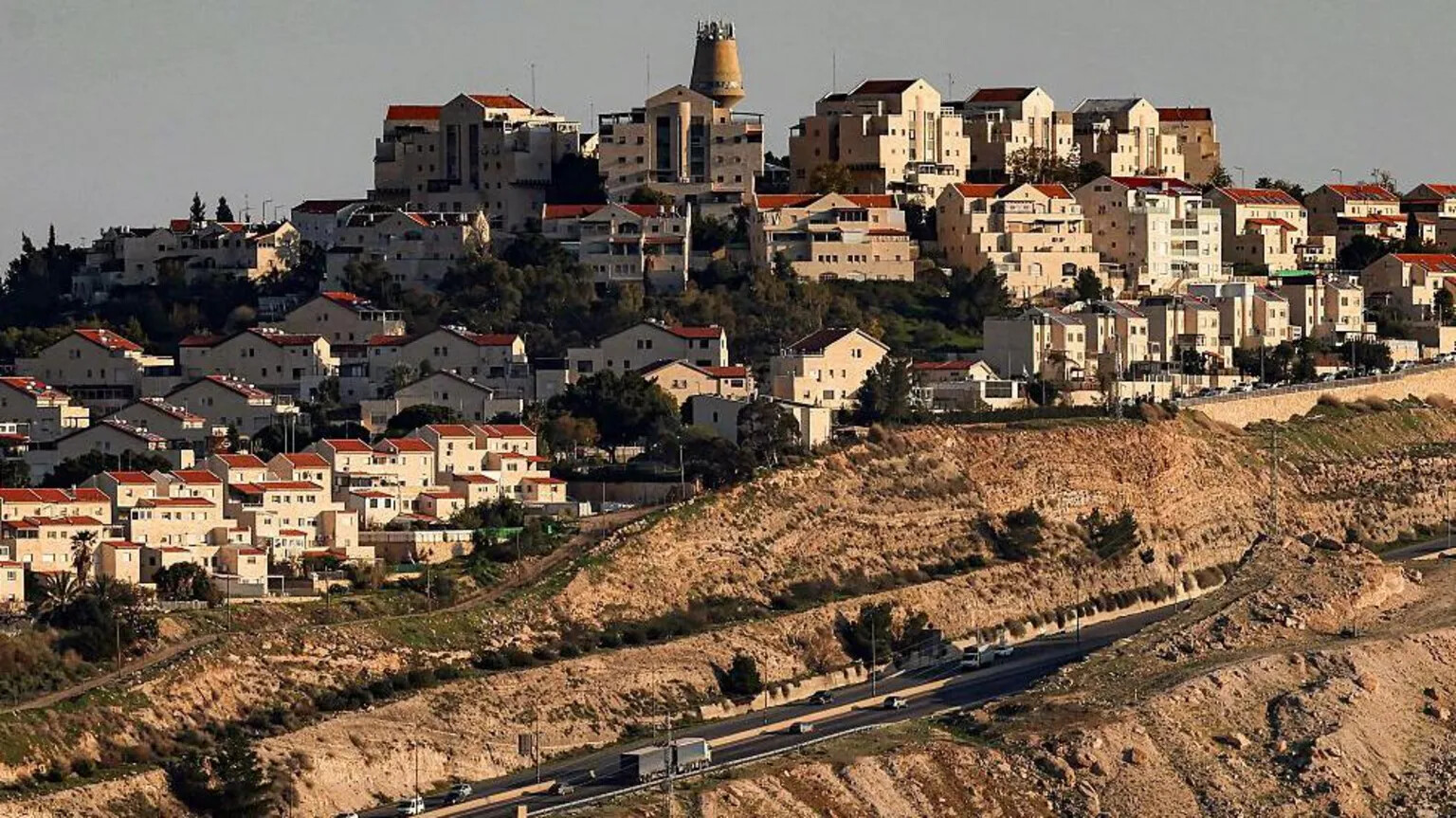
What struck me was the sincerity of her conviction. As I understand it, however, the Oslo Accords did not give Area C to Israel. They established interim Israeli administrative and security authority pending a permanent agreement. They did not transfer sovereignty or title, and settlements were specifically left for permanent-status negotiations. The International Court of Justice, the United Nations Security Council, and much of the international community regard Israeli settlements in the occupied West Bank as contrary to international law; Israel disputes that conclusion. [1][2]
But Area C is not just an unresolved legal question frozen in time. While its final status remains unresolved, Israel has continued to expand Jewish settlements and facilitate the movement of more Israeli civilians into the area, creating facts on the ground that become harder to reverse with every passing year. [2]
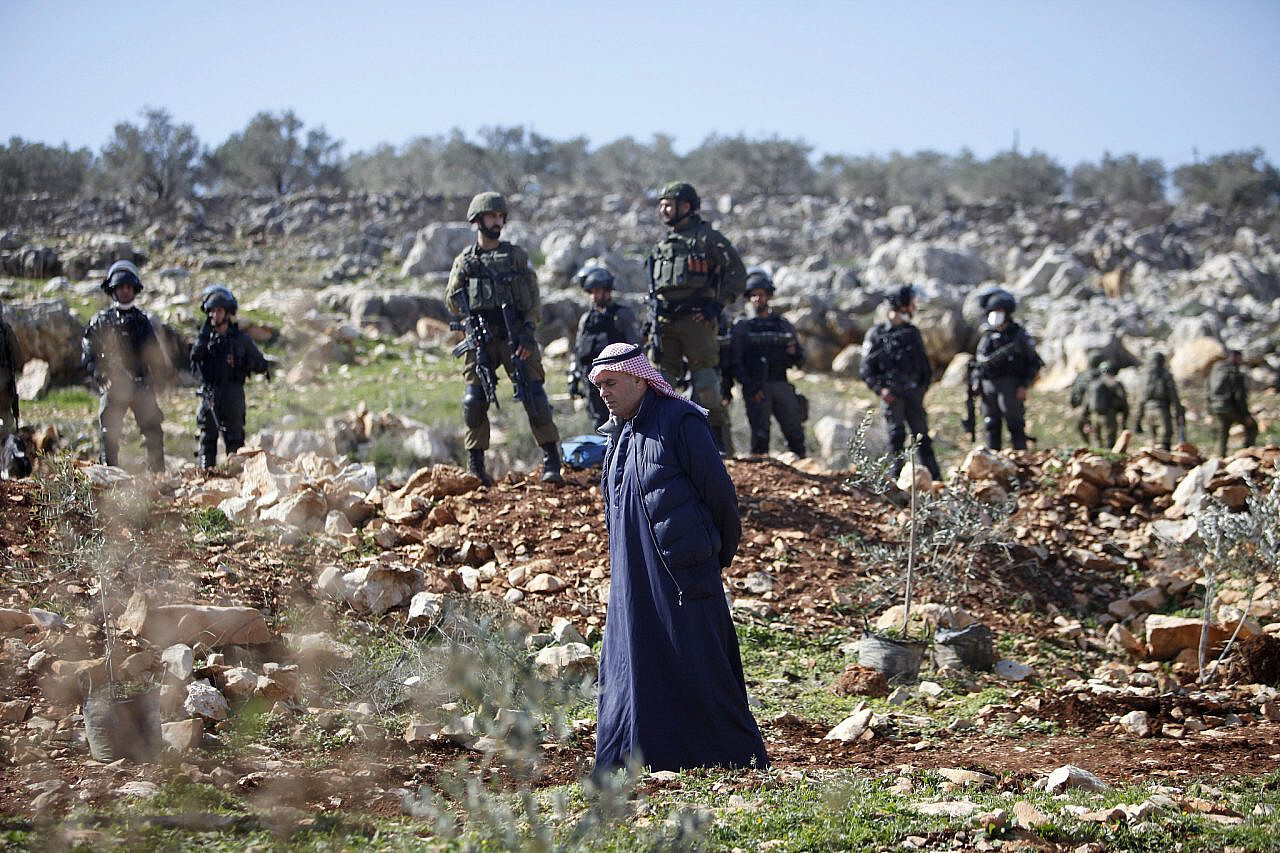
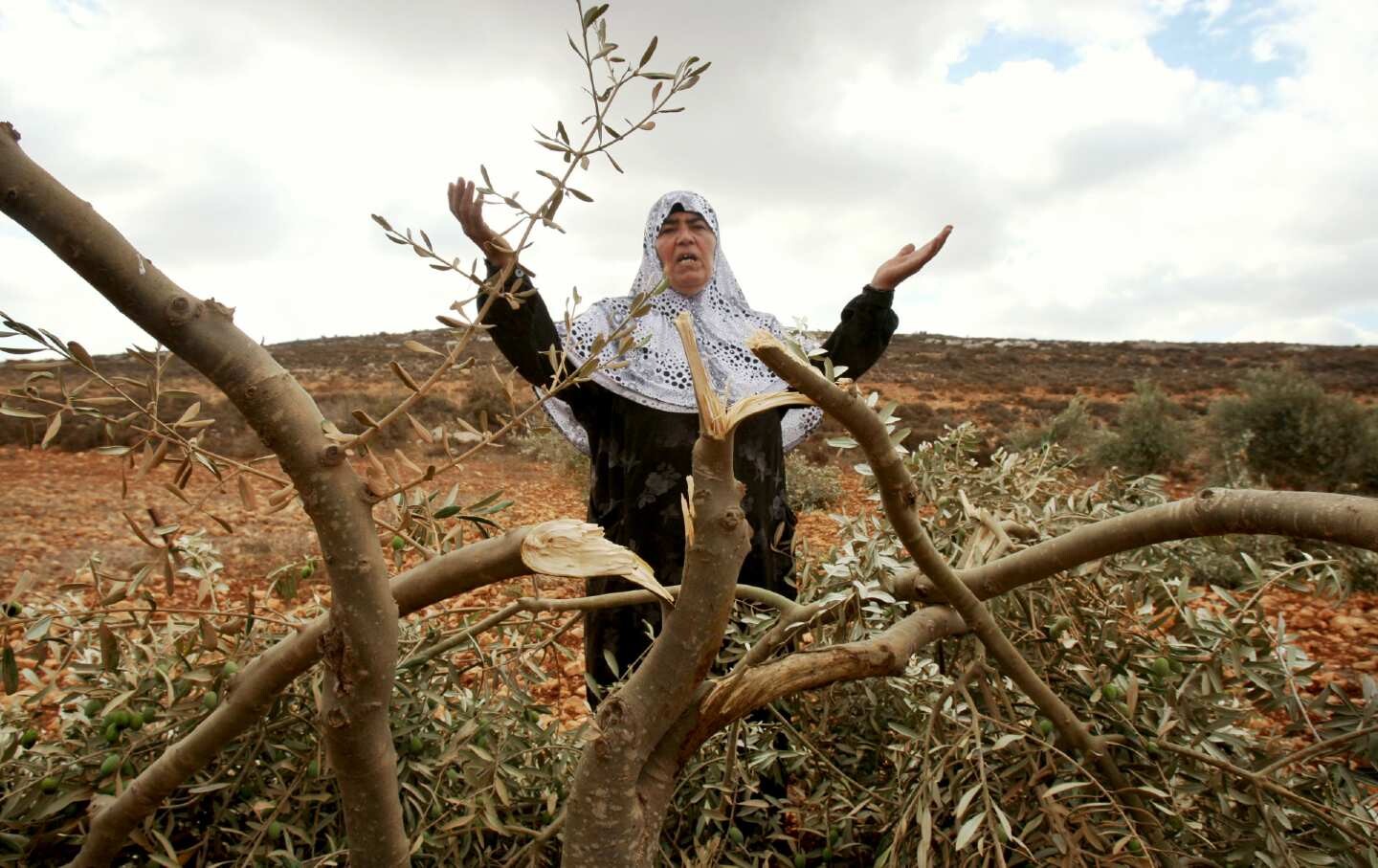
The problem goes beyond construction. In parts of the West Bank, extremist settlers have attacked Palestinians, damaged property, intimidated communities, restricted access to land, and contributed to conditions that have pushed Palestinians from some communities. Israeli human-rights organizations and international observers have documented this pattern extensively. [2][3]
This is especially disturbing because it occurs under an occupation in which Israel possesses overwhelming military and governmental power, including extensive control over water, electricity, fuel, borders and crossings, imports and exports, movement of people and goods, access to agricultural land, and the collection and transfer of much of the Palestinian Authority’s tax and customs revenue. These controls also affect the availability and movement of food, medicine, construction materials, agricultural supplies, and other necessities of everyday life. As the occupying power, Israel has obligations toward the occupied Palestinian population, including obligations to maintain public order and protect civilians. Yet enforcement against settler violence has repeatedly been inadequate. At times, Israeli political leaders have supported settlement expansion and defended or encouraged the larger settler movement rather than restraining it. [2][3]
That is what I mean by creating facts on the ground: interim authority becomes physical permanence without any formal transfer of sovereignty. Although most of the international community considers these settlements illegal, the state with the power to stop them continues to enable and protect much of their expansion. [1][2]
|
Image description: An Israeli settlement in the occupied West Bank. |
|---|
|
Image description: Israeli soldiers and a Palestinian man in the West Bank. |
|
Image description: A Palestinian woman beside a damaged olive tree in the West Bank. |
Area C became a test for me. Forget for a moment that this is Israel. If another country occupied land, moved its civilians onto it, protected them with its army, and the people already living there were gradually squeezed into less space, what would I call it? I know what I would call it if another country were doing it.
I had heard variations of that certainty many times before, especially from Israelis and from Jews outside Israel who strongly identify with Zionism or defend the Israeli state, including some rabbis. They were often people who sincerely believed in compassion, justice, human dignity, equality, and the moral teachings of Judaism. Yet when the conversation turned to Israel and Palestinians, I repeatedly watched those principles bend under the weight of fear, perceived Jewish self-preservation, loyalty to Israel, and sometimes attachment to land.
How can we teach justice and then rationalize injustice when we benefit from it? How can we invoke compassion for the stranger while denying another people rights we would demand for ourselves? How can rabbis teach the moral lessons of Jewish history and tradition while finding theological, historical, or security arguments to excuse conduct they would condemn immediately if another people were doing it to Jews?
Fear is powerful. So is the need to protect ourselves. I know that from Israel and from my own family. But I have also seen how easily fear becomes an explanation for keeping what benefits us. Add land, religion, national identity, and real security threats, and people can convince themselves of almost anything.
The Moral Questions Beneath the Arguments Back to contents
I became exhausted by the usual Israeli-Palestinian argument. Every discussion seemed to arrive carrying a truckload of history, grievances, atrocities, maps, biblical claims, wars, resolutions, and reasons why the other side was more guilty. I wanted to ask a simpler moral question without pretending the history itself was simple.
Take the bird’s-eye view.
Strip away the labels and loyalties.
Forget, for a moment, who is Jewish and who is Palestinian. Forget what I was taught as an Israeli child. Forget religion, nationalism, inherited trauma, biblical promises, political slogans, and even the instinct for self-preservation.
Then ask some of the simplest moral questions:
Who lived there?
Who lost their homes?
Who controls the land today?
Who has freedom and political power?
Who does not?
Who is allowed to return?
Who is prevented from returning?
And if I belonged to neither people, what would I consider just?
These questions cannot solve borders, security, refugees, Jerusalem, settlements, or the fear each people has of domination. But they can help us decide what we should not excuse.
A fact does not stop being a fact because acknowledging it makes the eventual solution harder. Nor should we reject an uncomfortable moral conclusion simply because we cannot immediately explain how to implement it.
Before we can argue honestly about what is politically possible, we have to be honest about what has happened, what is happening now, and what should not be acceptable.
2. The Stories I Inherited and What They Concealed Back to contents
My mother's story is where this stops being abstract. Her family escaped persecution and homelessness in Europe and desperately needed a home. The home they received in Israel belonged to a Palestinian family no longer allowed to live there. My family was saved from homelessness, in part, by another family's loss. I cannot get around that fact.
The Wooden Horse Back to contents
I was born and raised in Israel. I grew up in a home that had belonged to a Palestinian family before 1948.
I knew something about that house long before I understood what it meant.
When I was about six years old, I found old wooden toys under the stairs: blocks and small carved animals. I remember holding a little wooden horse and asking my mother whose toys they were. She told me they had belonged to the children who lived in the house before us.
“Where are they now?”
She told me they had fled when the soldiers came.
I knew nothing about Zionism, the Nakba, competing histories, or the politics of 1948. I understood only what a six-year-old could understand: other children had once lived in my house and played with these toys. Something frightening had happened, they had left, and somehow their home had become ours.
There was a contradiction in that house that took me decades to understand. My parents were Jewish refugees who had lost almost everything in Europe and desperately needed a place to begin again. Yet the home in which we began again existed because another family was no longer there.
I can still picture that little wooden horse in my hand. The politics came much later. The human reality was already there.
The Horrible Transfer of Suffering: My Mother’s Story Back to contents
 |
||
|---|---|---|
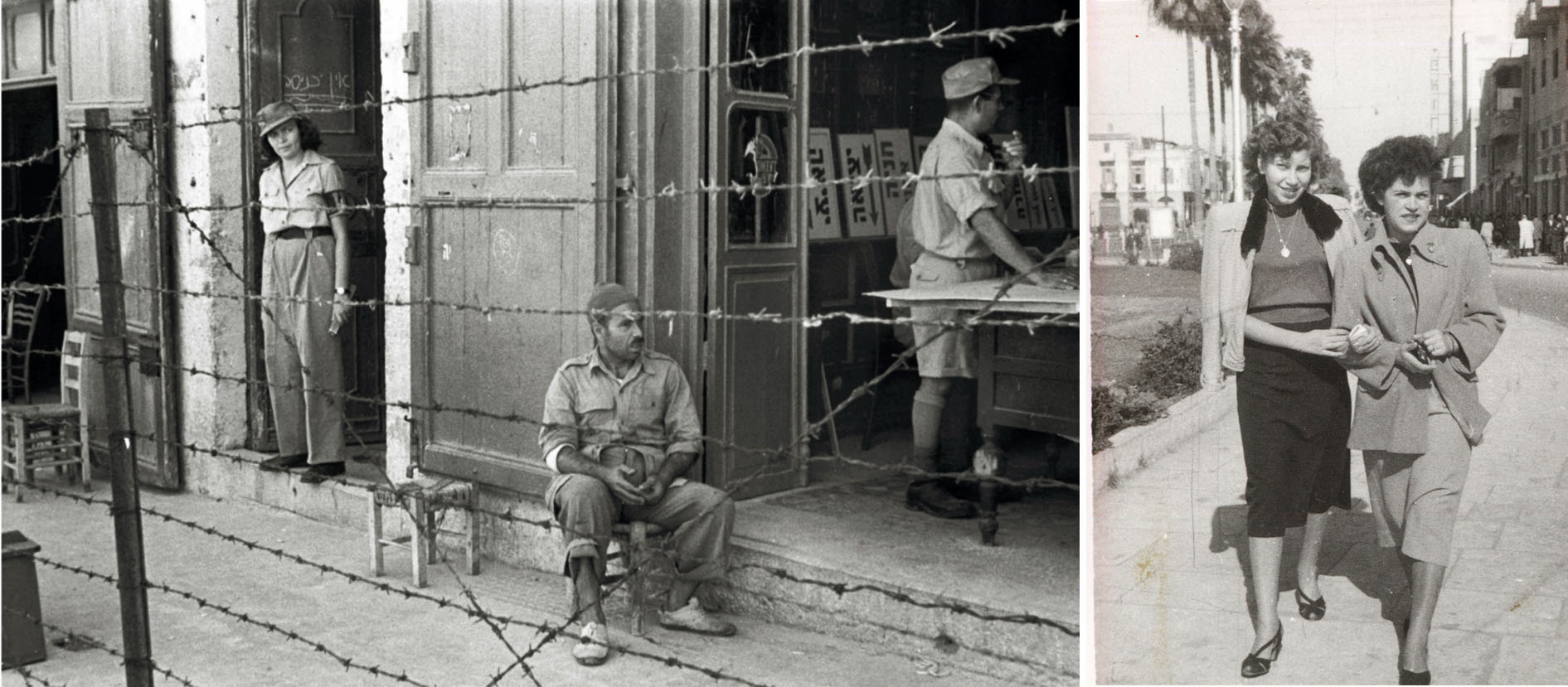
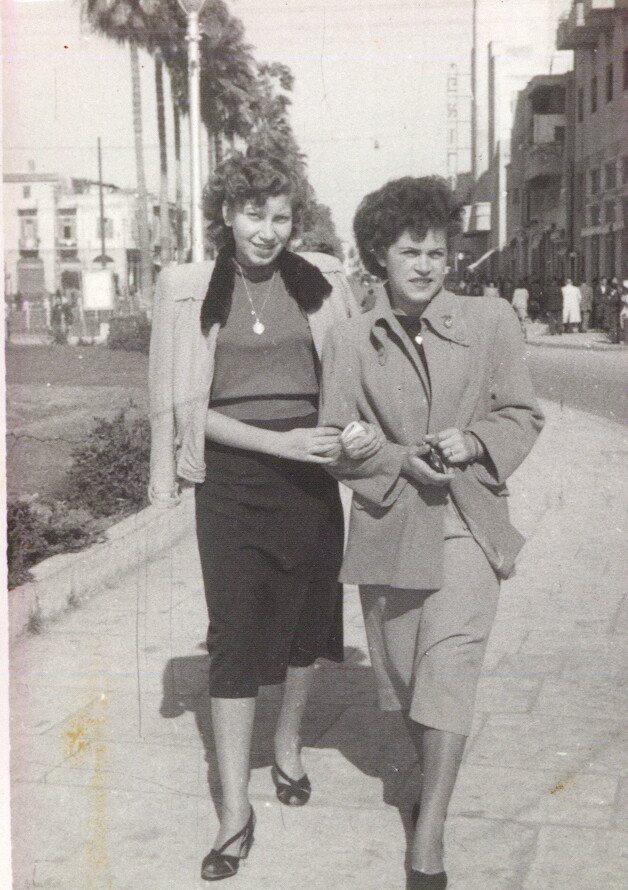
| Image description: my mother (right), a teenager, and her friend Bella walking freely through Jaffa in 1951. More than seventy years later, Bella was killed when a bomb from Gaza struck her home during the war.. | ||
 |
||
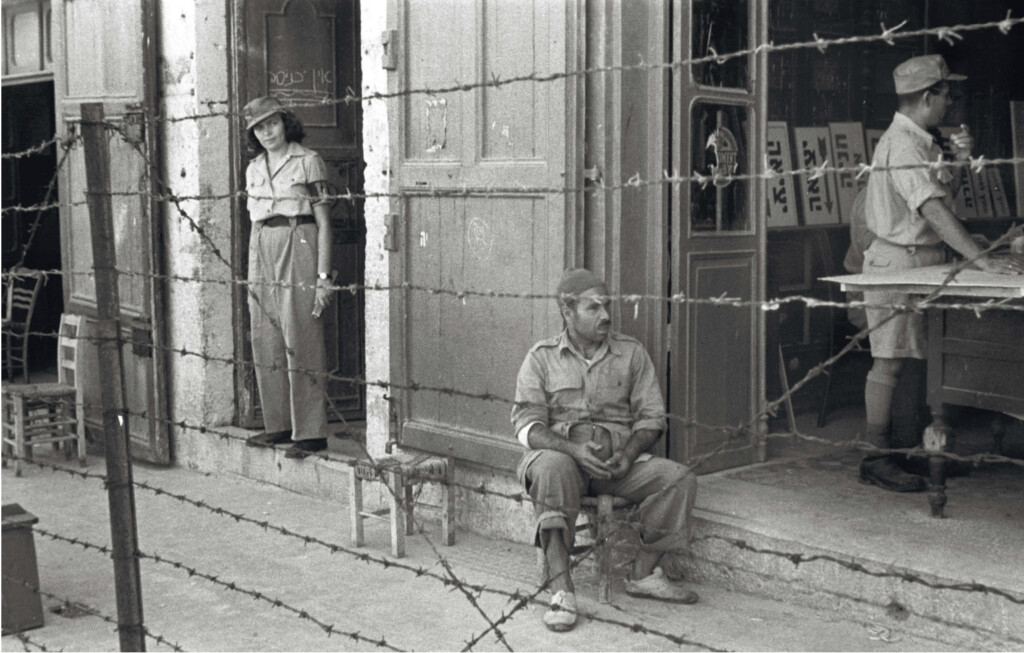
| Image description: Ajami after Jaffa’s conquest in 1948: a man sits behind the barbed-wire boundary imposed on the city’s remaining Palestinian residents. Source: Israel Defense Forces and Defense Establishment Archive. | ||
|
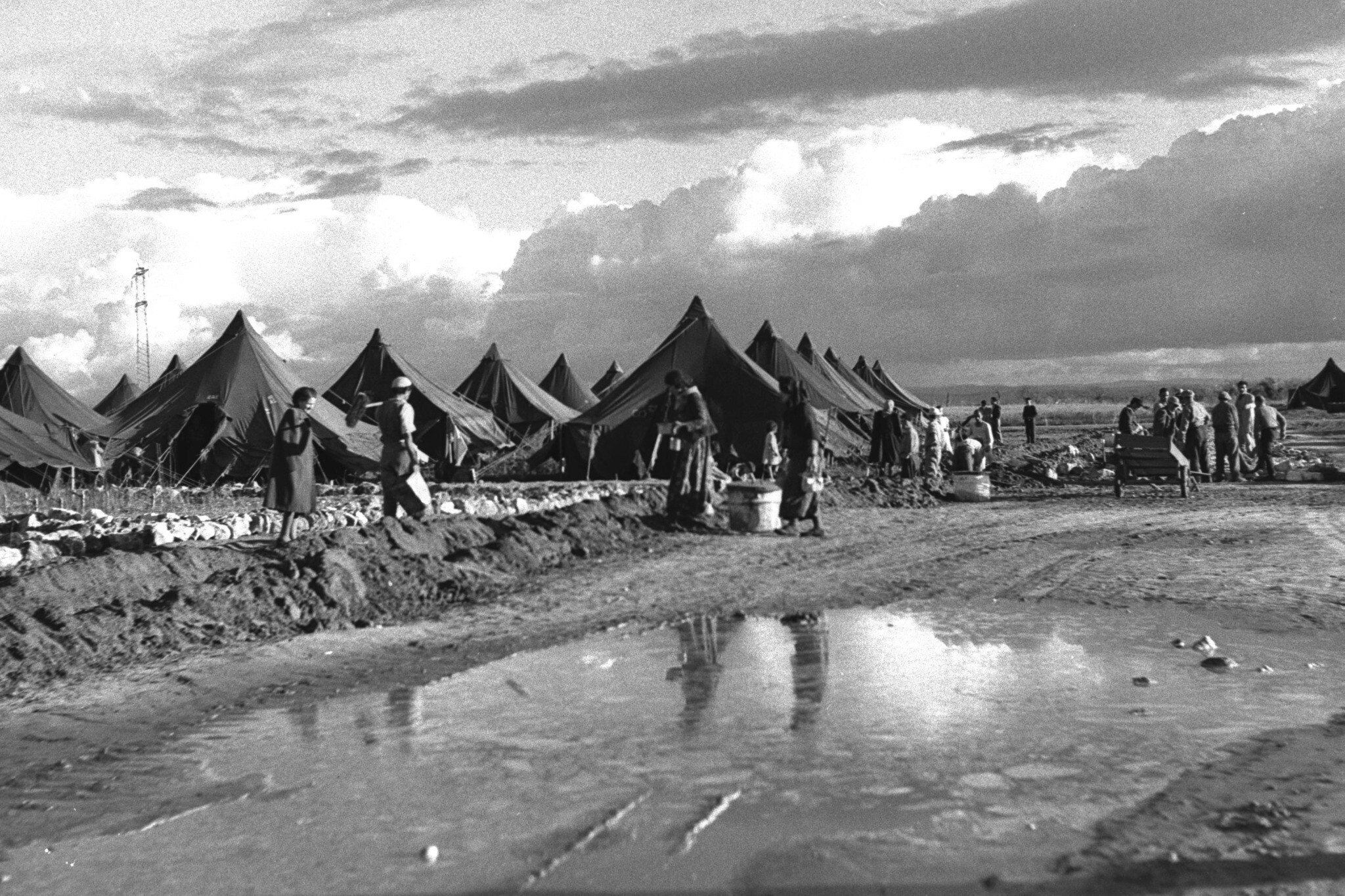
Image description: Jewish refugees living in tents in Hadera, where Morty Bachar’s mother and her family were initially housed. |
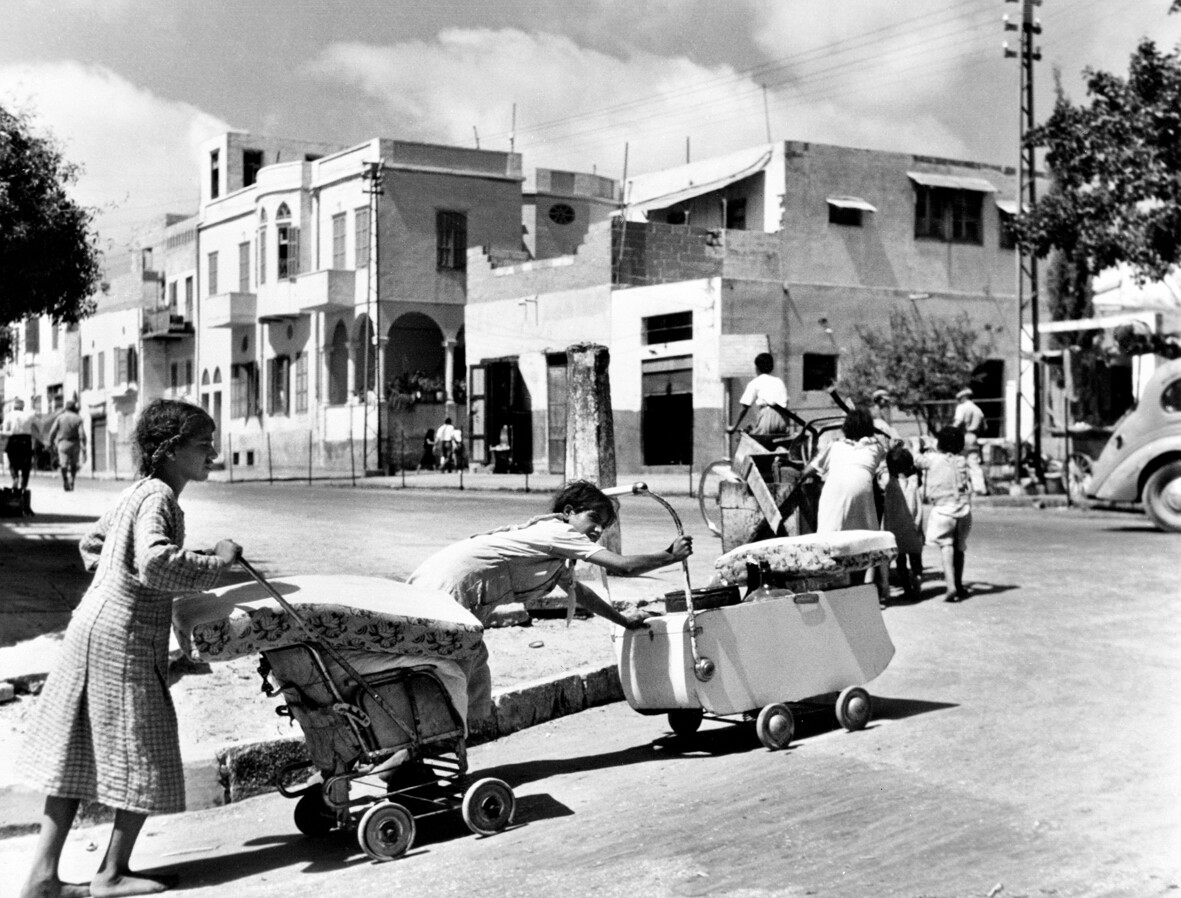
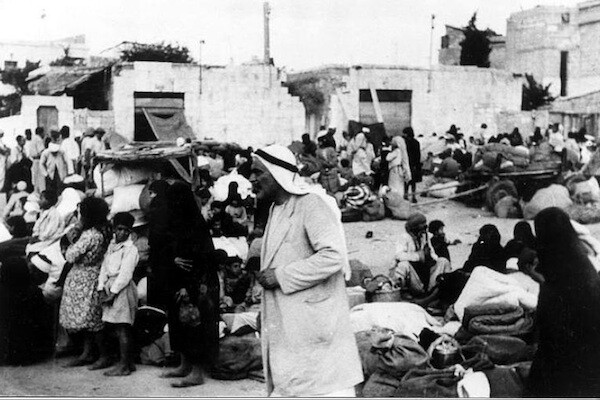
Image description: Palestinian families leaving Jaffa with their household belongings, 1948. |
|
|
Image description: Palestinian residents expelled from Lydda during Operation Dani, July 1948. |
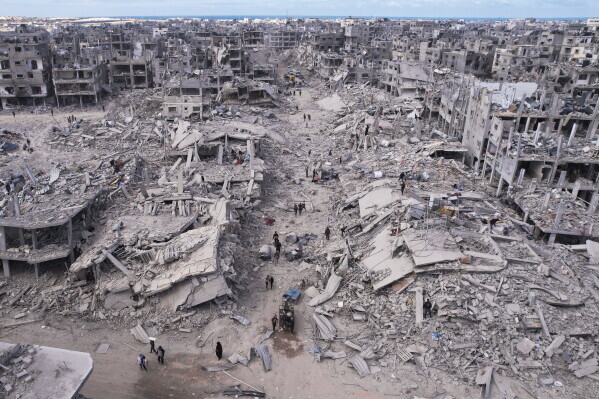
Image description: Palestinians walking through the ruins of Jabalia in northern Gaza, January 2025. |
|
Shortly before my mother died, I recorded her describing her arrival in Israel from Bulgaria as a thirteen-year-old refugee during the large migration of Bulgarian Jews in late 1948. Her education had ended after the second grade, when Jews were driven from their homes and stripped of their property. She could barely read or write, but she was intelligent, perceptive, and capable. Beginning at fourteen, she spent most of her working life as a seamstress in a seat-manufacturing shop. Still a child, she had already endured persecution, displacement, hunger, homelessness, bombings, dangerous conditions, and repeated escapes from death.
Her family arrived with nothing and was first placed in tents in Hadera. There they waited without a home, surrounded by other Jewish refugees, while soldiers assured them, “We are working on finding housing solutions for you.”
Eventually, her family was driven from Hadera toward Jaffa. She remembered passing through a city whose destruction still felt fresh. Buildings had collapsed. Walls were shattered. The war had moved on, but its aftermath was everywhere. Palestinian families were gone from most neighborhoods. Behind them remained furnished homes, dishes on shelves, clothing in closets, shops still stocked, and children’s belongings left behind.
Only later did the soldiers’ promise reveal its terrible meaning. “We are working on finding housing solutions for you” did not mean that homes were being built. It meant that confiscated homes from which Palestinians had already been displaced were being redistributed to Jewish refugees. The tents in Hadera and the confiscated homes in Jaffa were not separate stories. The promised solution was not ending suffering. It was replacing one people’s suffering with another’s.
My mother’s family was moved into one of those confiscated, fully furnished Palestinian Arab apartments. Her brother secured the apartment for the family. Her father took possession of several confiscated stores and later gave some of them to relatives. My mother was a good and caring person. Yet when she described taking possession of another family’s home and belongings, she said simply, “We arrived without anything. It helped us.”
The historical record establishes the setting of my mother's memory. When Jaffa surrendered in May 1948, fewer than 4,000 of its nearly 100,000 Palestinian residents remained. Israeli authorities concentrated those who stayed in Ajami behind barbed wire, under military rule, permits, and curfews, while Palestinian homes, apartments, shops, furnishings, and land were taken into state control and redistributed. Tens of thousands of Jewish immigrants were later directed into Jaffa, including Bulgarian Jewish refugees like my mother's family. The full historical and archival documentation appears in Appendix A, giving my mother's memory a documented structure. [24][25]
I do not hear cruelty in her words. I hear the moral narrowing that trauma and desperate need can produce. Her family had suffered so much that the Palestinian family disappeared from the picture. The people who had slept in those rooms, eaten from those dishes, worn those clothes, and raised children in that home were no longer visible, even while their home and possessions made my family’s new life possible.
My Father’s Life Among Palestinians Back to contents
My father knew what it meant to be uprooted, to become a refugee, to endure hunger and homelessness, and to struggle for his family’s survival.
At fourteen, he was displaced in Europe without his father, who had been taken to a forced labor camp. After their home was seized, my father, his mother, and his two younger brothers fled with only what they could carry. At times, they survived outdoors without shelter. He was still a boy, but he became responsible for keeping his mother and brothers alive.
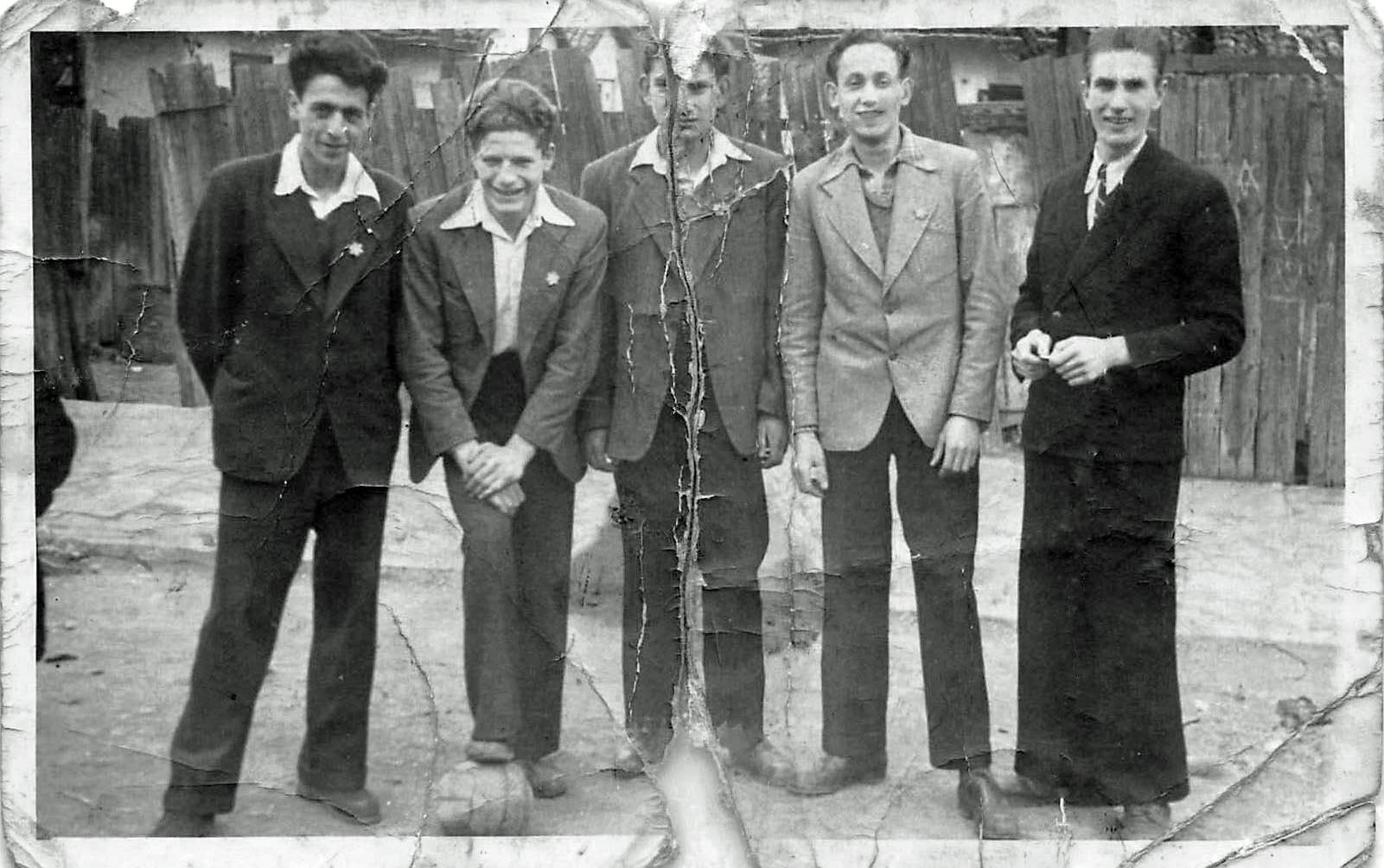
Image description: Morty Bachar’s father, second from the right, wearing a Jewish star in the ghetto during the persecution of Jews in Europe.
That history shaped him for the rest of his life.
After arriving in Israel, my father worked for many years as a nurse in a psychiatric hospital. Many of the other nurses were Palestinians from Akko and the surrounding area. He respected them, and they respected him. He also became nearly fluent in Arabic.
Because of him, Palestinians were never just an abstraction to me or an enemy I had been taught to fear. They were people my father knew, worked beside, laughed with, and cared about.
As a child, I saw that affection and respect firsthand. Our family was invited to Palestinian weddings and other gatherings in the Galilee. I remember sitting beneath the night sky near campfires, surrounded by Arabic singing, rhythmic drumming, dabke dancing, food, stories, and laughter. There was no electricity or running water, but the hospitality and generosity were unlike anything I had experienced. I was mesmerized by gatherings in which everything seemed connected to family, land, memory, and belonging.
Years later, after a long absence, I walked through the Arab market in Akko. A man came running after me, calling my father’s name. For a moment, he thought I was my father. When he realized I was his son, he spoke with great affection about how much he had loved and respected him.
That was the kind of regard my father inspired among people he had once been sent, as a young soldier, to patrol.
My Father’s Final Request Back to contents
Many years later, I hired a journalist to write the story of my father’s life. The book was printed privately and shared only with our family. I wanted his children and grandchildren to remember our history: the hardship he endured, the people he lost, and his remarkable survival. We believed his story was complete.
Then, about eight or nine years ago, while I was visiting my family in Israel, my father approached me. He looked weak and shaken. His face was filled with worry, and his voice sounded fragile.
“Sit with me,” he said.
I sat beside him as he began to speak.
“I have something very important to tell you. About the book, I omitted something. I was ashamed to tell it, but I must tell you now. Maybe it can still be added. It is important.”
I had never seen him look this way. Whatever he was about to tell me had clearly been weighing on him for a very long time.
Soon after arriving in Israel as a young Jewish refugee in 1948, my father was required to serve in the newly formed IDF. He was assigned to patrol near a Palestinian village that had been divided by a military line. What had once been one village had become two halves separated by a border.
During one patrol, my father was riding in a jeep with one other soldier, who was driving. It was nearly dark when they saw movement in the bushes. Fearing an ambush and believing they were in danger, my father fired his rifle into the place where they had seen the movement.
Then everything became quiet.
When they approached the bushes, they found an elderly Palestinian man lying dead on the ground. One of his hands still held the handle of a pot, and the cooked food he had been carrying had spilled onto the earth.
My father believed the man had been trying to bring food across the military line to hungry family members living under close military guard in the other half of the divided village.
The two soldiers left quickly. For years, my father tried to escape the memory. “I wanted to forget,” he told me.
As he continued, his chin began to tremble and tears poured down his face. I had seen my father cry only once before, when his mother died.
“This was bad, Morty,” he said. “We hurt them so much. We caused so much harm to innocent people.”
He tried to continue, but he could barely speak. “I was ashamed to tell this story. Please add it to the book.”
I placed my hand on his shoulder.
“Thank you for telling me,” I said. “I already knew that Palestinian land had been taken by force. But through your story, I understand more clearly how terrible the injustice was, especially when you were forced to become part of it. You liked the Arabs. I know that. When we walked through the Arab market in Akko, people greeted you with such respect. Even when I was a child, I could see how much they cared for you. I understand why this memory was so hard for you to carry.”
My father wept. Finally, he said, “I am so sorry. I am so sorry.”
My father had once been a homeless child trying to keep his own family alive. Only a few years later, wearing an Israeli uniform, he killed an elderly Palestinian man who appeared to be trying to carry food to his hungry family.
Fear, military training, and a new border drawn through a village had transformed an elderly man carrying food through his own community into a suspected enemy.
To governments and military authorities, a border may appear as a necessary line on a map. But such lines pass through villages, homes, fields, roads, and families. In this village, the line separated families and hungry people from food, determining who could move, return, help a relative, or be treated as a threat for crossing what had once been part of ordinary life. Those who created it may never have witnessed its consequences, but those who lived along it carried them through grief, displacement, fear, anger, and memory.
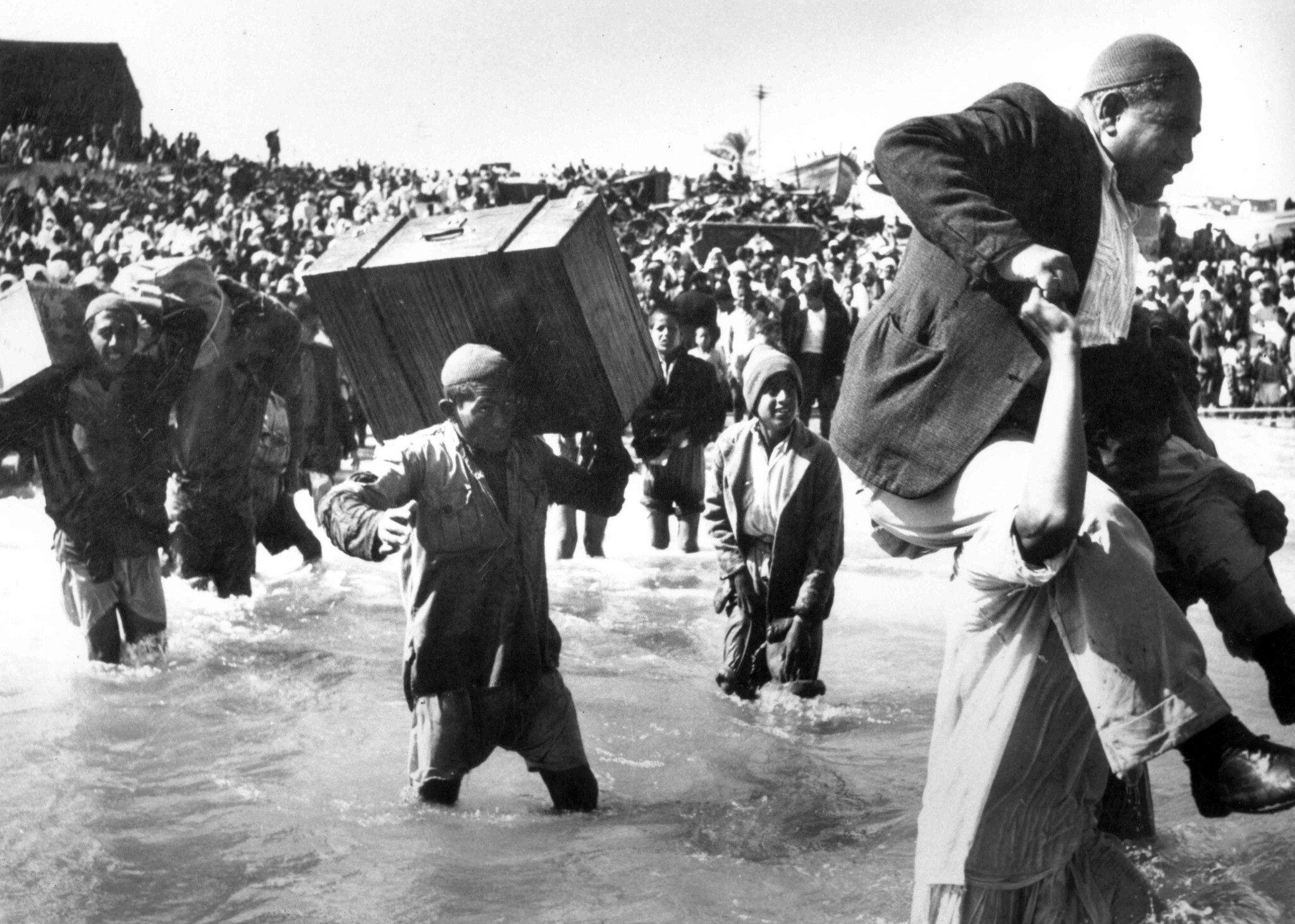
Image description: Palestinian residents fleeing Akko during the 1948 war, carrying children and household belongings.
My father carried the shame of that killing for nearly seventy years. He knew Palestinians too well to reduce the man to an enemy. He knew their language, food, music, celebrations, warmth, and generosity, and understood that a family was waiting for this man to return with food.
I do not know the elderly man’s name. I know only what my father saw when he approached the bushes: a dead man, food spilled onto the ground, and a hand still holding the handle of a pot. I also know what that memory did to my father for the rest of his life.
My father died a few years after telling me this story, at the age of ninety five. Before he died, he asked me to add it to the private book our family had made about his life.
I now understand that he was asking for more than an amendment. He wanted his children and grandchildren to know not only the story of his suffering and survival, but also the truth that caused him shame and implicated him personally. He had carried it in silence for nearly seventy years and, near the end of his life, entrusted it to me.
I do not tell this story to condemn my father. I tell it because he asked me to, and because the elderly Palestinian man's life should not disappear into a history remembered only through borders, armies, and maps. Silence may preserve a comforting version of history, but it cannot restore the humanity of those left out of it.
My father showed me what it means to confront a truth that is painful and difficult to reconcile with the story we would rather tell about ourselves. His confession became part of the larger history my mother's memories, my own military service, the Palestinians I knew, and Israel's records forced me to examine.
By telling what happened to both men and carrying that commitment through this essay, I am trying to fulfill my father's final request.
What a Human Being Can Carry Back to contents
The photographs earlier in this chapter show displaced families. The Hadera photograph shows Jewish refugees after Europe, living in tents in Hadera with only the belongings they had been able to bring. This was the world my parents knew. In Bulgaria, anti-Jewish laws restricted where Jews could live, work, and study. In 1943, Bulgarian authorities expelled almost 20,000 Jews from Sofia to the provinces, sent Jewish men into forced labor, and confiscated much of the property families left behind.
Jews living in Bulgarian-occupied Macedonia, Thrace, and Pirot suffered an even worse fate. More than 11,000 were deported into German custody, and virtually all were murdered at Treblinka.[40]
The next photographs show Palestinian families leaving Jaffa and Lydda in 1948. They, too, carried children, bundles, furniture, and whatever their bodies could bear. They did not know whether they would ever see their homes again. Most never did. Their houses, land, shops, furnishings, and belongings were taken, and families like mine were placed inside the world they had been forced to leave.
The recent photograph from Gaza completes the sequence. Again, families move through destruction carrying children, bags, blankets, water, and the remaining fragments of their lives. Again, their homes have become rubble. Again, civilians are ordered to move, pushed into ever-smaller areas, and left wondering whether there will be anything to return to.
These histories are not identical, and they do not need to be identical for us to recognize the same human terror. A frightened family leaves its home carrying only what the body can bear. Behind them remain rooms, family photographs, furniture, gardens, neighbors, graves, and the ordinary life that made that place home. Ahead of them is uncertainty, dependence, and the possibility that someone else will take possession of everything they were forced to abandon.
As the son of Holocaust survivors, I was taught to recognize this image when the people carrying the bundles were Jews. My moral failure was not recognizing it with the same clarity when the people carrying them were Palestinians. If the sight of Jewish families driven from their homes awakens grief and outrage in me, the same sight cannot become acceptable when the uniforms, language, or victims change.
Today, in Gaza, this image is being created again before the entire world.
I still have the original recording of my mother telling this story, together with my memories of several conversations we had about it before she died. When historical explanations and familiar excuses begin to obscure what happened, I return to her voice. A Jewish refugee family needed a home. A Palestinian family lost one. My family’s need was real. So was the other family’s loss. The moral failure was treating one as visible and the other as expendable.
3. The Soldier I Became and the Certainty I Lost Back to contents
When the Occupied Land Seemed Open to Me Back to contents
I remember the years after 1967 as a time when, at least from where I stood, the occupied land seemed open.
As a child, and later as a soldier and young man, I could travel through the occupied West Bank and Gaza with family, friends, or by myself without feeling that I was entering a place of constant danger. I went to Jericho, visited small villages, and traveled roads that passed through ancient, ordinary, living landscapes: olive groves, stone houses, markets, fields, and children playing near doorways.
Gaza did not feel like the sealed and shattered place people picture today. I remember being welcomed to generous, unhurried meals of bread, fish, vegetables, and coffee. There was conversation, warmth, and the feeling that hospitality was simply part of life.
There was hardship, much of which I did not understand then. But I remember movement: crowded, beat-up cars carrying workers from Gaza and the West Bank into Israel each morning. They were builders, masons, laborers, and tradesmen helping construct Israeli homes, roads, towns, and settlements, sometimes on land that had belonged to Palestinian families like theirs. Construction was everywhere, with cranes across the horizon.
They were treated as second-class workers. Israel wanted their labor, but not their presence. They were expected to arrive at a worksite, remain there throughout the day, and then be transported back to the occupied territories. They helped build communities over whose location and growth they had almost no say, while their own villages faced military rule, land loss, building restrictions, and an uncertain future.
Looking back, I understand that what felt calm and open to an Israeli traveler did not necessarily feel calm, open, or secure to the people living under occupation.
Perhaps many Palestinians believed the occupation would be temporary, that work and economic ties would bring respect and freedom, and that Israel would allow a Palestinian state to emerge alongside it.
That did not happen.
The occupation continued, settlements expanded, and more land was taken or placed beyond Palestinian use. What had been presented as temporary began to look permanent: Israelis living with full political rights and Palestinians beside them under military authority, without equal rights or an independent state.
The First Intifada began in 1987 after twenty years of occupation, settlement growth, humiliation, economic dependence, and the realization that patience and work had not brought Palestinians freedom or political change. [69] [70]
The Oslo peace process created hope again. Israelis and Palestinians formally recognized one another, and Palestinian self-government was supposed to lead within a few years to a final agreement. But the hardest questions were postponed: borders, Jerusalem, refugees, security, and settlements. While negotiations continued, settlement construction continued too. [71] [72]
Palestinians saw negotiations on one side and cranes on the horizon on the other. Roads, towns, and settlements were spreading across the same territory from which their future state was supposed to emerge. It became harder to believe that the peace process would ever lead to real independence.
Then came violence in both directions. Palestinian armed groups attacked Israelis, including civilians. Those attacks caused real terror, grief, and rage in Israel. Israel responded with military force, closures, arrests, checkpoints, barriers, and greater control. Israeli settlers also attacked Palestinians, while protecting the settlements required an ever-larger military presence. Each side’s fear became proof, in its own eyes, that the other could not be trusted.
The place I remembered as open became divided by checkpoints, walls, permits, guarded roads, closed borders, and suspicion.
I would not claim that every Israeli leader intended to create danger for its own sake. Israel faced real attacks and had real security concerns. But Israel made choices that made greater violence far more likely: continuing the occupation, expanding settlements, using Palestinian labor while denying Palestinians equal rights or a sovereign future, and allowing temporary arrangements to become permanent.
My memories do not prove that everything was good. They show that people were capable of meeting, working together, sharing meals, and moving through the same land.
But ordinary contact was not enough. Work was not enough. Hospitality was not enough.
A people cannot be expected forever to build the homes, roads, and towns of the power ruling them while being told that their own freedom must wait.
That is what changed. Hope that life might become normal gave way to the belief that normal life would never come unless the system itself changed.
When My Certainty Began to Break Back to contents
My military service reinforced the Israeli story I had been taught. Looking back, I can see how thoroughly I absorbed its assumptions: who we were, who the Palestinians were, why we were always defending ourselves, and why the violence around us was supposedly forced upon us.
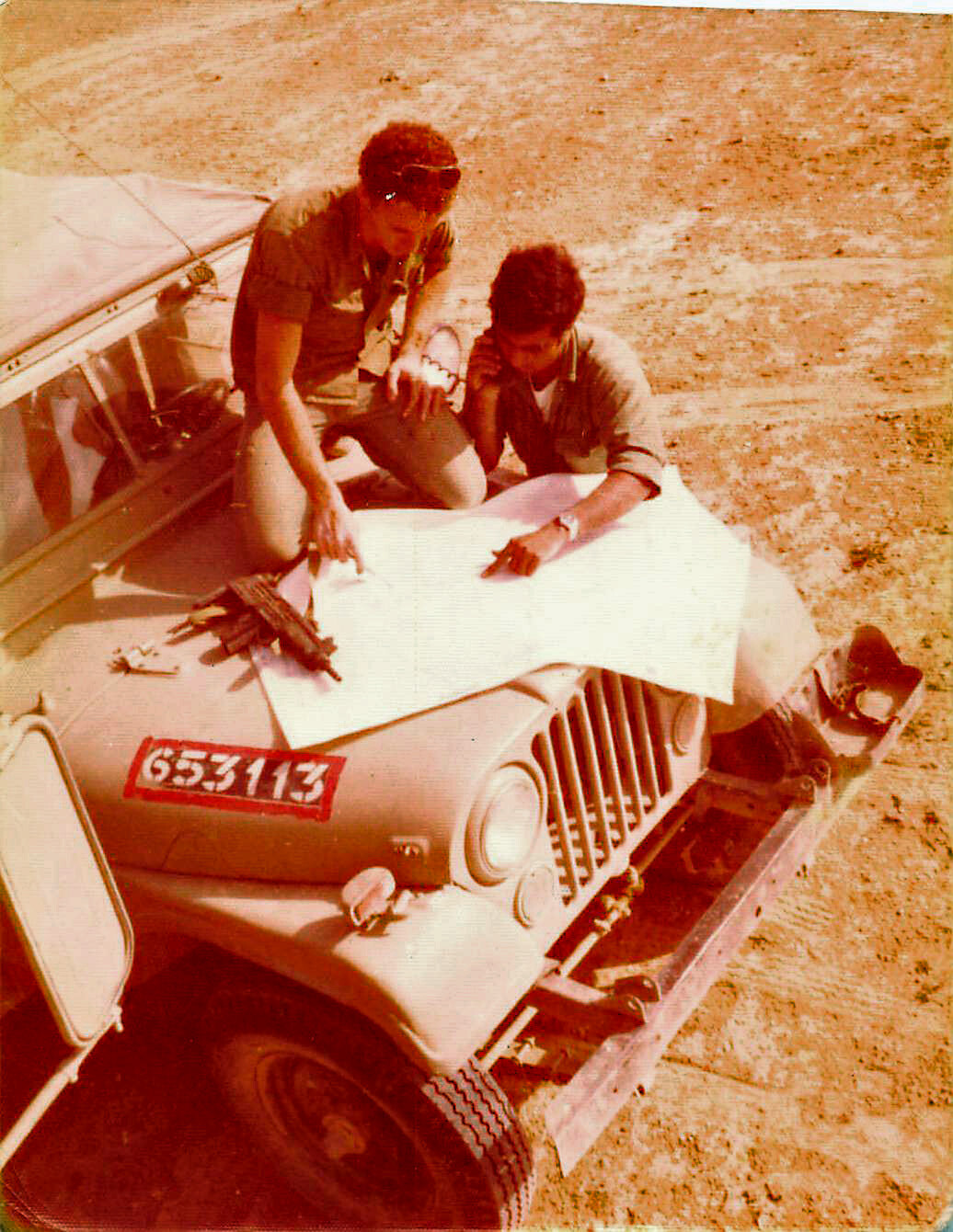
Image description: Morty Bachar sitting on the hood of a dusty military jeep with a machine gun, navigating through the Sinai Desert during his IDF service.
For much of my life, that narrative did not feel like a narrative. It felt like reality.
My questioning had already begun while I was still living in Israel. After my regular military service, and during the years when I returned for reserve duty, I began seeing things I had previously accepted or failed to see. Questions about land, equality, the treatment of Arabs, and the gulf between our image of ourselves and the reality experienced by Palestinians became impossible for me to push aside.
Leaving Israel gave me physical and emotional distance from a country in which I had been completely immersed. I had experienced the conflict from the inside, as an Israeli who lived the story, served the state, and believed much of what I had been taught. From farther away, I could examine those assumptions, compare them with historical evidence, and take Palestinian experience more seriously.
None of this felt intellectually exciting. It hurt. As what I had been taught began to unravel, I experienced something close to an identity crisis. I had grown up believing in the essential righteousness of Israel's story and served in its military believing that story. Discovering that the history was incomplete and distorted made me angry, ashamed, and betrayed. Questioning it meant questioning part of myself.
Distance did not magically remove my bias. I can still be wrong, and I probably am wrong about some things. I have to question what I believe now just as I question what I was taught growing up. The test I keep coming back to is simpler: would I judge this the same way if I had been born into the other family, on the other side?
I inherited a story in which Jewish suffering was personal and immediate, while Palestinian suffering remained distant and abstract. My own experiences, and the history I later uncovered, made it impossible to keep seeing one so clearly while barely seeing the other.
Over time, I reached a conclusion I once would have resisted: the occupation was no longer just a temporary response to security threats at the edge of Israeli life. It had become one of the main forces shaping the state, shaping territory, law, military service, politics, and the future imagined for both peoples. What I had understood as reluctant control for the sake of safety began to look like a long-term project of expansion and domination.
4. What Israel’s Own Records Show Back to contents
My memories and family stories led me to question what I had been taught. Israel’s own archival records allowed me to test those questions against documented evidence.
What You Need to Know
Conquest, Displacement, and Prevention of Return Back to contents
For decades, many of us were taught a simple explanation for the Palestinian exodus of 1948: the Arabs left, often because Arab leaders told them to leave. Israel fought a defensive war and inherited the homes they abandoned.
A secret Israeli intelligence analysis written in June 1948 concluded that Jewish military actions and their effects were responsible for approximately 70 percent of the Palestinian displacement it examined, while orders from Arab institutions and armed groups accounted for only about 5 percent of evacuated villages. By June 1, the report estimated that approximately 391,000 Palestinians had already been displaced. [41]
The Newly Revealed Archival Evidence Back to contents
Then, nearly eighty years later, important additional Israeli records came into public view. Thousands of wartime documents discovered beside a Tel Aviv dumpster in 2024, together with military-court records made public and examined in 2026, include written Israeli military orders involving killing and removal of Palestinians and sworn testimony from senior Israeli officers describing terror and violence as methods used to induce populations to flee. [42][43]
These records do not prove that every Palestinian was expelled at gunpoint or that every village experienced the same events. They establish something more precise and extremely difficult to dismiss: the mass Palestinian exodus cannot credibly be explained as a population simply choosing to leave, or primarily obeying Arab orders to evacuate. Israel’s own contemporary intelligence, military orders, and officers’ testimony contradict that story.
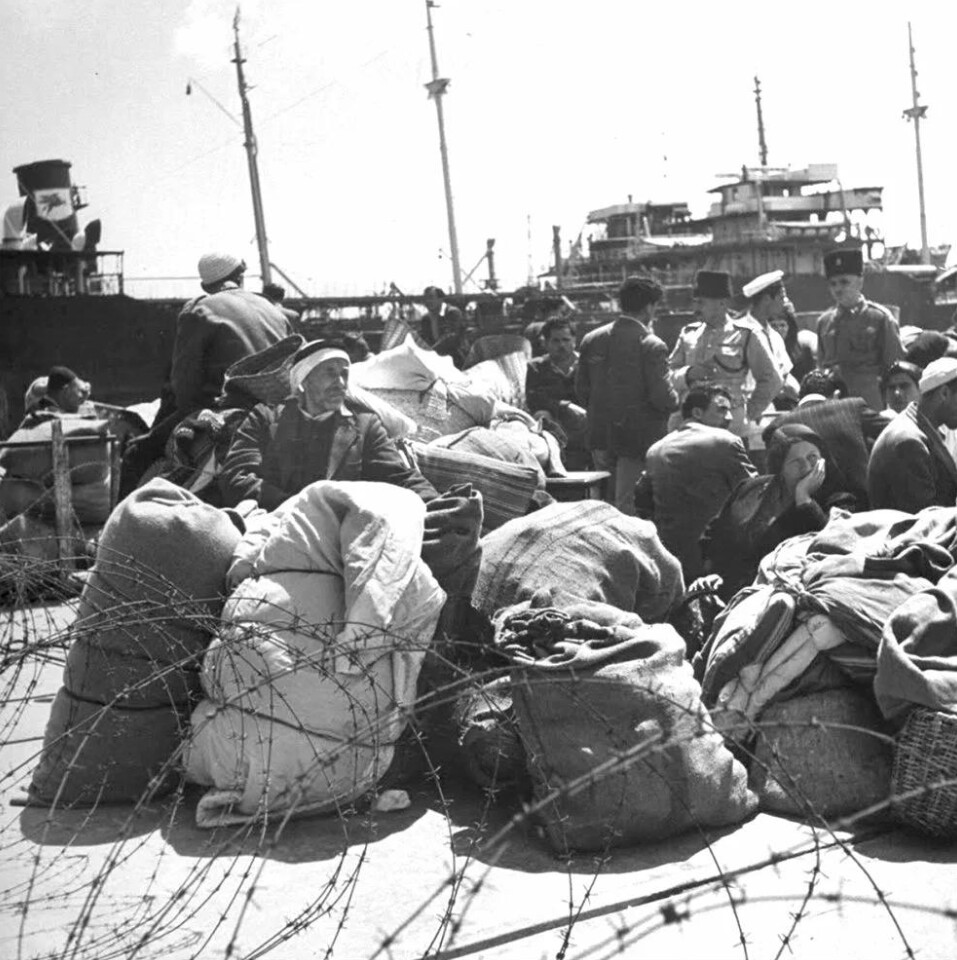
Image description: Palestinian civilians with their belongings during the 1948 war. The image gives human scale to the displacement examined in the Israeli intelligence and military records discussed in this section.
The testimony itself is even more direct. During the military trial of Shmuel Lahis following the October-November 1948 killings at Hula, Mordechai Maklef, then an operations officer on the northern front and later the IDF's third chief of staff, testified: “The intention was to expel. It is impossible to expel 114,000 people … without terror.” Haim Ben-David, a Carmeli Brigade operations officer who later became an IDF major general and David Ben-Gurion's military secretary, described what happened when a Palestinian insisted on remaining in his home: “He gets a bullet.” These statements were given by senior Israeli officers in an Israeli military court. [42][43]
Taken together, the intelligence analysis, operational orders, and sworn testimony document military action, killing, expulsion, terror, and fear that drove civilians from their communities and discouraged or prevented return. They make the old blanket explanation that Palestinians simply chose to leave, or mainly obeyed Arab evacuation orders, impossible to sustain. [41][42][43]
For me, this reaches directly into the story I learned as an Israeli child: that we fought for survival, the Arabs chose to leave, and their abandoned homes therefore became available. Israeli intelligence, operational orders, and commanders' testimony do not permit that simple story to survive.
The complete intelligence findings, military orders, testimony, document images, historical qualifications, and links to the original collections are presented in Appendix A for readers who wish to examine the record in detail.
The Myth of an Empty Palestine Back to contents
One of the most consequential ideas inside the narrative I inherited was that pre-1948 Palestine was essentially empty, uncultivated, or waiting for others to develop it. The phrase most closely associated with that idea is “a land without a people for a people without a land.” Not every Zionist used the slogan, and not everyone who used it meant that literally no human beings lived there. Some meant that the country lacked a people whose national claim they were prepared to recognize. But that distinction does not rescue the idea. It reveals how the erasure worked: Palestinians could be physically present while being treated as politically, culturally, and morally absent. [30]
As a description of Palestine's population, society, agriculture, and urban life, the 'empty land' story was false. Used to erase the people living there and present their country as vacant or awaiting redemption, it became a Zionist political lie. Israeli historian Anita Shapira wrote that the phrase was common among Zionists around the turn of the twentieth century and legitimized the Jewish claim while easing concern about a competing one. [30]
The demographic record leaves no room for the literal myth. The 1947 report of the United Nations Special Committee on Palestine estimated the population at the end of 1946 at 1,203,000 Arabs, 608,000 Jews, and 35,000 others. Arabs formed the clear majority. These were not statistical shadows. They lived in cities, towns, and hundreds of villages; cultivated fields and orchards; worked in ports, factories, shops, schools, newspapers, religious institutions, and municipal bodies; and participated in an active political and cultural life. [31]
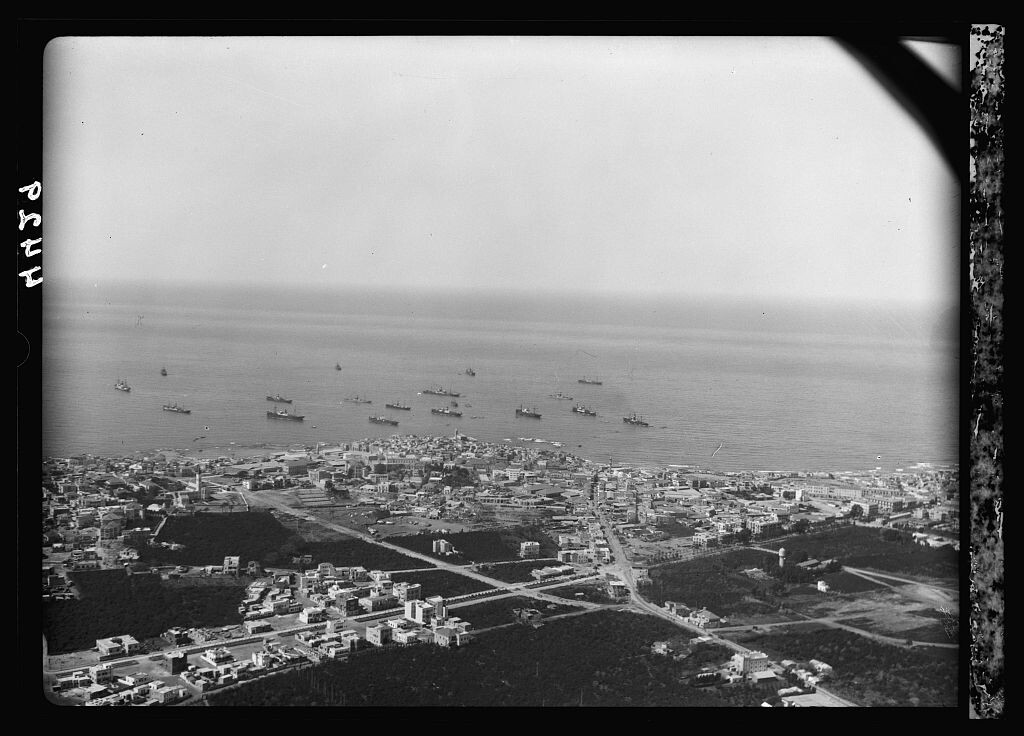
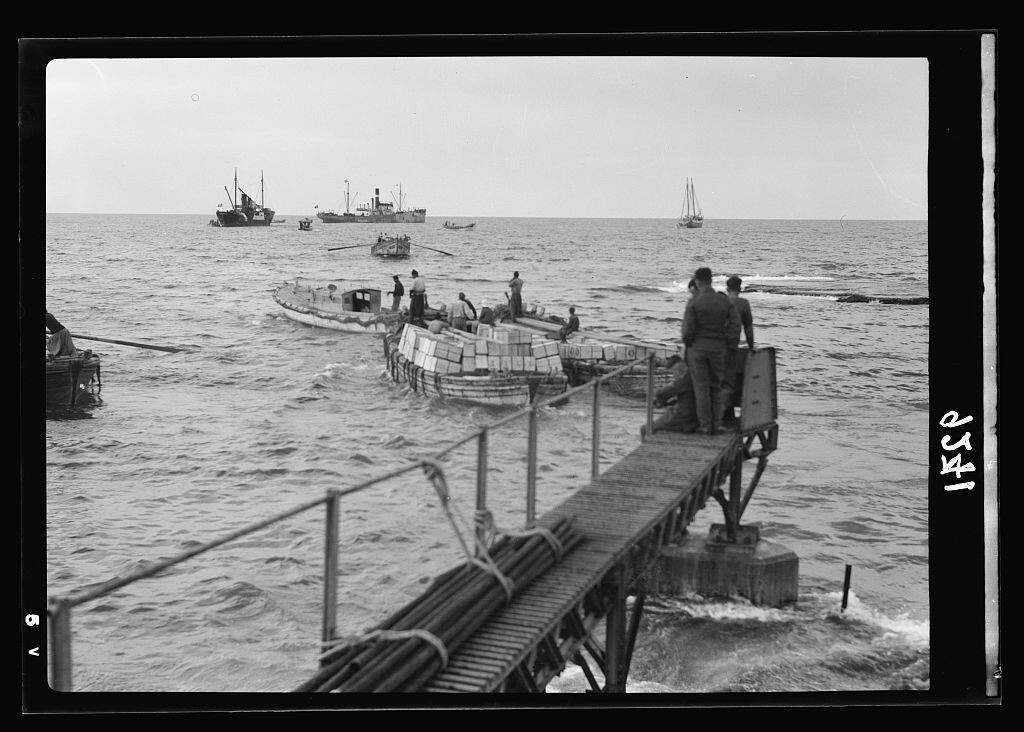
The photographs below make the point visible. Jaffa in 1932 was a dense coastal city linked to surrounding citrus groves, roads, commerce, and a working port. The 1936 photograph of orange crates being moved from Jaffa to ships documents an export economy that required growers, laborers, packers, merchants, boat crews, transport, capital, and international trade. These images do not romanticize Palestine or deny poverty, uneven development, conflict, or the Jewish contribution to the country’s growth. They refute the claim that Palestine was socially blank or economically inert. [32]
|
Image description: Jaffa from the land side, 1932: a built city, roads, orange groves, and ships in its roadstead. Library of Congress, Matson Collection. No known restrictions. |
|---|
|
Image description: Orange crates being carried from Jaffa to ships, 1936: direct evidence of cultivation, labor, commerce, and export infrastructure. Library of Congress, Matson Collection. No known restrictions. |
|
Image description: One Palestine pound, dated 1939, issued by the Palestine Currency Board with English, Arabic, and Hebrew inscriptions. British Mandate currency; image via Wikimedia Commons. |
|
Image description: Public-works cover inscribed “Government of Palestine, P.W\\\.D., Haifa District,” with English, Arabic, and Hebrew. It records the official Mandate-era administrative name; |
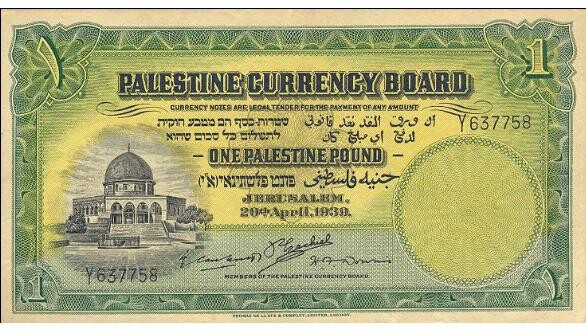
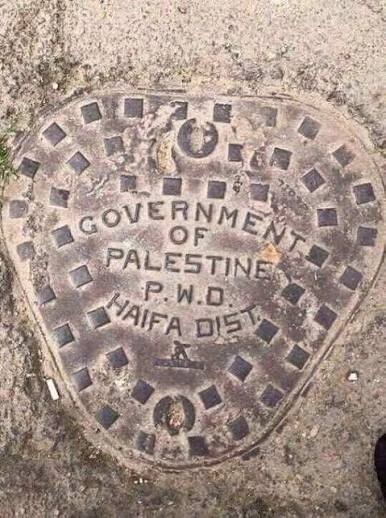
The banknote and public-works cover establish a narrower but important fact: “Palestine” was the ordinary official geographic and administrative name under the British Mandate, printed on currency and public infrastructure in English, Arabic, and Hebrew. They do not prove that an independent sovereign Palestinian state existed before 1948. They prove that the name was real, official, and used throughout daily administration. Denying that history is not clarification. It is erasure. [33]
Three claims are often collapsed. There was no independent sovereign state called Palestine immediately before 1948; the territory was governed as the British Mandate. But it does not follow that there was no Palestinian people or that the land was empty. A large Arabic-speaking population possessed communities, institutions, family histories, economic life, and an increasingly defined national identity. The absence of sovereignty is not the absence of a people.
Recognizing this does not require denying Jewish history, persecution, labor, attachment to the land, or the genuine achievements of the Zionist project. It requires refusing to build those truths on the deletion of another people. The myth of vacancy prepared the mind to see dispossession as development and those displaced as obstacles rather than human beings with homes. Pre-1948 Palestine was not empty. It was inhabited, cultivated, organized, argued over, loved, and remembered.
That is why this issue belongs beside my mother’s testimony and the documented histories of Jaffa and Akko. If I was taught that Palestinians left by their own will, and if the inhabited country that existed before 1948 was reduced to desert awaiting rescue, then the omissions were not peripheral mistakes. They protected a moral story in which conquest could be remembered only as liberation, emptied homes could become available housing, and the people behind barbed wire could vanish from the account. The evidence does not permit that story to stand.
When the Evidence Collides With the National Story Back to contents
I encountered the power of the national narrative during a conversation with a cousin who grew up with me in Akko. He was defending the expansion of Israeli control over the land as just.
“They attacked us in 1948,” he said. “We had to defend ourselves. During the fighting we pushed them away for our safety, and Akko became ours. We defended ourselves.”
“But we conquered Akko,” I said.
“No, we did not conquer it.”
I told him that the fact was written in stone on a memorial in Akko, not far from where he lived. He insisted that could not be true. So I sent him a photograph of the memorial.
The Hebrew inscription honors the fallen of the War of Liberation, the fighters of the Western Galilee, and כובשי עכו, “the conquerors of Akko.” The official memorial itself uses the word “conquerors.” [23]
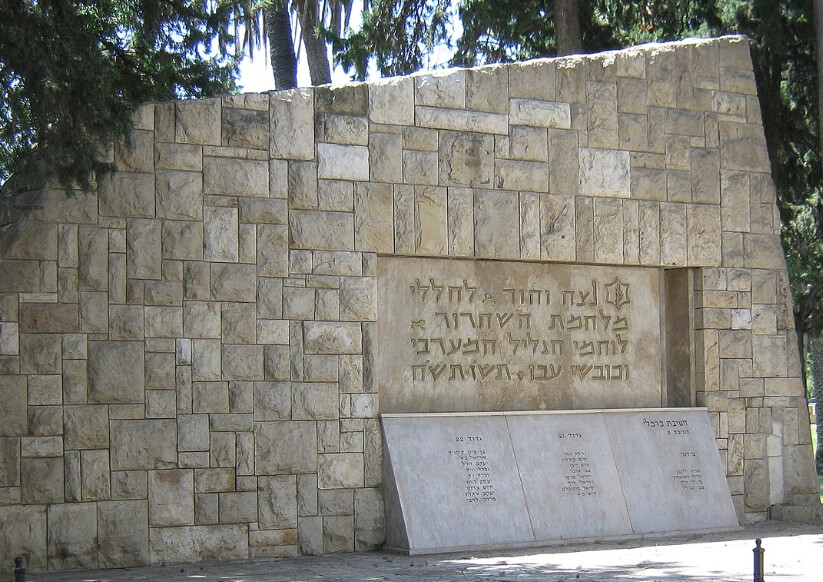
Image description: Memorial in Akko honoring the fighters of the Western Galilee and כובשי עכו, “the conquerors of Akko.”
He continued to argue.
The evidence was carved into a public monument near his home. But 'conquered' could not enter his understanding because it collided with the national story that Jewish forces had only defended themselves and Akko had simply become ours. The same state could honor 'the conquerors of Akko' while teaching its citizens to hear only 'the liberators.' That is the power of a national narrative: it can make someone reject the words carved into his own memorial.
Israel developed powerful official, educational, political, and cultural narratives emphasizing Jewish vulnerability, existential danger, and self-defense. In the version I absorbed, Palestinian displacement and occupation carried far less moral weight. Palestinian violence was understood primarily as hatred of Jews rather than also as a response to dispossession, occupation, statelessness, and despair, while Israeli military force was presented as defensive, necessary, and unavoidable.
I know that narrative's power because I wore the uniform and accepted assumptions so self-evident that I did not recognize them as assumptions. The woman living in Area C did not appear to be lying. She believed what she said. A national narrative is most powerful when its assumptions are absorbed so completely that they feel like personal knowledge.
Nurit Peled-Elhanan devoted much of her scholarly work to examining how that absorption occurs inside Israeli Jewish education. In her 2012 study, Palestine in Israeli School Books: Ideology and Propaganda in Education, she analyzed history, geography, and civics textbooks not only through their words, but through their maps, photographs, graphic design, place-names, and omissions.
She found that Palestinians were frequently absent as ordinary human beings or confined to narrow categories such as refugees, farmers, enemies, terrorists, or a demographic threat. Jewish historical attachment and Israeli statehood were presented as the natural way to understand the land. Palestinian displacement and Israeli responsibility received far less attention, while Israeli military force was generally presented as necessary self-defense.
Her work helps explain how my mother's story could be true, personally witnessed, and still remain outside the national moral picture. Indoctrination does not require every textbook sentence to be false. It works through repetition, emphasis, maps, images, place-names, and omissions until the story no longer feels taught, but like memory, knowledge, and common sense. [22]
Israeli education has not been uniform, and it has changed. Early state textbooks largely centered the official Zionist narrative and gave limited space to Palestinian society or to Palestinian displacement in 1948. Later materials became more varied, and some teachers and historians introduced critical accounts and Palestinian perspectives. Yet the erasure did not simply disappear. A peer-reviewed 2025 study found that the Nakba was explicitly mentioned in only 40 percent of the Israeli Jewish-school teaching materials it examined. Some materials opened space for ethical inquiry; others minimized Palestinian suffering or denied the event’s significance. [22] [34]
The system is larger than textbooks. It includes schools, news media, politics, religious nationalism, military culture, and shared fear and trauma. Together they can teach that security justifies almost anything, criticism is betrayal, and empathy for Palestinians is weakness. The pressure does not have to be formally coordinated. It works because conformity is rewarded, while moral questioning can threaten a person’s standing, relationships, and sense of belonging.
No society is immune to this. History is filled with nations that persuaded ordinary people to support what, from a distance, was morally indefensible. The tragedy is that many of those people did not think of themselves as cruel. They believed they were protecting their families, defending their country, and doing what was right.
For many years, Israel was very successful in presenting its understanding of the conflict internationally, especially in the United States. Political and public discussion often emphasized Israel as a democracy defending itself against aggression. Occupation, settlement expansion, unequal systems of rights, and the daily reality experienced by millions of Palestinians received far less attention.
Outside schools, the narrative was reinforced through government messaging, political advocacy, lobbying organizations, media framing, religious claims, and the suggestion that forceful criticism of Israel revealed hostility toward Jews. These institutions did not all participate in the same way, but together they created pressure to remain within accepted boundaries. Those who spoke openly could be shunned, excluded, described as traitors or self-hating Jews, accused of antisemitism, or threatened with the loss of relationships, reputation, employment, and opportunity. Others learned to soften what they said until the truth no longer sounded like the truth.
Genuine antisemitism is real, dangerous, and must be confronted. But when the accusation is used against people for documenting Palestinian dispossession, criticizing occupation, or questioning a political system built around ethnic and religious privilege, the word becomes a weapon against truth. It protects Israel from accountability while weakening the meaning of antisemitism when actual hatred of Jews occurs.
But today, people can see far more for themselves. Smartphones, social media, independent journalism, human-rights documentation, Israeli and Palestinian voices, and the constant visibility of Gaza and the West Bank have made it much harder for any government or national narrative to determine what the outside world sees.
I do not base this judgment on social media or outside commentary alone. I often read two major Israeli newspapers and regularly watch one of Israel’s most-watched television news channels because I want to understand what Israelis themselves are being shown and told. What troubles me is not only what appears, but what is pushed aside. Palestinian suffering is often briefly acknowledged, stripped of context, or framed in ways that make it easier to look past the people living through it. The more closely I follow Israeli coverage, the more disturbed I become by the gap between what is happening and what Israelis are being told about it.
The Arab-Jewish World That Nationalism Shattered Back to contents
Before Israel and Palestine became the central political categories through which so many people understood the region, Jewish communities lived across Baghdad, Cairo, Alexandria, Damascus, Aleppo, Beirut, Sana'a, Tunis, Casablanca, Jerusalem, and countless smaller towns. Their lives were neither a fantasy of perfect coexistence nor an unbroken history of persecution. Many belonged to Arabic-speaking societies through language, food, music, commerce, neighborhood, memory, and deep attachment to the countries in which they lived.
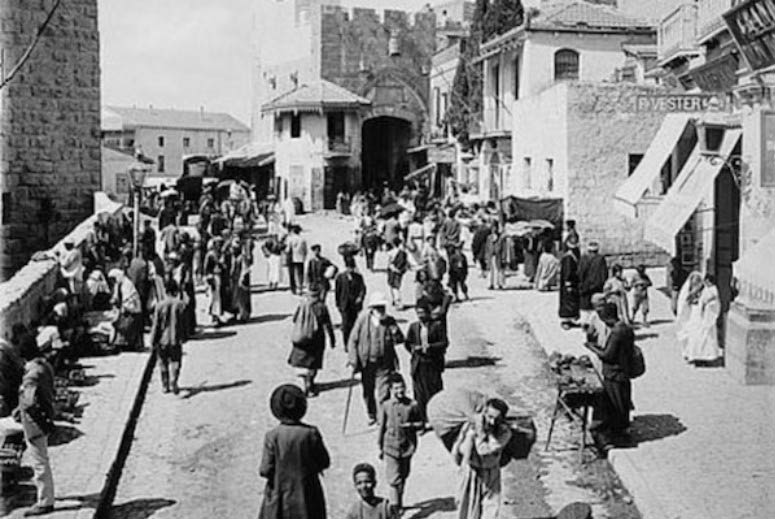
Image description: Jerusalem's Old City near Jaffa Gate, early twentieth century. The photograph evokes a shared urban setting, but it cannot identify every person or prove that relations were harmonious. The visible Fr. Vester & Co. storefront helps establish the location and period. [76]
These communities were not interchangeable, and neither were the circumstances of their departure. Iraqi Jews, Egyptian Jews, Yemeni Jews, Moroccan Jews, Tunisian Jews, Libyan Jews, Syrian Jews, Lebanese Jews, Algerian Jews, Kurdish Jews, Amazigh Jews, Persian Jews, Sephardi Jews, and others carried different identities and histories. Some would embrace the term Arab Jew; others would reject it. The more precise truth is that many Jews were deeply rooted in Arab cultural worlds even when their religious, ethnic, or national self-understanding differed.
Elie Eliachar and the Future Zionism Rejected Back to contents
One life makes this lost possibility especially visible. Elie Eliachar was born in Jerusalem in 1899 to a Sephardic family that traced its residence in the city to 1485, centuries before modern political Zionism. He became a leader of Jerusalem’s Sephardic community, served as deputy mayor of Jerusalem and as a member of the first two Knessets, and helped found the World Sephardi Federation. He was not an opponent of Jewish national renewal. He was a Zionist, but his understanding of what Zionism could become differed sharply from the European-centered movement that ultimately prevailed. [77]
Eliachar believed that Jews returning to the land should return to the Middle East culturally as well as geographically. He imagined Jewish renewal not as a European outpost surrounded by an alien Arab world, but as part of the region. Sephardic and other Eastern Jews, with their knowledge of Arabic language and society, could have helped connect European Jewish immigrants with Palestinian Arabs. Their experience was largely disregarded.
The three men shown below represented sharply different approaches toward the Palestinian Arab population. David Ben-Gurion placed state-building and Jewish political sovereignty first and treated population transfer as a possible instrument in particular circumstances. Ze'ev Jabotinsky argued that Palestinian Arab resistance to Zionism was natural and that Zionist development would require an "iron wall" of decisive force before an eventual political accommodation could be negotiated. Eliachar proposed a different path: a Jewish national home rooted in the Middle East, culturally connected to its neighbors, and shaped through Sephardic knowledge of Arab language and society. Their views changed over time and cannot be reduced to three slogans, but the contrast helps show which approach gained power and which possibility was pushed aside. [6] [77]
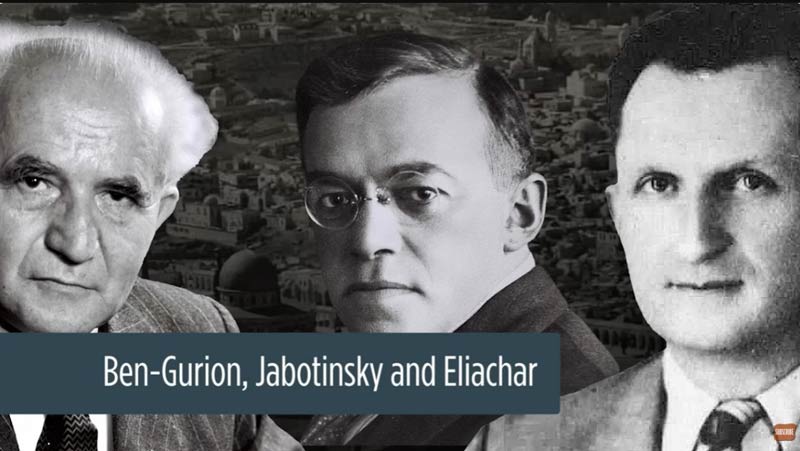
Image description: Composite image of David Ben-Gurion on the left, Ze'ev Jabotinsky in the center, and Elie Eliachar on the right, against a historic view of Jerusalem. The image introduces three sharply different Zionist approaches toward the Palestinian Arab population and the surrounding region. Still from the video essay "Elie Eliachar: Palestinian Arab Jew." [77]
A short video essay titled “Elie Eliachar: Palestinian Arab Jew” brought me to one of his most arresting judgments: “The original sin of the Zionist movement was the fact that, in returning to our homeland, which is part and parcel of the Orient, we did everything we could to estrange ourselves from the Middle East in which we wanted to live.” [77]
The video calls him a “Palestinian Arab Jew.” I use the more precise “Palestinian Jew”: he was deeply connected to Arab society, but his family’s mother tongue was Ladino and, as the preceding history shows, not every Jew rooted in an Arab cultural world understood that belonging in the same way.
Eliachar’s vision should not be romanticized as proof that conflict could easily have been avoided. Palestinian opposition to mass immigration, land acquisition, displacement, and political Zionism was real, and cultural familiarity alone could not have resolved it. His importance lies in demonstrating that the iron wall was not the only imaginable Jewish response. A Jewish homeland did not necessarily have to define itself through separation from its neighbors or rejection of the region’s languages and cultures. Another Zionist path existed, and it was pushed aside. [77]
The catastrophe is that these worlds were broken apart. Zionism did not cause every rupture, and no honest history should say that it did. European antisemitism and the Holocaust drove the demand for Jewish refuge and sovereignty. British and French colonial rule reshaped borders and political identities. Zionist organizing, the creation of Israel, the Palestinian Nakba, Arab nationalism, local antisemitic violence, discriminatory laws, confiscation, war, fear, state pressure, migration, and family reunification all played different roles in different countries. Varied causes do not make the losses less real. [75]
Palestinian Arabs lost homes, land, communities, and political freedom. Many Jews in Arab and Muslim-majority countries came to face fear, discrimination, violence, expulsion, confiscation, or pressures that made continued life impossible. A history that recognizes only one of these losses turns human beings into arguments.
Israel became a refuge for many of those Jews, but refuge did not always mean equality. An Ashkenazi-led establishment often treated Mizrahi and Sephardi languages and cultures as backward, dispersed families into peripheral development towns and transit camps, and expected them to become Israeli by leaving parts of their former identities behind. The same nationalist project that gathered Jewish communities also narrowed the many ways Jews had once belonged in the region. [75]
The suffering of Jews from Arab countries must not be used as compensation for the dispossession of Palestinians. People do not become entitled to another family's home because their own home was taken elsewhere. Palestinians were not responsible for what happened to Jews in Baghdad, Cairo, Tripoli, or Sana'a. But Palestinian justice also cannot require us to forget Jewish communities whose languages, belongings, cemeteries, synagogues, neighborhoods, and memories were left behind across the Middle East and North Africa.
This is another form of the transfer of suffering. One uprooted people was offered safety through a state built in part on the uprooting of another, while the pain of Jews from Arab countries was later used to defend the permanence of Palestinian loss. Neither history cancels the other. Jewish safety cannot depend on Palestinian dispossession, and Palestinian freedom cannot depend on denying Jews safety, memory, or belonging. Repair begins by refusing both erasures.
5. From Temporary Occupation to Permanent Control Back to contents
Displacement and the Right to Return Back to contents
Palestinians should have a right to return and, even more important, the right not to have been expelled or displaced in the first place. That is my moral conclusion.
The irony of the twenty-five-year-old Birthright Israel program is hard to miss. A young Jew can be born anywhere, have no parent or grandparent who lived in Israel, and never have visited, yet receive a free trip based on the idea that Israel is their birthright. Meanwhile, Palestinians born on that land, whose families lived there for generations, were expelled and remain unable to return. A distant ancestral connection becomes one person's birthright, while another's birthplace, home, and living family history are treated as creating no right at all.
I know the right of return is one of the hardest parts of this conflict. I do not know how full return could work in practice after so many decades. Some combination of return, restitution, and compensation may be necessary. But the difficulty does not make the original loss disappear. People lost homes, land, communities, and a country, and many were prevented from going back. Something is still owed to them.
My mother's testimony prevents me from treating that principle as an abstraction. Her suffering was real, and her need for safety urgent. But the Palestinian family's home did not become morally ownerless, nor did that family become responsible for Jewish suffering because its home stood where Jewish refugees needed refuge. The injustice done to my family could not be repaired by transferring dispossession to theirs.
Remedy matters too. Germany did not undo the Holocaust by paying compensation, and no check could restore what survivors lost. But postwar Germany accepted an ongoing obligation to compensate many survivors, and German-funded programs continue to make pension and hardship payments today. My own parents received regular compensation checks. Those payments did not erase their suffering, but they represented something morally important: acknowledgment that a grave historical wrong can create obligations that do not simply expire with time. If I believe that principle when the victims are Jews, I have to be willing to apply it when the victims are Palestinians. Return will not be possible in every case, but restitution, compensation, and other agreed forms of reparation should be part of any serious attempt to repair the dispossession of 1948 and allow surviving refugees and their descendants to live with greater security and dignity. [47]
Jews unquestionably have a powerful historical, religious, and emotional connection to the land, and the longing for refuge after centuries of persecution was real. But neither ancient connection nor terrible suffering grants an unlimited right to land inhabited by another people. The tragedy is that one people’s legitimate need for safety and belonging was answered through another people’s displacement.
Whatever one concludes about every detail of Israel’s creation, the basic problem remains. The Zionist project sought to create a Jewish-majority state, and later to preserve that Jewish majority, in a land that at the beginning of the project was overwhelmingly inhabited by non-Jews. That goal created an unavoidable conflict: it was extremely difficult to establish and maintain a Jewish majority while preserving the continued presence, political equality, and property rights of the Palestinian population already living there. [4]
In 1948, that conflict led to the mass displacement of Palestinians through a combination of war, flight, expulsion, coercion, and fear. Historians continue to debate the degree to which particular expulsions were planned in advance, arose from wartime circumstances, or resulted from local decisions. But what is not seriously disputable is that a very large Palestinian population lost its homes and was prevented from returning. [5]
Zionist discussions of population transfer, including those associated with Ben-Gurion, show that transfer was contemplated well before 1948. The history of particular quotations is sometimes disputed, which is why I do not rest this argument on any single sentence attributed to Ben-Gurion. The history as a whole is more important: transfer was considered, displacement occurred on a mass scale, and Palestinian refugees were not permitted to return. [6]
This history was not simply a story of Zionists acting and Palestinians passively suffering. Palestinian Arabs fiercely opposed Zionism and Jewish immigration. Violence against Jewish civilians occurred before Israel existed. Palestinian Arab leadership rejected the 1947 UN partition proposal, and after Israel declared independence, neighboring Arab states entered the war. [7]
That rejection also needs context. Arabs formed the majority of Palestine’s population, yet the proposal asked them to accept partition and the creation of a Jewish state in a substantial part of the country. Palestinian Arab leaders sought independence in an undivided Palestine, and opponents of partition argued that it violated the majority’s right to self-determination. [7][31] Understanding that objection does not justify attacks on Jewish civilians. But describing the rejection without explaining it leaves out what Palestinians believed they were being asked to surrender.
Jews experienced the conflict not only as a project of national expansion but also as a struggle for survival, especially in the immediate shadow of the Holocaust. Those realities matter. They help explain fear, resistance, and the intensity of Jewish attachment to sovereignty. But they do not erase the equally important question of what happened to the Palestinian population during Israel’s creation, or whether people who lost their homes should permanently bear the consequences of decisions made by leaders, armies, and neighboring states.
Regardless of whom one blames for every war, uprising, terrorist attack, military operation, or failed negotiation that followed, that original displacement is fundamental to understanding the violence that grew from this conflict.
The Moral Boundary: Violence Against Civilians Back to contents
It does not justify murdering civilians. Nothing does.
October 7 affected me not as a distant political event, but as someone born and raised in Israel, with people and memories tied to the country. I felt horror for those murdered and kidnapped, fear for people I knew, and grief at seeing Israelis subjected to terror no civilian population should endure. Murder, rape, torture, kidnapping, and deliberately terrorizing civilians are wrong whether committed by Hamas, other Palestinian armed groups, Israeli settlers, the Israeli state, or anyone else. Such acts do not become moral because those committing them have suffered injustice. [8]
Eventually I found myself asking a question that stripped away almost everything else:
What if I had simply been born Palestinian?
Not a morally different person. Me. The same temperament, the same stubbornness, the same attachment to family and home, but born on the other side.
What would I believe if my parents had taught me their history instead of mine? What would I feel if my family had lost its home or land, if I spent my life passing through another people’s checkpoints, if my grandfather’s olive trees were uprooted, or if soldiers entered my home in the middle of the night and took my son away?
Would I peacefully accept circumstances that I would never expect an Israeli Jew to accept?
I cannot know exactly what I would do. But I know myself well enough to doubt that I would simply accept it.
Understanding why a human being resists and morally approving everything done in the name of resistance are entirely different things.
We cannot demand from Palestinians a level of passive acceptance that we would never demand from ourselves.
Palestinians also have moral responsibilities that cannot simply be explained away by occupation or dispossession. Hamas’s deliberate murder and kidnapping of civilians on October 7 was impossible to justify. So are rockets deliberately or indiscriminately directed at civilian communities, glorification of attacks on civilians, antisemitism, and political movements that deny Jews any legitimate place in the land.
Palestinian leaders have also failed their own people through corruption, authoritarianism, destructive political choices, and missed opportunities. None of this makes occupation, settlement expansion, displacement, or collective punishment morally acceptable. It means only that, if I am going to apply the same moral standard to everyone, Palestinians do not receive an exemption from it either.
When the Other Side Stops Being Human Back to contents
There is another part of this that became especially disturbing to me during my most recent visit to Israel. Contempt toward Arabs is not new to me. I grew up with it. But this time, it felt different in its intensity and in how openly it was expressed. Attitudes that had always existed seemed more extreme, more casual, and more widespread. The dehumanization of Arabs seemed to have moved closer to the surface.
The language was part of my childhood too. I remember hearing expressions such as “stinking Arab,” “they breed like rabbits,” “you cannot trust them,” and “they only understand force.” This was not language confined to extremists. It was common language among regular Israelis around me.
As a child, I did not hear this and identify it as prejudice. Adults repeated it casually, so it became part of how the world supposedly worked. I learned who “we” were and, just as importantly, who “they” were.
I remember guard dogs behind fences or on chains at some workshops and auto body shops. Certain dogs that seemed calm when Jewish people passed would erupt when Arabs approached. As a boy I wondered: How does the dog know who is Arab?
A dog knows nothing about Jews or Arabs, religion, history, borders, or 1948. Whatever association it learned came from the human environment around it. Children learn from their environment too. We watch adults, hear their words, and notice whom they welcome and whom they fear. Eventually those lessons can sink so far below conscious thought that they feel instinctive.
There is an important contradiction in my own childhood memories. Some of my warmest memories of growing up in Akko are of the Arab residents of the Old City. As a boy, I wandered its narrow alleys, market, and fishing piers, often by myself. Among Arab Muslims and Christians, I remember feeling safe and welcomed.
People greeted me warmly with ya ayuni, “my eyes,” an expression of affection, or habibi, “my dear.” I heard sabah al-kheir, “good morning,” and keef halak?, “how are you?” I especially remember the bakeries, with their enticing displays of breads, pastries, and sweets. I had no money and was not asking for anything, yet I was often invited to taste something simply because I was a child passing by.
At the harbor, fishermen let me linger beside them and taught me some of their fishing tricks, including how to make good bait. Shopkeepers welcomed me. People stopped to talk to me. I was not seeking their generosity or kindness; it was simply offered.
They treated this wandering Jewish boy as someone who belonged there.
At a time when other parts of my childhood often felt hostile or unsafe, the Arab quarter was one of the places where I could simply wander and feel at ease.
Looking at these photographs, I understand more clearly why I loved being inside Old Akko. The beauty was not only in the stone alleys, arches, market, harbor, and sea. It was the only place I knew where Palestinians seemed to inhabit a space that was still recognizably their own. Arabic filled the market. Palestinian families worked, shopped, cooked, prayed, fished, greeted one another, and welcomed me into a living world that had not been completely remade around a Jewish national story. As a child, I did not yet understand that this was only a surviving fragment of a much larger Palestinian city and country. I simply felt that, inside those walls, I was entering their space rather than seeing them as tolerated outsiders in mine. That may be why I felt both the difference and the belonging so strongly, and why Old Akko remained one of the places I loved most.
|
Image description: The market in Old Akko, remembered by Morty Bachar from childhood. |
|---|
|
Image description: The fishing port of Old Akko. |
|
Image description: A panoramic view of Old Akko, its walls, harbor, religious buildings, and dense historic neighborhoods. |
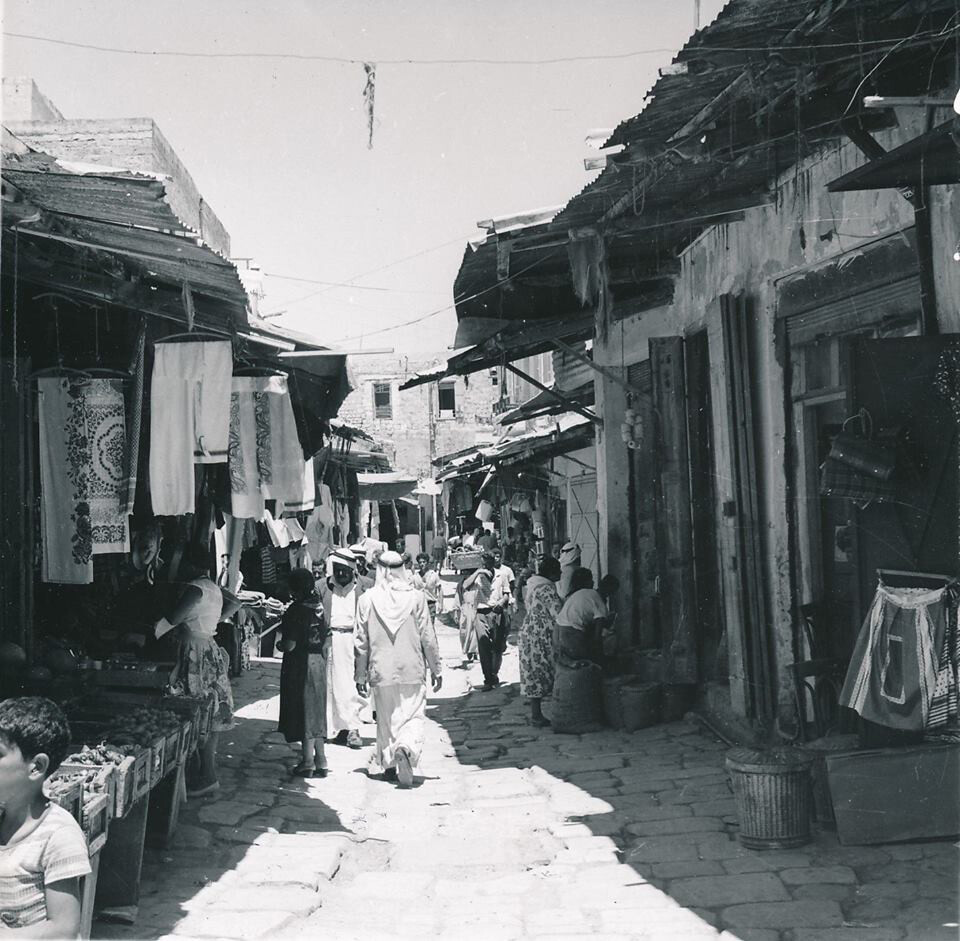
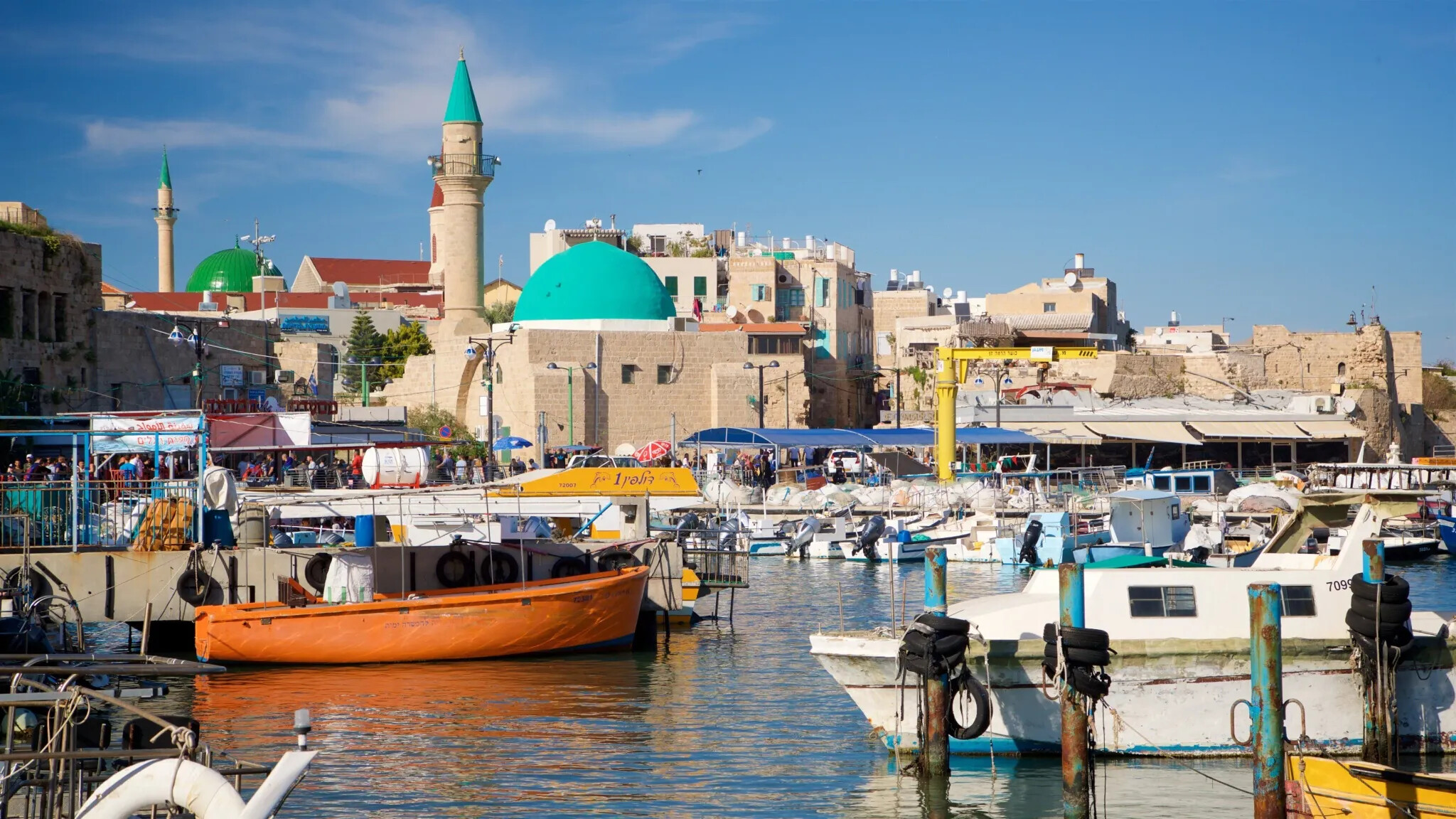
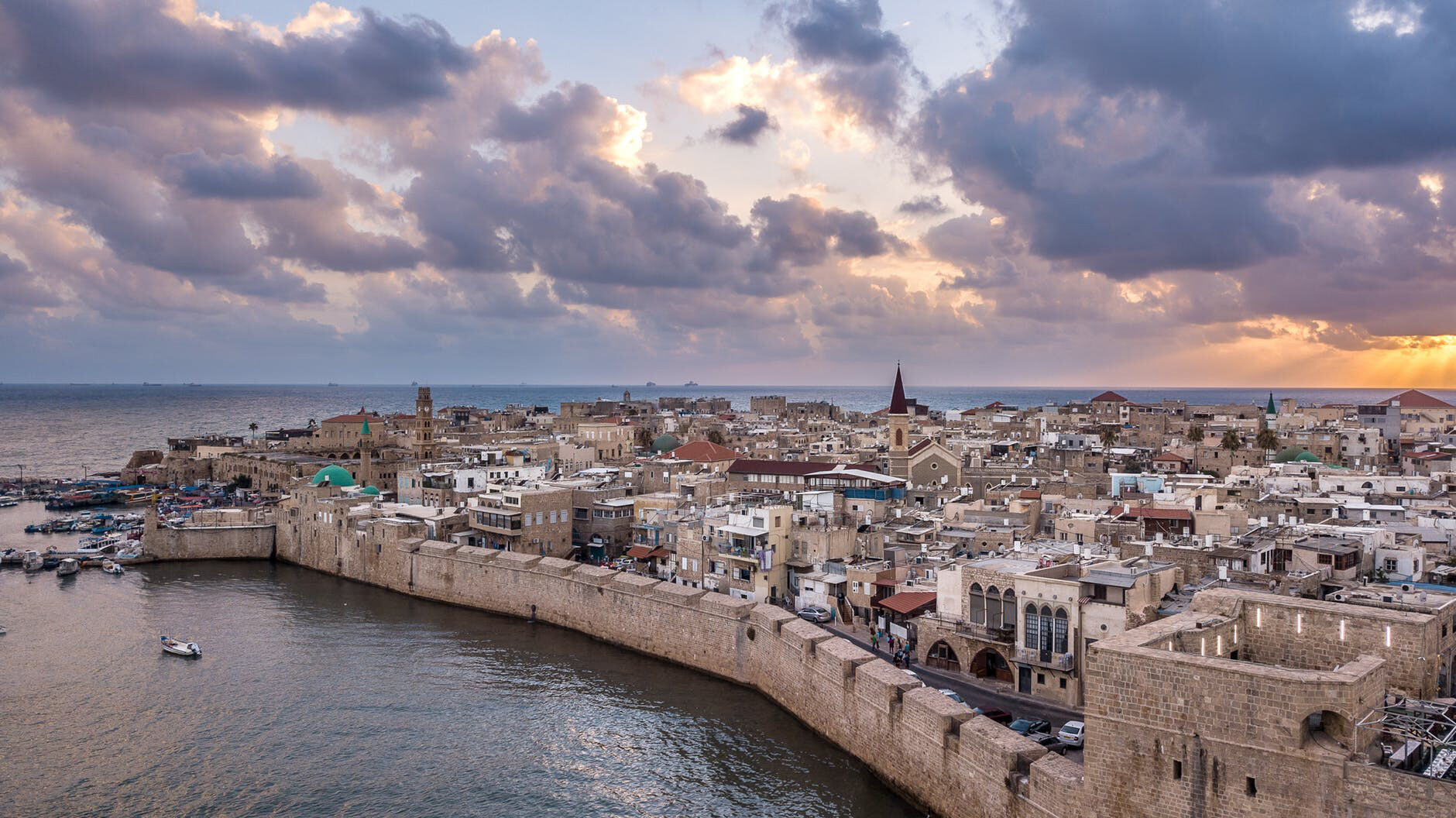
When my children were growing up, I took them to Akko and Arab villages because I wanted them to encounter what the news, school curriculum, and national narrative often omitted: ordinary people, families, markets, hospitality, humor, generosity, and a culture integral to the country in which I had grown up. I wanted them to know Arabs as people rather than as a category or enemy and to see difference as something beautiful, not something to fear. Those experiences stayed with them into adulthood. [18]
One experience with Patty and one of our daughters has stayed especially vivid. We were walking through Old Jaffa when I became almost mesmerized by the mixture around us: the Italian Embassy, people speaking French, Orthodox Jews, tourists, market visitors, shopkeepers, and vendors. Then the Muslim call to prayer floated from a minaret across this unusual gathering of languages, religions, clothing, cultures, and histories.
I stopped and took a video because the moment struck me as beautiful. Nothing dramatic was happening. That was exactly what made it beautiful. People who were different in almost every imaginable way were simply living alongside one another.
Later I showed the video to my sister. Her six-year-old grandson was watching. When he heard the Arabic call to prayer and saw how captivated we were, he looked at his grandmother in genuine surprise: “Grandma, what? They like Arabs? Look what they like. Why?”
At six years old, he had already learned that liking something Arab required an explanation. Before he could understand occupation, terrorism, Zionism, Palestinians, or history, he had absorbed the division between “us” and “them.” The moment in Jaffa showed me how naturally different people can inhabit the same space. His question showed me how early a child can be taught that they should not.
Perhaps that is why today's dehumanization troubles me so deeply. The people reduced to 'Arabs,' 'terrorists,' or enemies are not abstractions to me. I still see their faces and remember their kindness to a wandering Jewish boy.
I heard variations of “they are all terrorists,” “kill them all,” “wipe them out,” and insulting references to “stinking Arabs,” as if an entire people could be reduced to something less worthy of concern. What disturbed me was not only the words themselves, but how ordinary they could sound. They were not always spoken in rage during a political argument. Sometimes the contempt seemed almost automatic, as though the humanity of the people being discussed had simply disappeared.
One moment during my visit has stayed with me. A young relative was watching a news report about a car accident in which two Arab Israelis had been killed. His immediate reaction was: “Good, they are not Jews.”
My mind immediately went to Patty, the love of my life, who is not Jewish. Would he feel the same way if Patty had been in that car? Would her death somehow matter less because she was not a Jew?
His reaction revealed what the environment around him had taught him. A child does not naturally decide that one human life matters more than another because that person is Jewish. He learned that distinction, and what he said matched what I was hearing from the adults around him.
This kind of dehumanization may be one of the deepest obstacles Israel eventually has to confront. Governments can change. Policies can change. Settlements can be removed. Borders can theoretically be negotiated. But none of those things, by themselves, erase generations of fear, hatred, separation, superiority, and the habit of seeing another people as less human.
Palestinians have accumulated generations of fear, grief, anger, and trauma as well, and I do not imagine those feelings will simply disappear. But my responsibility in this essay is first to examine the society I came from and the beliefs and attitudes I grew up around.
A political agreement, if one ever comes, will not be enough. Israelis and Palestinians will somehow have to learn to see each other again as individual human beings rather than simply as categories: Jew, Arab, terrorist, occupier, enemy.
When I entered the military, one lesson drilled into us was that empathy could be a weakness. I understood the military logic: a soldier who hesitates at the wrong moment can get himself or others killed. We were trained to react, follow orders, control fear, and suppress emotions that might interfere with what had to be done.
A soldier may sometimes need to suppress empathy to survive a moment. A society cannot suppress empathy indefinitely without changing what it becomes.
The Arabs I had known as a boy kept interfering with the category of enemy. The human beings stored in my memory never matched the category I had been taught to fear.
Looking back, I sometimes think of my changing views less as acquiring a new political ideology than as unlearning a reflex. The instincts needed to confront an armed enemy become dangerous when transferred to an entire people. In some ways, I am still doing that work.
Years later, outside Israel, I occasionally encountered the same mechanism from the opposite direction. People who carried stereotypes about Jews sometimes told me after knowing me, “You’re Jewish, but you’re different.” I was not different. Their category was wrong. An actual human being had entered a space previously occupied by a stereotype.
6. Gaza, Greater Force, and Territorial Expansion Back to contents
Without confronting displacement, occupation, unequal power, fear, and trauma, I do not believe peace will ever exist.
Palestinian resistance will continue: some nonviolent, some political, some armed, and some, tragically, crossing every moral and legal boundary by targeting civilians.
If the underlying conditions remain unchanged, Israel is likely to answer recurring resistance with greater military force, tighter control, and further repression. That force will generate more Palestinian suffering, which will produce more anger, more resistance, and another Israeli response.
We have watched this cycle intensify dramatically since October 7.
The Human Cost in Gaza Back to contents
Gaza is perhaps the most extreme physical expression of that cycle. After years of war, an enormous proportion of its housing stock has been damaged or destroyed. A 2026 assessment by the United Nations, World Bank, and European Union reported that approximately 371,888 housing units had been directly affected, representing 76.6 percent of Gaza’s housing units. [9]
Destruction on this scale can make numbers lose meaning. By August 2026, Palestinian health authorities were reporting more than 73,000 Palestinians killed in Gaza since October 2023. The figure does not distinguish civilians from combatants, so it would be irresponsible to call everyone killed a civilian. But uncertainty about the civilian proportion cannot make the human cost disappear. Among the dead are enormous numbers of children, women, elderly people, medical workers, journalists, aid workers, and others who were not fighting anyone. If more than 73,000 Israelis had been killed, would I begin by arguing about which number was precise enough before allowing myself to understand the scale of the catastrophe? I know the answer. [65]
The Word Genocide Back to contents
There is a word I have hesitated to use casually because, as the son of Holocaust survivors, I know its weight: genocide.
Genocide is not simply another word for mass killing. Under the 1948 Genocide Convention, it requires certain acts committed with the specific intent to destroy, in whole or in part, a national, ethnic, racial, or religious group. Those acts include killing, causing serious bodily or mental harm, and deliberately creating conditions of life calculated to bring about a group’s physical destruction. The difficult legal question is usually intent. [66]
The word cannot simply be asserted, but neither can it be dismissed as inflammatory language. Amnesty International concluded in December 2024 that Israel was committing genocide in Gaza. In September 2025, the United Nations Independent International Commission of Inquiry also concluded that Israeli authorities and forces had committed genocide and found evidence of the required intent. Israel strongly rejects that accusation. [66]
The International Court of Justice has not issued a final judgment that Israel committed genocide; the case brought by South Africa remains underway. I am not a judge, and this essay is not a court. But after what has happened in Gaza, and after serious international bodies concluded that the legal threshold has been met, I cannot honestly avoid the word simply because it is painful for Jews to hear. [66]
The Yellow Line and the Prevention of Return Back to contents
The territorial change inside Gaza worries me just as much as the physical destruction. The October 2025 arrangement placed approximately 53 percent of Gaza behind what became known as the Yellow Line. By June 2026, OCHA reported that tighter Israeli access restrictions had expanded to nearly 65 percent of Gaza, and Netanyahu later said he had instructed the military to expand Israeli control toward 70 percent. [67]
I cannot look at that without thinking about Area C, described in Chapter 1: another interim arrangement that hardened into physical reality over decades. That history is why I take temporary territorial lines seriously.
I do not know that Gaza will follow the same path. But permanent territorial change need not begin with civilian settlement. It can begin with a military line, destroyed communities, an inability to return, and a temporary security arrangement that keeps moving.
Will the Yellow Line disappear, or will today's military line become tomorrow's political boundary? With Israeli political movements already calling for Palestinian emigration and renewed Jewish settlement in Gaza, we cannot wait twenty years to ask whether another temporary arrangement is becoming permanent.
People already displaced are being crowded into an even smaller part of an already tiny strip of land.
There is another pattern that troubles me: the use of harm to families and surrounding civilians as a claimed means of deterrence or military necessity. Israel has long demolished or sealed the family homes of Palestinians accused of attacks, even when other people living in the home were not accused of the act. Israel describes punitive demolitions as deterrence; human-rights organizations have condemned the practice as collective punishment. B’Tselem reports that during the Second Intifada, 628 housing units were demolished because of the alleged acts of 333 Palestinians, leaving 3,983 people without homes, and that almost half of those homes had never housed the person whose actions were cited as the reason for demolition. [48]
The same moral question arises in war when Israel says a militant, command post, weapons cache, tunnel, or other military objective is located in or near a civilian building or neighborhood. Some of those military claims may be genuine. But a security explanation does not erase the obligation to distinguish civilians from combatants, assess proportionality, and take feasible precautions to reduce civilian harm. Nor does it erase the human question: how much destruction to uninvolved families can be justified in order to reach the person or military objective being targeted? [49]
There is something else about Gaza that I find impossible to escape: we cannot easily say that we did not know.
We have watched much of this unfold almost in real time: dead and injured children, grieving parents, destroyed neighborhoods, displaced families, damaged hospitals, desperate searches for food and water, and human beings digging through rubble for the people they love. No argument about Hamas, military necessity, responsibility, disputed numbers, terminology, or international law can erase what is visible.
I wake up every morning with a sense of dread, wondering what new suffering I will witness in Gaza, the West Bank, or Lebanon as a result of Israeli actions. I watch the images, the videos, and the reports, and often find myself in tears.
The deepest pain is knowing that much of this is being done in my name, by my own country. The soldiers carrying it out are not strangers to me. They could be people I once knew. They could be my cousins, my nephews, my former neighbors, or the children of friends. I wore the same uniform. I was once part of the same military.
I do not want someday to comfort myself by saying that I did not understand what was happening. Once we know, the moral question becomes what we are willing to do with that knowledge.
Lebanon troubles me for the same reason. Where does this much force lead, not only for those receiving it, but for Israel itself?
When Expansion Stops Being a Fringe Idea Back to contents
There is another reason the destruction and displacement in Gaza, the West Bank, and southern Lebanon cannot be viewed only as the temporary consequences of war. A growing political movement in Israel does not see the present map as final. It speaks in the language of return, settlement, sovereignty, and a Greater Israel.
Greater Israel describes neither one agreed map nor an official government plan. For some, it means permanent Israeli rule over the West Bank. For others, it includes Gaza. At the outer edge, religious-nationalist maps extend into parts of Jordan, Lebanon, Syria, Egypt, and still farther. Most Israelis do not necessarily support those maximal maps, and Israel has not formally adopted a policy of annexing all the territories they depict. That distinction is important. But it would be equally irresponsible to dismiss the movement as an irrelevant fantasy.
The governing coalition sworn in under Benjamin Netanyahu in December 2022 declared that the Jewish people have an exclusive and inalienable right to all parts of the Land of Israel and promised to promote settlement in the Galilee, the Negev, the Golan Heights, and Judea and Samaria, the biblical names it uses for the occupied West Bank. In 2023, Finance Minister Bezalel Smotrich spoke in Paris from a lectern displaying a map that incorporated Jordan and the West Bank into Israel. In August 2025, Netanyahu said in an i24NEWS interview that he felt he was on a historic and spiritual mission and was very attached to the vision of the Promised Land and Greater Israel. [54][55][56]
Gaza shows how quickly an idea once treated as politically impossible can acquire ministers, conferences, promotional material, and a practical vocabulary. In January 2024, eleven cabinet ministers and fifteen members of the Knesset attended a Jerusalem conference calling for renewed Jewish settlement in Gaza and the so-called voluntary migration of Palestinians. Among them were National Security Minister Itamar Ben Gvir and Finance Minister Smotrich. Ben Gvir called for Palestinians to leave Gaza, while Smotrich had publicly advocated emigration and renewed settlement. These were not anonymous extremists outside the political system. They were members of the government helping shape policy while Gaza was being destroyed. [57][58]
The marketing had already begun. In December 2023, Harey Zahav, an Israeli developer associated with West Bank settlement construction, circulated the promotional image below, placing proposed villas over the ruins of Gaza. The company later described it as humor and wishful thinking rather than an actual sale offering, while acknowledging that it was intended to open discussion about rebuilding settlements in Gaza. This was not an authorized government development plan. But the image still matters. Before Palestinian families could even return to the ruins of their homes, an Israeli business was already presenting those ruins as the setting for Jewish beachfront housing. [59]
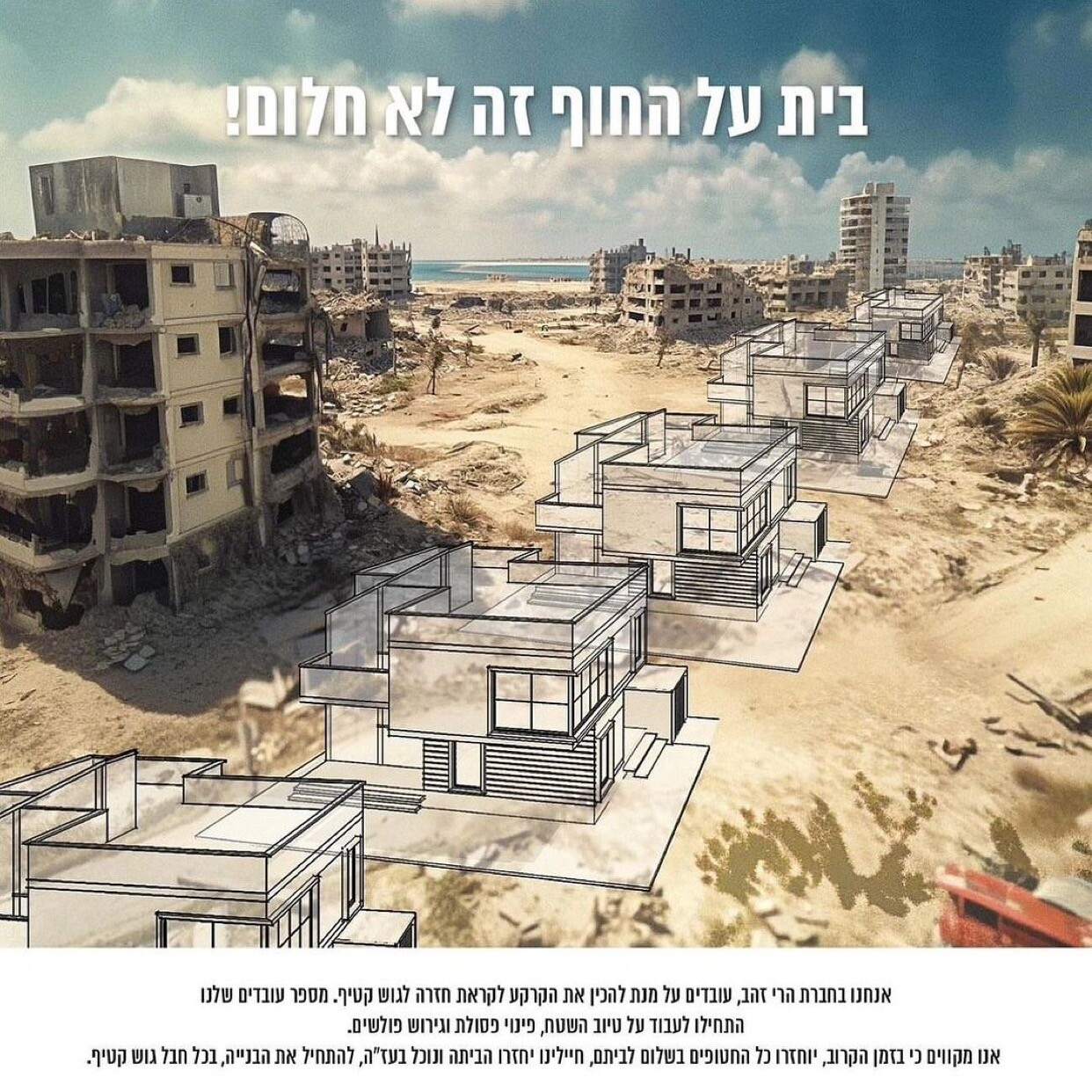
Image description: Harey Zahav’s December 2023 promotional image placed proposed Israeli villas over the ruins of Gaza beneath the Hebrew slogan, “A house on the beach is not a dream.” The company later said this was not an actual sale offering or authorized project. Image circulated by Harey Zahav; reproduced for critical commentary. [59]
Greater Israel, Lebanon, and Syria Back to contents
The same pattern is now visible to Israel’s north. The Uri Tzafon movement openly advocates Jewish settlement in southern Lebanon, distributes maps and proposed Hebrew community names, and argues that lasting security requires moving Israel’s border to the Litani River. This remains a minority position, and Israeli governments long denied territorial ambitions in Lebanon. Yet by 2026 the idea was receiving greater attention from politicians and the media. Ben Gvir spoke of a settlement plan for Lebanon, while Defense Minister Israel Katz announced that Israeli forces would seize and control a broad security zone reaching to the Litani. A military occupation is not the same as civilian settlement or legal annexation. But history gives us reason to pay close attention when temporary security control, destruction that prevents return, and an organized settlement movement begin to occupy the same territory and the same political conversation. [60][61]
Syria adds another warning. Israel has occupied additional Syrian territory beyond the previously occupied Golan Heights and has demanded a demilitarized zone across southern Syrian provinces. Israeli leaders describe these measures as security requirements, not annexation. That may be the present official explanation. But the larger expansionist movement treats military reach, biblical claim, settlement, and sovereignty as stages of the same historic mission. [62]
This is exactly the pattern I trace across this essay: force creates facts, and facts are then presented as permanent. That history is why today's declarations of territorial ambition deserve to be taken seriously, not dismissed as fringe rhetoric.
For almost eighty years, Israel has been very successful at separating each act from the larger pattern and persuading much of the world to accept its explanations one event at a time. The past documented in this essay is a warning against allowing that to happen again. When senior officials speak of Greater Israel, when ministers gather to plan Jewish settlement in Gaza, when movements map Israeli communities in Lebanon, and when Palestinians are being driven from land that others openly imagine inhabiting, we should believe that the intention is serious enough to confront before it becomes another accomplished fact.
This is not an accusation against every Israeli or every Jew. It is a demand that governments, journalists, religious leaders, and citizens stop treating explicit expansionist ambitions as harmless rhetoric. The world should insist now that military necessity cannot become a pathway to permanent territorial acquisition, that displaced civilians must be allowed to return safely, and that no people’s homes or homeland may be converted into another people’s real-estate opportunity.
The Same Playbook: No Home and No Land to Return To Back to contents
In southern Lebanon, I see a pattern that raises a similar moral danger: civilian displacement, widespread destruction of homes and agricultural land, and conditions that can make return difficult. The result is not simply that families may have no house to come back to. Damage to orchards, soil, water systems, and agricultural infrastructure can also undermine the livelihoods on which return depends. [11][12][38][39]
A June 2026 assessment by the United Nations Development Programme and Lebanon’s National Council for Scientific Research found 11,095 buildings completely destroyed in southern Lebanon, affecting 17,891 housing units. Another 2,242 buildings were partially damaged and 9,311 sustained lesser damage. Amnesty International had already documented the destruction of more than 70 percent of all structures in three border municipalities and concluded that many residents had no homes to which they could return. [11][38]
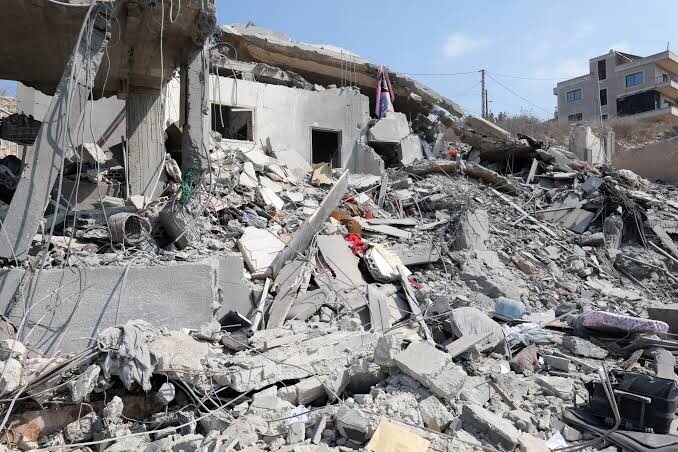
Image description: Destroyed homes in a southern Lebanese border community.
The destruction extends beyond buildings. Human Rights Watch verified Israeli use of white-phosphorus munitions in at least 17 municipalities in southern Lebanon. Soil studies found white-phosphorus residues in several affected villages, while agricultural assessments documented burned orchards, damaged crops, lost livestock, and long-term harm to food production. In February 2026, after Israeli aircraft sprayed a chemical substance along the border, Lebanese laboratory testing reported glyphosate concentrations 20 to 30 times higher than normal application levels in some samples and warned of risks to soil fertility and agriculture. [12][39]
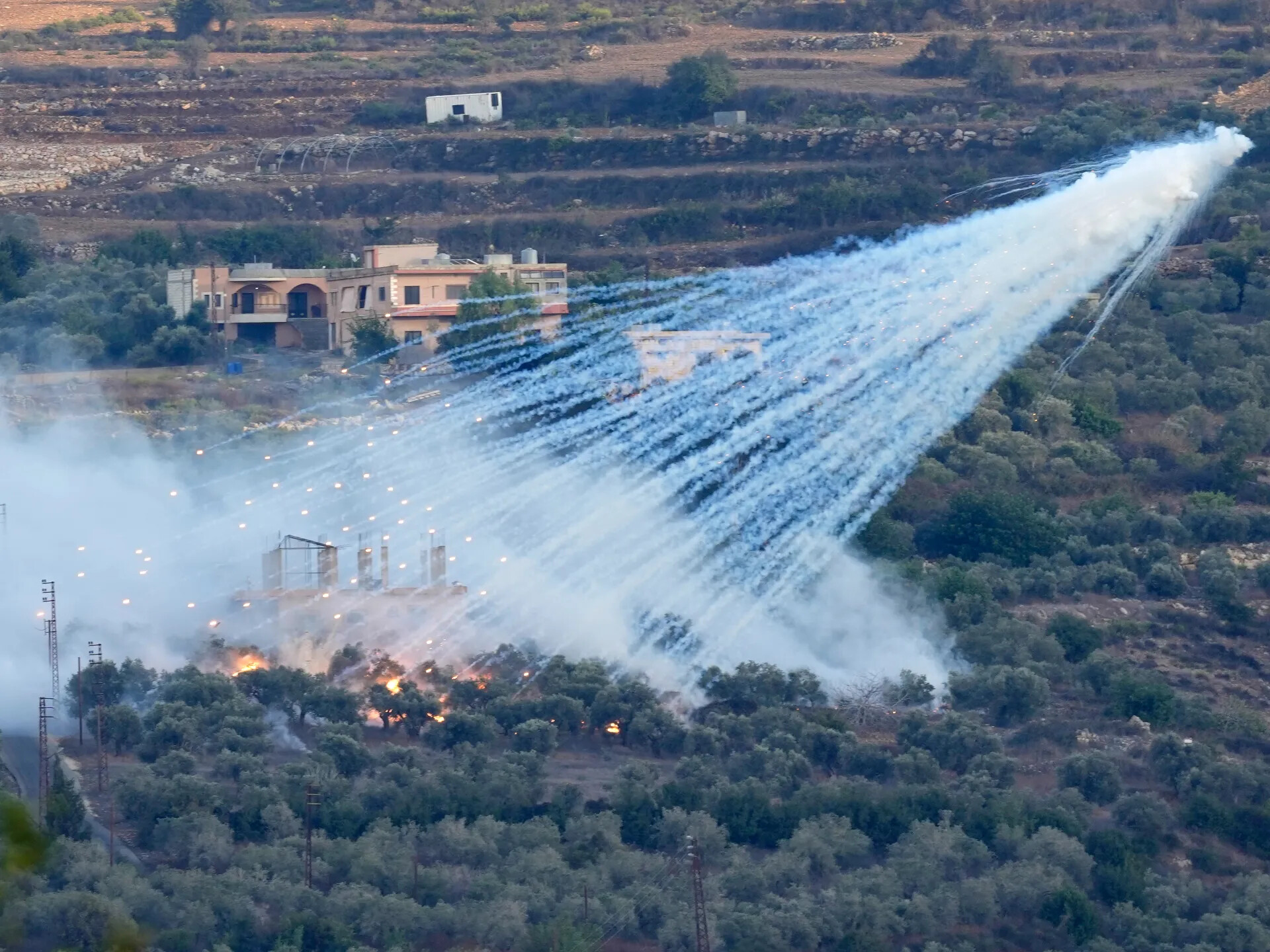
Image description: White-phosphorus munitions descending over southern Lebanon.
Why Greater Force Makes Israel Less Secure Back to contents
Every turn of that wheel makes Israel less secure, not more.
The greater the force Israel employs, the more isolated it becomes. As Palestinian suffering becomes more visible to the world, sympathy for Palestinians grows and anger toward Israel grows with it. Tragically, some of that anger spills over into antisemitism against Jews who have absolutely nothing to do with Israeli government policy.
I also see another possible stage in that projection. Israel’s international position may begin to resemble what happened internationally with apartheid South Africa. I am not saying the histories or systems are identical. I am talking about the direction of world opinion.
A country can defend what it is doing for a long time, especially when powerful allies stand behind it. But there can come a point when people outside the country have simply seen too much. The explanations stop overcoming what they see with their own eyes. Public opinion changes, and eventually governments feel that pressure too.
I believe Israel is heading toward that isolation. The world can now watch Gaza and the West Bank almost in real time. It can see settlement expansion, Palestinian communities being displaced, different systems of rights and movement, military occupation, settler violence, demolished homes, and enormous civilian suffering.
Israel has an explanation for almost every individual action. The problem is what all those actions look like when you put them together.
I believe Israel risks reaching that same crossroads, not because the world has suddenly become hostile to Jews, and not because every criticism of Israel is fair, but because modern communications have made it nearly impossible for any country to control how the world sees what it is doing.
My projection is not that Israel can indefinitely suppress Palestinian resistance through greater force. It is that greater force will accelerate the international isolation that makes the existing system impossible to sustain.
The Strategy Depends on Forgetting Back to contents
There is a strategy hidden inside the story Israel tells about itself. Israel presents each new use of overwhelming force as an isolated act of self-defense, beginning the clock at the moment Israelis are attacked and refusing to show what preceded it. The attack against Israelis becomes the whole history. Occupation, blockade, settlement expansion, dispossession, earlier bombardment, and the denial of return are pushed outside the frame. Israel appears only as the victim, even while it possesses the army, controls the borders, destroys the homes, displaces the population, and determines who may return. [7] [9] [10]
The manipulation does not require inventing every Israeli injury. The October 7 attacks against Israeli civilians were real crimes. Hezbollah attacks were also real, and Israeli civilians had a right to safety. The distortion begins when those crimes are used to erase everything that came before them and to make Palestinian or Lebanese civilians collectively responsible. A real wound is turned into an excuse to do almost anything: strike, empty, demolish, hold the land, prevent return, and then describe the result as an unavoidable defensive response.
October 7 raises another painful question. Israeli investigations have documented catastrophic intelligence, preparedness, command, and response failures. At Kibbutz Be’eri, residents were largely left to defend themselves for the first seven hours. Those failures demand accountability. But I have found no credible evidence that Israeli leaders deliberately allowed Hamas to massacre Israelis in order to create a justification for invading Gaza, and suspicion is not evidence. [68]
There is, however, a different question that does not require a conspiracy theory: what did October 7 make politically possible?
The murder and kidnapping of Israelis created genuine grief, rage, fear, and a demand for protection. It also transformed Israel into the unquestioned victim in the eyes of much of the world and gave Israel the opportunity to take military action in Gaza on a scale that would previously have been very difficult to justify.
That matters because some ambitions revealed afterward already existed. Israeli political movements already wanted permanent control of Palestinian land. Senior government figures later called for Palestinians to leave Gaza and for Jewish settlements to return. The destruction did not create those desires. It created an opportunity in which ideas previously regarded as extreme could suddenly be discussed as possible.
So I am not asking whether Israel wanted October 7 to happen. I have no evidence for that. I am asking whether, once it happened, political forces that already wanted more land, fewer Palestinians on that land, and renewed Jewish settlement recognized the catastrophe as an opportunity. Looking at what has happened since, I think that question has to be asked.
Across decades, I have seen the same pattern: less Palestinian land and freedom, more Jewish land and Israeli control. The means change: military force, settlement expansion, land confiscation, movement restrictions, unequal legal systems, home demolitions, and economic pressure. The sequence is familiar. Insist that Israel had no choice. Widen the meaning of security until almost any destruction fits inside it. Remove or confine the people. Transform the emptied landscape into military space, settlements, parks, roads, housing, or new development. Then control the memory. Teach the next generation about the danger Israel faced, but not about the homes that were emptied, the people prevented from returning, or the new society built inside the ruins. [27] [28] [29]
Manshiyya, the northern Jaffa neighborhood shown below, makes that process visible. Israeli photographer Rudi Weissenstein recorded the ruins at the end of 1948. Research by Israeli architectural historian Or Aleksandrowicz of the Technion concludes that the large-scale demolitions were not simply an unavoidable result of battle. Wartime confusion and claims of urgent security were used to advance a planned and legally questionable modernization project. Much of the erased neighborhood was later absorbed into Tel Aviv’s roads, offices, parking areas, beachfront development, and Charles Clore Park. The rubble disappeared beneath a new landscape, and the Palestinian neighborhood disappeared from ordinary public memory. [35] [36]
|
Image description: Manshiyya, Jaffa, at the end of 1948. Much of the neighborhood was later erased beneath roads, development, and Charles Clore Park. Photograph by Rudi Weissenstein, The PhotoHouse, Tel Aviv. |
|---|
|
Image description: Palestinians walking through the ruins of Jabalia in northern Gaza, January 19, 2025. Photograph by Mahmoud Al-Basos, Reuters. |
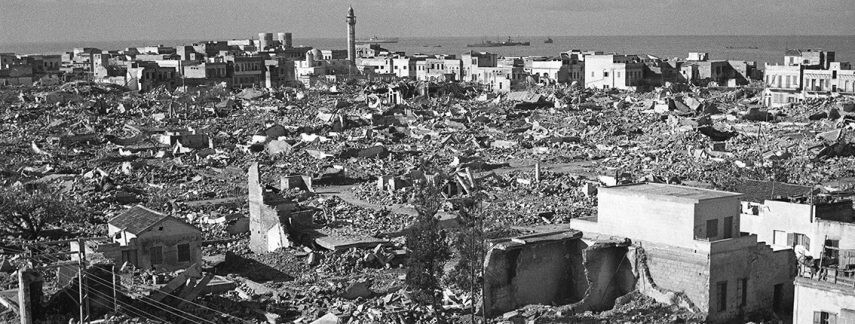
The photograph from Jabalia in January 2025 is separated from Manshiyya by seventy-seven years, but the visual resemblance is impossible to dismiss. Entire neighborhoods have again been reduced to rubble. Families have again been displaced. The language is again security and necessity. Meanwhile, territorial lines, military corridors, buffer zones, and prohibited areas determine where Palestinians may live and whether they can return. The events are not identical, and history never repeats mechanically. But the governing logic is recognizably similar: destroy the physical world of a population, compress or remove that population, control the land, and insist that the aggressor is only defending itself. [9] [10] [37]
I see the same danger in southern Lebanon. Hezbollah’s attacks do not make Lebanese villages expendable. Yet extensive destruction of homes, infrastructure, and agricultural land has again been explained through security and the need to create distance from Israel’s border. A temporary security zone can become a prolonged military fact. A prolonged military fact can become a new boundary. When the original residents are absent long enough, political language begins to treat their absence as normal. [11] [12]
I have come to understand how important forgetting is. Once enough time passes, land taken by force can start to look as if it simply belongs to whoever has it now. A destroyed village becomes open land. Refugees become a 'refugee problem.' A Palestinian neighborhood becomes a park, a highway, a museum, or an expensive address. Eventually a child growing up there has no idea what was there before. I was that child.
But the machinery of forgetting no longer works as it once did. In 1948, photographs could be archived, testimony marginalized, Palestinian place names removed, and the official story repeated for decades before most outsiders encountered the evidence. Today the destruction is recorded by satellites, journalists, aid agencies, smartphones, survivors, and sometimes by Israeli soldiers themselves. Images cross the world before the dust settles. Governments may dispute the meaning, restrict access, attack the messenger, or flood the public sphere with competing claims, but they cannot make the ruins invisible.
The evidence is no longer hard to find. What is hard is allowing it to change what we believe. Jaffa taught me what can happen when destruction is followed by silence and rebuilding. Gaza is happening in front of us. In southern Lebanon, I hear the same language of temporary security that can become permanent reality. I do not think this record can disappear the way so much of 1948 disappeared from the story I was taught.
7. What Israel Is Becoming and What Repair Requires Back to contents
Israel’s Changing Society Back to contents
While international pressure on Israel is growing, Israeli society appears to be moving in the opposite direction. In 2023, I wrote that Israel was fragmenting along religious, ideological, and ethnic lines. I worried that religious nationalism would gain power, settlement and territorial expansion would become harder to restrain, and educated, professionally mobile Israelis might conclude that the country was moving somewhere they could no longer follow.
I hoped I was being too pessimistic. But religious-nationalist and far-right movements have gained influence, and politicians such as Itamar Ben Gvir, once far outside the mainstream, now hold substantial power. [13]
That extremism has now entered the law itself. On March 30, 2026, the Knesset passed legislation making death by hanging the default punishment for Palestinians from the occupied West Bank convicted by military courts of deadly terrorist attacks. The law permits a death sentence without a unanimous judicial decision, sharply restricts appeal or clemency, and does not apply equally to Jewish Israelis accused of comparable ideologically motivated violence. The United Nations human-rights chief condemned it as discriminatory and incompatible with international law. [52]
The brutality was not confined to the legislation. At his fiftieth birthday celebration in May 2026, National Security Minister Itamar Ben Gvir was presented with cakes decorated with hanging nooses, one bearing the words, “Sometimes dreams come true.” Senior police and prison officials reportedly attended. A government minister and people responsible for law enforcement were not solemnly confronting the taking of human life. They were celebrating its prospect while wearing small noose-shaped lapel pins. The noose had become a political emblem, and the execution of Palestinians a decoration on a birthday cake. This is what dehumanization looks like when it moves from the political margins into government, law, and public celebration. [53]
At the same time, some of Israel’s fastest-growing communities are among its most religious and politically conservative. If those demographic and political patterns continue, voting power may shift toward greater support for the nationalism, religious absolutism, settlement expansion, and hard-line policies that are already making compromise more difficult. [14]
A substantial portion of Haredi men spend many prime working years in full-time yeshiva study rather than in the labor force. As this population grows, low male labor-force participation creates a genuine economic challenge because many households contribute less through employment and taxation while receiving government support and public services. Haredi women work at much higher rates, and Haredi communities contribute greatly to Israeli social, religious, and communal life, but those distinctions do not eliminate the economic concern. [14][15]
Many secular, educated, and highly skilled Israelis, including scientists, physicians, engineers, entrepreneurs, academics, and technology workers, have both the ability and, increasingly, the motivation to leave. If alienated by religious extremism, endless war, weakening democratic institutions, and international isolation, some will take their skills and families elsewhere. Their departure would weaken Israel's economy and remove an important political and cultural counterweight to the groups moving the country further toward nationalism and religious rule.
This is no longer purely hypothetical. Israel experienced negative net migration in 2024, projected to grow in 2025, while its technology sector recorded an outward movement of workers after October 7. The figures do not explain every departure or prove that the trend will become permanent, but they show that a damaging brain drain is no longer theoretical. [16][17]
If those two trajectories continue, growing pressure from outside and growing fanaticism from within, they will eventually collide.
I worry that the greatest long-term danger to Israel may not come solely from external enemies. It may also come from what prolonged occupation, religious nationalism, internal division, and the normalization of domination do to Israel itself.
My concern is for the people who live there and the future they will share, not the preservation of unequal rights.
A country can possess enormous military power and still weaken from within. Weapons can defend borders. They cannot create social cohesion, economic resilience, democratic values, or a shared moral purpose.
Israel’s future depends on more than its ability to defeat its enemies. It depends on what kind of society Israelis are willing to become in order to defeat them.
If I Applied the Same Standard to Everyone Back to contents
When survival becomes the way we judge everything, it can distort what we are willing to see. Fear can cloud the very moral values we believe we are protecting. The words our survival, our people, our homeland, and never again have enormous emotional power for Jews, especially for children of Holocaust survivors.
But moral principles mean very little if they apply only when our own survival, identity, land, or interests are not threatened.
It is easy to believe in justice when justice costs us nothing. The real moral test comes when justice requires us to surrender something we want: land, power, privilege, control, security, or simply the comforting belief that our side has always been right.
This is where self-preservation, and sometimes greed, can overwhelm morality. We can become so determined to preserve ourselves, our state, our demographic majority, and our claim to the land that we fail not only Palestinians, but ourselves and the Jewish moral tradition we claim to represent.
If our biblical and Jewish teachings about justice, compassion, the stranger, and the value of human life apply only when they do not conflict with Jewish interests, then what exactly are those teachings worth?
Being the son of Holocaust survivors makes this conflict inside me even harder.
One lesson I inherited from my parents’ history was that Jews must never again be defenseless. I understand the power of that lesson in my bones. But I inherited another lesson too.
I also learned what happens when people are reduced to a category, their rights become conditional, displacement becomes acceptable, and ordinary people look away because another population has been defined as dangerous or inferior. I cannot carry that history and silence my conscience when another people is dehumanized. The lesson of the Holocaust cannot end with Jewish survival.
I am also troubled by our selectivity. We can invoke ancient scripture when it supports a Jewish claim to the land and become considerably less literal when the same religious tradition demands justice, compassion, humility, and concern for the stranger.
Chosen for Responsibility, Not Privilege Back to contents
I also struggle with the idea of Jews as the “chosen people.” In Israel and among some American Jews, I have seen chosenness interpreted as special status, sometimes carrying the implication that Jewish lives, needs, or claims matter more.
But Jewish tradition teaches nearly the opposite. Chosenness is a covenant of responsibility, not a grant of superiority. The Israelites were called to become “a kingdom of priests and a holy nation.” The prophet Amos warned that being chosen meant being held more accountable for wrongdoing, not less. [64]
This responsibility is reflected in tikkun olam, commonly understood today as repairing the world through justice, compassion, and care for others. Yet the convenient interpretation reverses that meaning. Chosen becomes privileged. Responsibility becomes entitlement. Instead of requiring more from ourselves, it is used to justify demanding more from others.
I sometimes see a quieter version of this in reactions to Patty. She is an exceptionally kind, charitable, and respectful person. Yet when some Jewish people learn that she is not Jewish, the response is occasionally disappointment: 'Oh, she isn't Jewish? She is going to convert, right?' The implication is that the person she already is remains somehow incomplete or less worthy.
I hear it in language too. Words such as goy or shiksa are not necessarily insults, but I have heard them spoken with a tone that makes “not Jewish” sound like something lesser. I have heard that tone directed toward Patty simply because she is not Jewish, and it troubles me.
That may seem like a small thing compared with what Palestinians endure, and of course it is. But it has made me think about how easily human beings divide the world into “us” and “them,” and how dangerous that division becomes when reinforced by nationalism, fear, and war. With Palestinians, and especially Muslims, I have watched that distance become far more severe. Once another people are seen primarily as a threat, rather than as individual human beings, actions that would otherwise be morally unbearable become easier to tolerate.
Dehumanization does not always begin with hatred. Sometimes it begins quietly, with the belief that our people matter more.
If chosenness has moral value, it cannot mean being chosen above Patty, Palestinians, Christians, Muslims, or anyone else. It must mean accepting a greater responsibility toward them. Otherwise, chosenness becomes privilege disguised as faith.
For years, I have encountered the assumption that criticizing Israel means I do not love it. I have come to believe almost the opposite.
Indifference would be much easier. I could simply stop looking. But the stubborn insistence on defending Israel regardless of what it does, even when that requires setting aside one’s own moral principles and the moral teachings of Judaism, has gradually weakened my attachment to it.
Love should allow us to confront wrongdoing. When loyalty requires us to stop questioning, it becomes something other than love.
Israel formed me. Hebrew is my first language. Its landscape is part of my childhood. Its history intersects with my family’s history, and people I love still live there. That is exactly why watching what Israel has become capable of doing is painful.
A Jewish State and the Limits of Democracy Back to contents
That same moral standard also forces me to examine the character of the state itself.
Israel has important democratic institutions, including competitive elections, political parties, courts, and formal citizenship rights. But democracy means more than elections. It requires equal protection under law, equal political worth, and a genuine ability to influence the authority that governs one’s life. It requires a political system in which ethnicity or religion does not determine whose belonging or rights carry greater weight. [19]
When I consider the different legal and political realities experienced by Jewish citizens, Palestinian citizens of Israel, Palestinians in East Jerusalem, Palestinians in the West Bank, and Palestinians in Gaza, I cannot call the overall system democratic in the full moral sense of that word. [19]
I also have to question why the state must belong primarily to one ethnic or religious people.
Remove our emotional attachment to the word Jewish for a moment.
How would we judge an Islamic or Christian state built around maintaining the demographic dominance and political character of one religious or ethnic group while another people living under its authority were expected to accept a secondary place?
Would we call that a liberal democracy?
Even the Israeli flag illustrates the contradiction. A national flag should allow every citizen to imagine belonging equally, but Israel's central symbol, the Star of David, represents Jewish identity rather than a shared civic identity. I have to ask what that means to a Palestinian citizen of Israel.
And the question of equality goes far beyond symbols. Palestinian citizens of Israel have the right to vote and hold citizenship, but formal citizenship does not mean that every citizen encounters the state on equal terms. Decades of land-allocation, zoning, and planning policies have sharply restricted the ability of many Arab communities to expand. Palestinian citizens have faced serious obstacles in obtaining building permits, while some mostly Jewish communities have been permitted to use admissions committees that can restrict who may live there. [21]
The result is that an Arab citizen can possess an Israeli passport and vote in the same election as a Jewish citizen while still confronting very different practical opportunities to acquire land, build a home, or live in particular communities. [21]
The mechanism is not identical to American segregation or redlining, but the moral comparison is useful. In the United States, formal citizenship and constitutional equality coexisted for generations with zoning, lending, housing, and land-use practices that restricted where Black citizens could live and whether their communities could prosper. If we recognize the injustice when those mechanisms operate in American history, we should be willing to recognize a related injustice when land and planning systems produce unequal realities in Israel.
I once encountered that difference between citizenship on paper and equality in life while Patty and I were lost in the ancient Arab quarter of Akko. An Arab Israeli man recognized that we were lost and changed where he was going simply to walk us out of the maze.
As we walked, I asked whether he finally felt like an equal citizen of Israel. He smiled. “No. Not at all.” He spoke about overcrowding, inadequate schools and public services, sanitation, the difficulty of obtaining permission to build, and the barriers Arab families faced in trying to move beyond neighborhoods like his.
He told me that after 1948 his grandparents had told his parents to be patient: “They promised us. Eventually we will be equal.” His parents later told his generation the same thing. Then his own children began asking why another generation should believe equality was coming if they only remained patient.
“How long can we wait?” he asked.
He was not talking about Gaza or the occupied West Bank. He was an Israeli citizen who spoke fluent Hebrew and had lived his life inside the state whose citizenship he carried. Yet after generations of his family being told to wait, he still did not experience that citizenship as equality.
The contradiction stayed with me. Here was a man telling me that his country had kept people like him at a distance for generations. Yet when he saw two strangers lost in his neighborhood, his first instinct was to help us find our way home.
At some point, “give it time” begins to sound less like a promise and more like an answer designed never to be fulfilled. If we want to understand where anger, rejection, and extremism come from, we should pay attention to how long people have been asked to wait before condemning them for losing patience.
How can we tell that citizen, “You are completely equal here; this country belongs to you exactly as much as it belongs to me,” while the flag, national anthem, immigration laws, and fundamental identity of the state explicitly celebrate my Jewish identity rather than our shared citizenship? [20]
I have often heard, 'It is a democracy. They are citizens just like us.' But citizenship alone does not answer what this man told me. Voting rights do not erase barriers to housing, opportunity, or belonging. Too often, Palestinian citizens are offered as proof of equality while their accounts of inequality are dismissed.
I also find myself questioning how we see places like the Arab quarter of Akko. We can enjoy the market, the food, and the old streets without asking whether the people who live there have the same opportunities we expect for ourselves. Their culture is welcomed as part of the experience of visiting the city. Are they equally welcomed as people to whom the country belongs?
A similar contradiction troubles me when I see large Bedouin tents set up for tourists, where visitors drink coffee served by Bedouin hosts in traditional clothing. Their culture becomes something to admire and photograph. Yet restrictions on land, movement, and grazing have undermined traditional herding livelihoods for many Bedouin families in the Negev. Many living in unrecognized villages face severe poverty, inadequate roads, and limited access to water, electricity, and basic services. [73] We celebrate their traditional way of life for visitors while restricting their ability to practice it, without ensuring decent conditions for the life that replaces it.
The question of belonging also reaches into the classroom. Human Rights Watch’s 2001 report documented how state control over Arab education marginalized Palestinian history and identity in the curriculum. [74] A child can hold Israeli citizenship while finding little recognition of their own family’s history in the education the state provides. That does not mean Palestinian children never learn their history. Families and communities also pass it on. But what schools teach, and what they leave out, helps tell children whose story belongs.
Equal belonging should not require Palestinians or Bedouins to give up their identity. It should mean having the same freedom, opportunities, and dignity that Jewish citizens expect for themselves.
Safety, Equality, Accountability, and Repair Back to contents
Jewish history, culture, identity, and connection to the land can continue without determining whose rights, belonging, freedom, home, or humanity count more.
That principle must be equally true for Jews and Palestinians.
And if I have to abandon that principle in order to preserve a Jewish state as we currently define it, then I have to ask myself whether it is the principle or the state that needs to change.
Conclusion: My Father’s Request Back to contents
Permanent military domination cannot be the answer. Displacement without remedy cannot be the answer. Attacks on civilians cannot be the answer. Unequal political and legal rights cannot be the answer. And the security and freedom of one people cannot permanently depend on controlling, displacing, or denying the freedom of another.
My mother’s story taught me why: security built by making another people permanently insecure cannot produce lasting safety.
Any just future must protect civilians on both sides; provide equal human and political dignity; address Palestinian displacement through return, restitution, compensation, or genuinely agreed alternatives; and allow both Jews and Palestinians to live securely without requiring either people to surrender its identity, history, or humanity.
It is easy to recognize injustice when someone else commits it. The real moral reckoning begins when we are willing to recognize it in ourselves.
If I were not Jewish or Israeli, and none of this belonged to my own family history, what would I call fair?
I cannot change what was done before me, or undo what I once accepted. But I can refuse to defend it, challenge its continuation, and make clear that it does not have my consent. Israel is part of my history. It does not speak for my conscience. Being Jewish does not require my silence. It calls me to oppose injustice, especially when it is committed in my name.
Jews deserve safety, memory, dignity, freedom, and belonging.
Palestinians deserve exactly the same.
If preserving any political system requires me to believe otherwise, then it is not the moral principle that needs to change. It is the system.
The challenge is not to decide whose humanity matters more. It is to build a future in which neither people must deny the other’s humanity, freedom, dignity, safety, or belonging in order to live securely.
About the Author Back to contents

Image description: Morty Bachar and Patty Storms in Lewes, Delaware.
Morty Bachar has lived in the United States for many years and now lives in Lewes, Delaware, with his partner, Patty Storms. Before devoting himself to art, he built a career in engineering and technology management, holding senior positions working with early applications of artificial intelligence, RF ID, face and voice recognition, telecommunications, and consumer technology.
Morty and Patty own and run Lakeside Pottery Studio, which they founded in Stamford, Connecticut, and later relocated to Delaware. What began as a ceramic art and teaching studio grew into a nationally recognized center for ceramic and sculpture restoration, custom pottery, and Kintsugi. Its educational programs recorded more than 15,000 class and workshop enrollments, and its extensive online library of pottery, restoration, and Kintsugi lessons is used by artists, educators, students, and craftspeople around the world.
Patty is a lifelong artist from Maine, a painter, ceramic artist, instructor, and master ceramic-restoration painter. She works in oil, watercolor, pencil, pen and ink, and ceramics; creates commissioned art; and has exhibited and sold her work through galleries and exhibitions. As co-founder and co-owner of Lakeside Pottery, she has taught children and adults and helped shape the studio’s creative and educational mission.
Morty’s Kintsugi work was selected twice as an official White House gift for Japanese prime ministers, in 2021 and 2024. Lakeside Pottery also received the Better Business Bureau of Delaware’s 2019 Torch Award for Marketplace Ethics.
Morty continues to work as a ceramic artist, educator, and writer. Whether restoring damaged three-dimensional art or examining difficult history, he is guided by the belief that repair begins with seeing clearly what has been broken.
Appendix A: Israel’s Archival Record of the 1948 Palestinian Exodus Back to contents
This appendix preserves the detailed historical and archival discussion supporting the main narrative. It is separated from the personal stories so readers can examine the underlying record without interrupting their flow.
Jaffa, Ajami, Akko, and the Transfer of Property Back to contents
The historical record establishes what surrounded my mother's encounter. Jaffa surrendered to the Haganah on May 13, 1948, one day before Israel declared independence and several months before the main Bulgarian immigration wave. Fewer than 4,000 Palestinian residents remained. Israeli authorities removed families from neighborhoods across the city and concentrated them in Ajami behind barbed wire, armed military rule, permits, and curfews. Palestinian homes, shops, furnishings, and land were taken into state control and assigned to Jewish newcomers, sometimes with large houses divided among several families. Ajami was not a UN refugee camp, but a Palestinian neighborhood turned into a fenced and controlled enclave. Jaffa's direct military rule ended in 1949, but Israel's broader military government over Palestinian citizens continued until 1966, and ending the fence did not restore the property or equal freedom that had been taken. [24]
Look first at the man seated behind the strands of barbed wire. We cannot know his private thoughts, but we can understand the reality forced upon him. He was confined in the city to which he belonged while European Jewish refugees moved freely through streets from which Palestinian families had been removed. Somewhere beyond that wire may have stood his home, a relative’s home, a shop, a workplace, or the rooms of neighbors now occupied by newcomers. To be dispossessed is one pain. To remain nearby, fenced in, and watch other people prosper inside the life taken from you is another. It can produce grief, humiliation, helplessness, and rage. The photograph of my mother and Bella in 1951 makes that contradiction painfully intimate. They are young, well dressed, and walking freely and joyfully through Jaffa, only a short distance from Palestinians confined in Ajami. Their freedom was not abstract: my mother’s family was living in a confiscated Palestinian apartment, and her father had taken possession of confiscated Palestinian stores. I cannot say that the man in the photograph owned their particular apartment or shops. But he represents the people whose homes, storefronts, streets, and city were taken and transferred to families like mine. My mother was generous, helpful, and self-sacrificing. The point is not that she was cruel. The point is more disturbing: decent people can benefit from theft and land seizure when the people who paid the price have been placed behind a fence and outside the national story. One photograph shows the freedom created for Jewish refugees; the other shows the freedom taken from Palestinians to provide it. This is not history sealed in 1948. The same logic continues wherever Palestinian land is seized, Palestinian movement is restricted, Palestinian homes are taken or demolished, and a new Israeli reality is built in their place.
What happened after the wire is part of the same story. Once direct military rule over Jaffa ended, Palestinians were not simply restored to the city that had been taken from them. Many remained concentrated in Ajami and nearby Jaffa neighborhoods, often as protected tenants in property now controlled by the state rather than as secure owners of the homes in which they lived. Families grew, but adequate housing, infrastructure, public investment, and legal room to expand did not keep pace. Additions needed approval from state property managers and municipal planning authorities; when residents enlarged crowded homes without those approvals, the same additions could become grounds for demolition or eviction. In 2007, a government housing-company document listed 497 eviction and demolition orders issued in eighteen months in Ajami and Jabaliya, many involving alleged squatting or additions made without approval and building permits. [24]
Then the pressure acquired a profitable form. Ajami occupies beautiful Mediterranean land. After decades of neglect had helped produce poverty and deterioration, state land and housing bodies auctioned or sold properties, municipal development drew investors, and coastal real-estate prices rose beyond the reach of many Palestinian residents. Expensive homes and luxury projects received the planning path and capital that local families had long struggled to obtain for ordinary additions or housing for their children. Some residents, exhausted by debt, insecurity, legal disputes, overcrowding, and the rising cost of remaining, sold and left. A sale made under that pressure can be recorded as voluntary while still belonging to a larger structure of displacement. This is the creeping method: restrict the space in which a community can live, make normal growth difficult, allow deprivation to deepen, then open the same land to wealthier developers and buyers. Palestinian residents are left watching costly new homes rise beside neighborhoods whose deterioration was treated for years as inevitable. The barbed wire disappeared, but the struggle over who is permitted to remain, build, inherit, and belong did not. [24]
This contradicts the story that Palestinians simply left voluntarily and abandoned their property. Whatever mixture of flight, fear, expulsion, and individual decision operated elsewhere, Jaffa disproves that blanket claim. Many were driven out; those who remained were confined under armed rule; and the property of both groups was transferred for Jewish use. Voluntary departure does not require barbed wire for those who remain or confiscation preventing the displaced from returning.
The timing is equally revealing. A contemporary Jewish Telegraphic Agency report dated December 19, 1948, recorded 3,000 immigrants arriving in Israel in a single movement, more than 2,500 of them from Bulgaria. That shipment was part of the migration in which approximately 45,000 of Bulgaria’s roughly 50,000 Jews came to Israel and Jaffa became the center of their new community. My mother’s family was not stumbling into an accidental vacancy. It was entering a documented system that transformed Palestinian dispossession into housing for Jewish refugees. [25]
Jaffa and Akko were not isolated accidents. The same larger sequence, with local differences in timing and force, reshaped Haifa, Tiberias, Safad, Beisan, Lydda, Ramle, Palestinian neighborhoods of West Jerusalem, and hundreds of villages: military conquest or intimidation; mass flight and expulsion; refusal of return; state seizure of homes, land, shops, and belongings; destruction or repopulation; and the settlement of Jewish citizens and immigrants in the emptied space. More than 400 Palestinian villages were destroyed or depopulated during the 1948 war. [27][28]
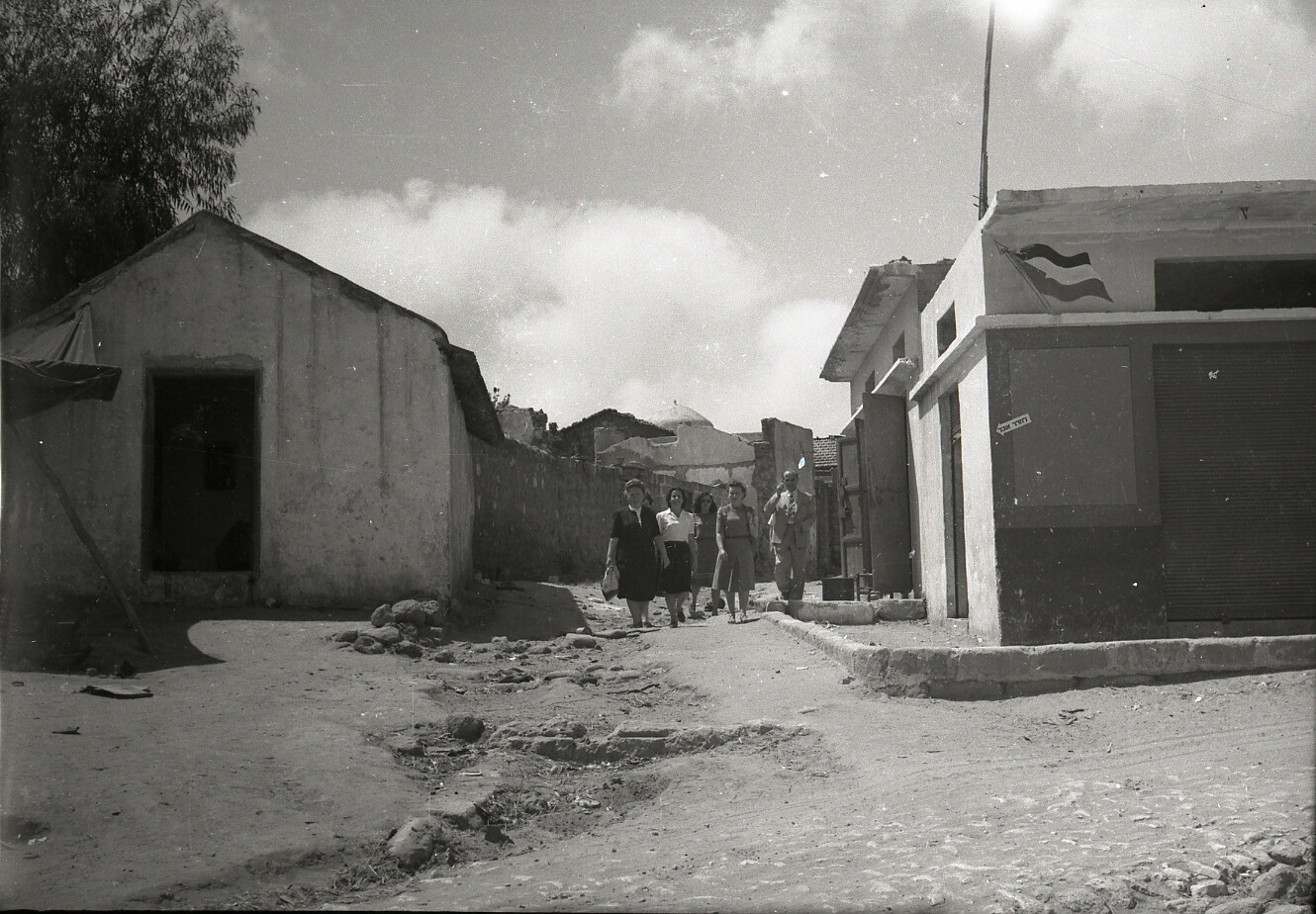
Image description: Figure 4. Jewish immigrants walking through Salama, a depopulated Palestinian village near Jaffa, 1948. Photograph: Benno Rothenberg; Meitar Collection, National Library of Israel, CC BY 4.0.
This was not merely thousands of unrelated families making the same spontaneous choice to abandon everything at the same moment. Plan Dalet, finalized by the Haganah in March 1948 before statehood, authorized operations against Arab population centers, including the destruction of villages that could not be continuously controlled and the expulsion beyond the state’s borders of populations where resistance occurred. Historians dispute whether it constituted one blanket order to expel every Palestinian, but its written provisions supplied a premeditated military framework within which depopulation, expulsion, destruction, and territorial consolidation could occur across the country. [27]
The policy after the flight and expulsions removes any remaining doubt about the desired result. On June 16, 1948, while ministers debated whether refugees should return, Ben-Gurion stated, “We must settle Jaffa; Jaffa will become a Jewish city,” and argued that Arab return should be prevented. The new government then converted wartime absence into a durable transfer of population and property. The “big plan” was not only what happened during battle. It was the combined system: create or exploit the emptying, prevent return, take control of the property, settle Jews in it, and erase the Palestinian presence from the national story. [29]
What Israeli Intelligence Reported in June 1948 Back to contents
There is an extraordinary contemporary Israeli document that helps answer one of the most disputed questions about 1948: Why did so many Palestinians leave their homes?
On June 30, 1948, the Intelligence Service, Arab Section, prepared a report titled Migration of Eretz Yisrael [Palestine] Arabs Between December 1, 1947 and June 1, 1948. This was not a Palestinian account written decades later, nor an accusation by Israel’s enemies. It was an internal Israeli intelligence assessment produced while the displacement was still taking place. [41]
The report estimated that by June 1, 1948, approximately 391,000 Palestinian Arabs had already been displaced from their places of residence, while acknowledging a possible margin of error of 10 to 15 percent. Within the borders of the proposed Jewish state, it reported that approximately 180 of 219 Arab villages were already empty. It estimated that 82 percent of Arab rural localities had been abandoned, 80 percent of the rural Arab population had left, and 94 percent of the urban Arab population had left. It calculated that 239,000 Arabs had left the territory it identified as the State of Israel, while another 152,000 had been displaced from their places of residence outside it, including Jerusalem. [41]
The report ranked the major causes of displacement. First was direct Jewish military action against Arab communities. Second was the effect of Jewish attacks on neighboring communities, particularly after the fall of major towns and population centers. Third were operations by the Irgun and Lehi. Only fourth came orders and directives from Arab institutions and armed groups. It also identified Jewish psychological-warfare operations intended to induce flight, evacuation ultimatums, fear of retaliation, the presence of armed groups and foreign fighters, fear of an Arab invasion, isolation of Arab villages within Jewish areas, and general fear and local circumstances. [41]
The report estimated that at least 55 percent of the overall displacement resulted from Haganah operations and the effect those operations had on surrounding communities. It attributed another approximately 15 percent to Irgun and Lehi operations and their effects. Its conclusion was unusually direct: approximately 70 percent of the Palestinian displacement it examined resulted from Jewish military actions and their consequences. By comparison, it estimated that orders and directives from Arab institutions and armed groups accounted for only about 5 percent of the villages evacuated. [41]
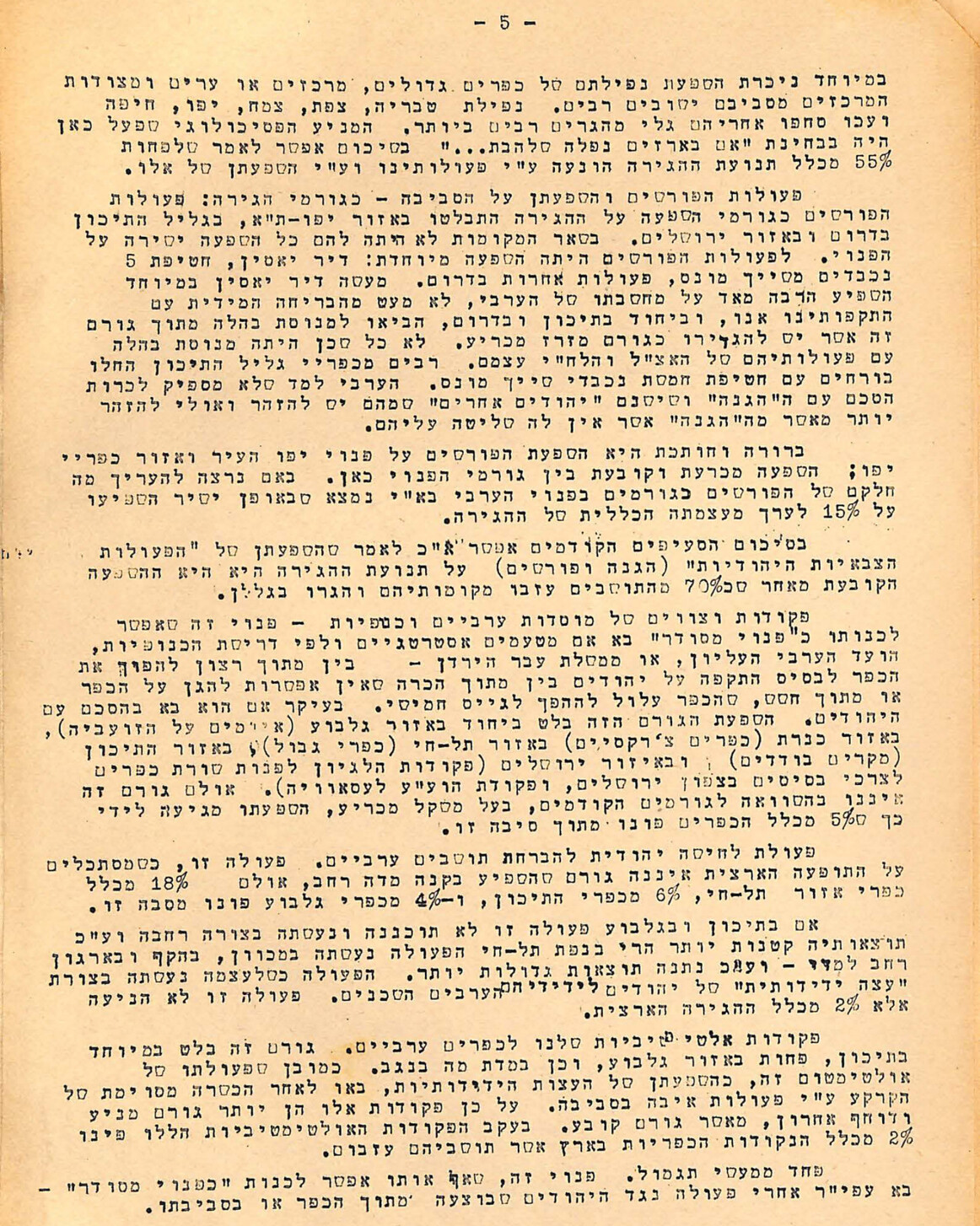
Image description: Original Hebrew page 5 of the Israeli Intelligence Service report, June 30, 1948. It states: “Without a doubt, hostilities were the main factor in the population movement,” and concludes that Jewish military action by the Haganah, Irgun, and Lehi was decisive, with approximately 70 percent leaving their communities as a result. Full English translation and archival link appear in source [41].
The report went further. It stated that in the early stages of the exodus, Arab institutions actually attempted to prevent people from leaving. The Arab Higher Committee tried to restrain the flight through restrictions, penalties, threats, press and radio propaganda, and efforts to keep military-age men from leaving. Those efforts eventually collapsed as the mass exodus accelerated. [41]
The Israeli intelligence officers also understood that a village did not have to be physically expelled at gunpoint for military action to cause its population to flee. They described the enormous psychological effect created when larger Palestinian centers fell. The report specifically identified the fall of Tiberias, Safed, Samakh, Jaffa, Haifa, and Acre as producing large waves of further displacement. It noted that attacks on one community could empty neighboring communities as well. The report also described the effectiveness of surprise, prolonged shelling with extremely loud explosions, Arabic-language loudspeakers, organized “whispering” campaigns, and evacuation ultimatums. [41]
Deir Yassin had a particularly powerful effect. The report stated that the attack had a particular impact on the Arab population’s psychology and described some subsequent departures as panic flight. It estimated that Irgun and Lehi actions had about a 15 percent direct impact on the overall intensity of the migration and described their effect on the evacuation of Jaffa and its surrounding rural area as decisive and critical. [41]
Perhaps most revealing is what happened when some Palestinians tried to go home. The report explained that villagers often initially fled only a short distance. When Jewish forces did not permanently occupy an evacuated village, some residents attempted to return. The intelligence officers acknowledged that this sometimes forced Israeli forces, in the report’s own words, to engage “on more than one occasion, in expelling residents” who had returned. [41]
None of this means every Palestinian was expelled at gunpoint or every village experienced identical circumstances. The report describes direct military attack, fear created by attacks elsewhere, Irgun and Lehi operations, psychological warfare, evacuation ultimatums, localized Arab orders, general fear, and other circumstances. Nor does it alone settle whether there was one centralized plan to expel the Palestinian population.
What Newly Revealed Records Added in 2026 Back to contents
In March 2024, Ronit Zilberman found boxes containing thousands of documents beside a dumpster in Tel Aviv. The collection had belonged to Rafi Kotzer, one of the first fighters in the Golani Brigade and a founder of the 12th Battalion’s commando unit. She brought the material to the Akevot Institute for Israeli-Palestinian Conflict Research. The collection included wartime orders, operational records, maps, photographs, and other material, some of it previously unpublished. Akevot’s work also coincided with the declassification of thousands of pages of 1948 military-court records, creating a documentary record that could be compared with the newly recovered papers. [42][43]
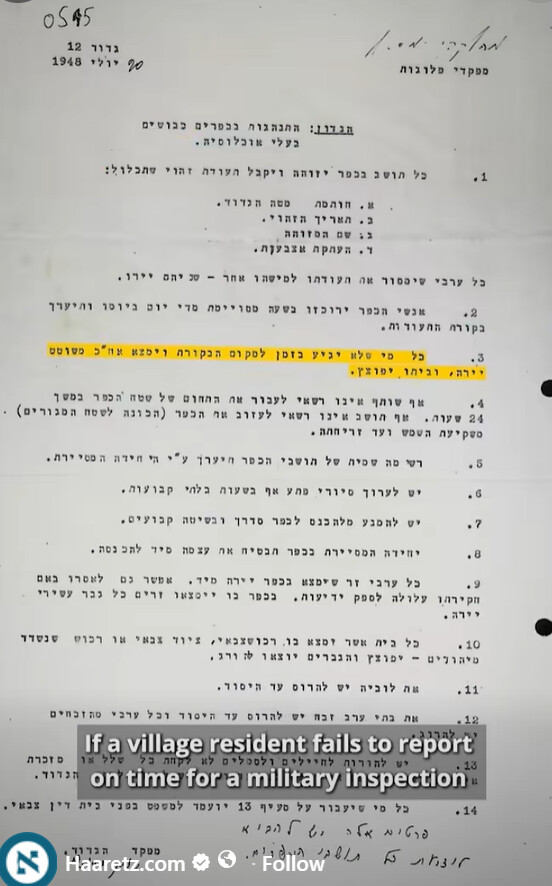
Image description: Israeli military order, July 12, 1948 - “Conduct in Captured Villages Where There Is a Population.” Issued by Yitzhak Broshi, commander of the Golani Brigade’s 12th Battalion, to the commanders of the battalion’s companies operating in northern Israel. The highlighted Item 3 reads literally: “Every person who does not appear at the appointed time for the military inspection will be shot, and his house will be blown up.” The order is signed by Broshi. Source: Rafi Kotzer collection; reproduced in Adam Raz, Haaretz, February 27, 2026, via the Akevot Institute. [42]
One of the most disturbing documents is a July 1948 order written by Yitzhak Broshi, commander of Golani’s 12th Battalion, titled “Conduct in captured villages where there is a population.” According to the document, residents of captured villages were to receive identification certificates. Transferring a certificate to another person could bring a death sentence. Failure to appear for military inspection could result in the person being shot and the person’s house being blown up. An Arab from outside the village who was found there was to be shot, and the order prescribed shooting every tenth man in a captured village where outsiders were discovered. It also ordered the execution of the men of a household in which property stolen from Jews was found. These were not recollections recorded decades later. They were written wartime directives bearing the commander’s signature. [42]
This document shows why Palestinians could be driven out without every family being physically marched from its home. Under orders making failure to report punishable by death and the destruction of one's house, flight could become an act of survival. The distinction between 'fled' and 'expelled' conceals more than it explains when remaining carries a credible threat of death. [42]
Another Broshi order concerned Arab a-Zabah, a Bedouin community in the Lower Galilee. The directive was that no person or trace of the community was to remain and stated that every Arab among the Zabahim was to be killed. A separate July order concerning Palestinians hiding around Mount Turan instructed soldiers to kill those found hiding. Another document reported Arabs returning to captured villages, apparently to retrieve possessions and food, and ordered that the area be “cleansed of Arabs”; under the heading describing the method, it instructed that every Arab encountered was to be killed. [42]
The newly available military-court testimony is equally consequential. It emerged from the case of Shmuel Lahis, a Carmeli Brigade company commander tried for killing civilians in Hula, a Lebanese village, on October 31 and November 1, 1948. Akevot’s Case 19/48 reconstructs the case from military-court transcripts, written orders, photographs, unpublished diaries, and other records. Lahis argued that he had acted in accordance with the practices and orders of the war, and senior officers testified at his trial about the methods used elsewhere. [42][43]
One witness was Mordechai Maklef, then an operations officer on the northern front and later the third chief of staff of the IDF. In testimony now published, Maklef told the military court that there had been operations in which civilians were killed and named Safsaf, Jish, Ilaboun, Lod, Ramle, and operations in the south. Speaking about the expulsion of approximately 114,000 Palestinians from the Galilee, he told the court that a population of that size could not be expelled without terror and that an initial element of terror was necessary to make people leave. [42]
Another witness, Carmeli Brigade commander Maxim Cohen, was even more explicit. Asked how a village was expelled, he described deliberately brutal violence against an individual in front of others as a means of frightening the entire population into flight. He testified that villages were not evacuated without such methods and said that Israeli victory depended on the fear these acts created. [42]
These military-court records provide the basis for the Maklef and Ben-David testimony quoted in Chapter 4. Read alongside the June 1948 intelligence analysis and the operational orders reproduced here, they document how killing, expulsion, terror, and fear contributed to Palestinian flight and prevented return. [42][43]
The Broader Israeli Archival Record Back to contents
There is now a larger Israeli archival record through which these documents can be examined rather than treated as isolated discoveries. The Akevot Institute maintains digital collections containing hundreds of original archival documents, and its Military Rule 1948–1966 collection includes internal correspondence, meeting minutes, testimonies, maps, photographs, and reports. Akevot has also published declassified 1948 provisional-government minutes showing that ministers discussed reports of massacres and suspected war crimes while the war was still underway, and it has documented the long-term restriction of public access to archival files concerning the uprooting of Palestinians in 1948. These collections provide additional primary-source material for readers who want to examine the Israeli documentary record directly. [44][45][46]
Two additional Akevot collections deepen this record. The Riftin Report, commissioned by Ben-Gurion in February 1948 and concealed for 73 years, documented internal Haganah investigations into extrajudicial killings, torture during interrogation, looting, and theft of Arab property, together with Riftin’s warning that legal procedures and public oversight were necessary. The Tantura collection presents a narrower case: a plan for Jewish settlement in the still-populated village before its conquest; the expulsion of its residents; contemporary orders and reports concerning unburied bodies and a mass grave; and later soldiers’ testimony alleging executions. The number and circumstances of deaths remain disputed, but the documents establish depopulation, advance settlement planning, the presence of many bodies, and the long silence surrounding what happened. [50][51]
Source Notes Back to contents
The notes below are organized by subject. Original note numbers are retained so that every reference in the essay and Appendix A continues to correspond to the same source note. Within each group, official and primary records are placed before interpretive scholarship and reporting where the available sources permit.
Historical Background and Terminology Back to contents
[40] Bulgaria’s persecution, expulsion, confiscation, and deportation of Jews. The United States Holocaust Memorial Museum records that Bulgarian authorities expelled almost 20,000 Jews from Sofia to the provinces, deployed Jewish men to forced labor, and confiscated much of the property left behind. It also records the deportation of more than 11,000 Jews from Bulgarian-occupied Macedonia, Thrace, and Pirot into German custody, after which virtually all were murdered at Treblinka. United States Holocaust Memorial Museum, “Bulgaria,” Holocaust Encyclopedia: https://encyclopedia.ushmm.org/content/en/article/bulgaria
[4] Population of Palestine and the demographic setting of Zionism. A documentary history by Eran Kaplan and Derek J. Penslar reports that in 1880 there were roughly 450,000 Arabs and 25,000 Jews in the area corresponding to present-day Israel, the West Bank and Gaza. Official Mandatory-era statistics likewise show a large non-Jewish majority: in the 1922 census, Palestine had 589,177 Muslims, 71,464 Christians and 83,790 Jews. By the end of 1946, UNSCOP estimated 1,203,000 Arabs and 608,000 Jews. These figures support the essay’s demographic description without implying that Jews lacked longstanding historical communities in the land. Kaplan & Penslar, \\*The Origins of Israel, 1882–1948: A Documentary History\\*, JSTOR; League of Nations/Mandate population statistics; UNSCOP 1947 population data
[31] Population of Palestine in 1946. The official 1947 Report of the United Nations Special Committee on Palestine estimated the end-of-1946 population at 1,203,000 Arabs, 608,000 Jews, and 35,000 others, for a total of 1,846,000. See https://www\\\.un.org/unispal/document/auto-insert-179435/
[33] Mandate-era currency and administration. The Bank of Israel records that banknotes during the Mandate were issued by the Palestine Currency Board. The illustrated one-pound note is dated 1939 and bears English, Arabic, and Hebrew inscriptions. The photographed Haifa public-works cover likewise bears the official English wording “Government of Palestine,” alongside Arabic and Hebrew. These objects document the Mandate’s official nomenclature; they are not evidence of an independent sovereign state. Bank of Israel, Annual Report 1955, Chapter XIV: https://boi.org.il/boi_files/BankIsraelAnnualReport/Annual%20Report%201955/part%20two/pe_14.pdf
[7] Partition, Palestinian Arab rejection and the 1948 war. Contemporary UN records state that the Jewish Agency accepted the 1947 partition plan while the Arab Higher Committee rejected any solution based on partition. UN historical records also document that fighting between Palestinian Arab and Jewish forces intensified before the end of the British Mandate and that armed forces from Arab countries entered after Israel proclaimed statehood in May 1948. UN Yearbook 1947–48; UN record on the status of Jerusalem and the 1948 war The same UN Yearbook records opponents’ argument that partition violated the right of self-determination of Palestine’s population; UNSCOP documents the Arab position against partition. See also population note [31].
[32] Jaffa and its orange economy in photographs. The Library of Congress identifies the 1932 aerial photograph as “Jaffa from the land side showing main roads into town. Orange ships at anchor,” and the 1936 photograph as orange lighters carrying full loads of orange boxes from Jaffa toward a ship. Both are in the G. Eric and Edith Matson Photograph Collection and carry the rights statement “No known restrictions on publication.” See https://www\\\.loc.gov/item/2019706662/ and https://www\\\.loc.gov/item/2019709020/
[6] Ben-Gurion and population transfer. The historical debate over Zionist transfer proposals is substantial, and the wording of one often-quoted sentence in Ben-Gurion’s October 5, 1937 letter to his son has a disputed textual history. The Journal of Palestine Studies published the letter and discusses the controversy in the context of the broader scholarly debate, citing historians including Benny Morris and Ben-Gurion biographer Shabtai Teveth. This source supports the essay’s deliberately cautious formulation that transfer was contemplated and that the argument does not depend on one disputed quotation. Journal of Palestine Studies / Institute for Palestine Studies, “JPS Responds to CAMERA's Call for Accuracy: Ben-Gurion and the Arab Transfer” Additional Israeli and academic foundation: Benny Morris, an Israeli historian at Ben-Gurion University, traces pre-1948 transfer thinking, wartime displacement, and the subsequent policy blocking return through Israeli archival records in The Birth of the Palestinian Refugee Problem Revisited. The Ben-Gurion Archive provides the leader’s original diaries and papers. Benny Morris, Cambridge University Press; Ben-Gurion Archive
[30] The “land without a people” formulation and its function. Israeli historian Anita Shapira writes in Land and Power: The Zionist Resort to Force, 1881–1948 (Stanford University Press, 1999) that the phrase was common among Zionists at the end of the nineteenth and beginning of the twentieth centuries and served to legitimate the Jewish claim while removing uneasiness about a competing claim. Historians disagree about how widely the exact slogan was used and whether “a people” meant inhabitants or a recognized nation. That dispute does not alter the demographic record. See https://books.google.com/books?id=EdhtAAAAMAAJ
[75] Jewish life in Arab and Muslim-majority countries and its unraveling. The causes, timing, and degree of coercion differed sharply by country; the body text therefore avoids a single explanation for departures and distinguishes expulsion, discriminatory law, violence, confiscation, fear, Zionist activity, state pressure, family reunification, and migration. Useful comparative and country-specific scholarship includes Norman A. Stillman, The Jews of Arab Lands in Modern Times; Orit Bashkin, New Babylonians and Impossible Exodus; Joel Beinin, The Dispersion of Egyptian Jewry; Alma Heckman, The Sultan's Communists; and Yehouda Shenhav, The Arab Jews. These works also document the cultural marginalization and unequal absorption experienced by many Mizrahi and Sephardi Jews in Israel. Further reading: Jewish Publication Society: The Jews of Arab Lands in Modern Times
[76] Jerusalem street photograph. The visible Fr. Vester & Co. name connects the image to the American Colony Stores photographic operation in Jerusalem. The British Museum identifies Fr. Vester & Co. as active in Jerusalem from 1914 to 1920 and located inside Jaffa Gate under the Grand New Hotel. The caption is deliberately cautious: the image shows a crowded shared urban setting, but appearance alone cannot establish the identities of individuals or prove social harmony. British Museum, collection biography for F Vester & Co.; Library of Congress, American Colony in Jerusalem collection. Further documentation: British Museum: F Vester & Co.; Library of Congress: American Colony in Jerusalem Collection
[77] Elie Eliachar and an alternative Sephardic vision of Zionism. Eliachar’s biographical record and his advocacy of Sephardic participation in Jewish-Arab relations are documented in his writings and in contemporary and scholarly accounts. His books include A Jew of Palestine Before the Royal Commission (1936), Living with Palestinians (1975), and Living with Jews (1981; English translation, 1983). See the Jewish Telegraphic Agency obituary; the Institute for Palestine Studies essay “The Predicament of the Arab Jew in Palestine”; and the interpretive video essay “Elie Eliachar: Palestinian Arab Jew”. The video is the immediate source for the quoted “original sin” passage. Because the recording does not display a complete primary citation for that wording, the passage is attributed through the video rather than presented as independently verified from Eliachar’s original text.
The 1948 War and Palestinian Displacement Back to contents
[5] Palestinian displacement in 1948. A 1949 UN Economic Survey Mission estimated approximately 726,000 refugees as people who had fled from territory held by Israel and were unable to return; its broader relief figure was higher when additional categories were included. The source establishes the mass scale of displacement and inability to return, while the essay appropriately leaves the causes of individual departures open to historical debate. UN Economic Survey Mission, First Interim Report (“Clapp Report”). General Assembly Resolution 194 subsequently stated that refugees wishing to return to their homes and live at peace with their neighbors should be permitted to do so at the earliest practicable date and addressed compensation. UN Conciliation Commission summary of Resolution 194
[23] Akko memorial and the conquest of the city. Israel’s official memorial website identifies the monument as commemorating the fighters of the Western Galilee and the conquerors of Akko. It transcribes the Hebrew inscription as “נצח והוד לחללי מלחמת השחרור, לוחמי הגליל המערבי וכובשי עכו. תש״ז-תש״ח.” The Haganah historical site likewise describes the May 1948 assault, bombardment, surrender, and conquest of Akko. Official Israeli memorial page; Haganah historical account of the conquest of Akko
[24] Jaffa’s fall, Palestinian displacement, and the redistribution of property. Adalah reports that fewer than 4,000 of Jaffa’s close to 100,000 Palestinian residents remained after the city fell in May 1948 and were concentrated in Ajami behind barbed wire and under military rule. It further reports that displaced residents’ homes and commercial properties passed into state control, that authorities directed new Jewish immigrants into the city, and that large Palestinian houses were sometimes divided among several immigrant families. Adalah, Modern Displacement of Palestinians in Yaffa Independent Israeli and peer-reviewed support: Israeli scholars Dan Rabinowitz and Daniel Monterescu document Jaffa’s depopulation, the June 1948 prohibition on Palestinian return, and the large-scale placement of Jewish newcomers in Palestinian property. The barbed-wire boundary photograph reproduced in this essay is credited to the Israel Defense Forces and Defense Establishment Archive. Rabinowitz and Monterescu, Cambridge University Press The same Adalah study reports that Palestinian population growth was not matched by adequate housing; that residents faced barriers to permits and approvals for additions; that a 2007 Amidar document listed 497 eviction and demolition orders issued over eighteen months in Ajami and Jabaliya; and that state property sales, the Jaffa Slope development, private investment, and rapidly rising prices intensified the displacement of Palestinian residents from valuable coastal land.
[25] The late-1948 Bulgarian immigration wave. A Jewish Telegraphic Agency report dated December 19, 1948, documented the arrival of 3,000 immigrants, more than 2,500 of them Bulgarian Jews. Guy H. Haskell’s historical study records that approximately 45,000 of Bulgaria’s roughly 50,000 Jews immigrated to Israel and that Jaffa became the principal center of Bulgarian Jewish life. These records establish the timing and scale surrounding Morty Bachar’s mother’s testimony; the details about her family’s apartment and stores remain her firsthand account. JTA contemporary report; Guy H. Haskell, From Sofia to Jaffa
[26] Akko’s conquest, displacement, and resettlement. The Journal of Palestine Studies dates Akko’s conquest to May 17, 1948. A peer-reviewed study in the International Journal of Middle East Studies reports that roughly 4,000 Palestinians remained and that approximately 3,600 Jewish residents had joined them by mid-1949. The statement that Morty Bachar’s father’s family was moved into a confiscated Palestinian home is family history supplied by Morty Bachar. Journal of Palestine Studies, The Fall of Acre in the 1948 Palestine War;International Journal of Middle East Studies, Reconfiguring the Mixed Town The Akko account is also supported by Mustafa Abbasi, an Israeli historian at Tel-Hai Academic College, whose archival research reconstructs the city’s May 1948 conquest, surrender, and population collapse. Rabinowitz and Monterescu place Akko within the peer-reviewed comparative history of Israel’s transformed mixed towns. Mustafa Abbasi, “The Fall of Acre in the 1948 Palestine War”; Cambridge comparative study
[27] Plan Dalet and the wider urban expulsions. The Haganah’s March 1948 Plan Dalet stated that operations against hostile population centers could include “destruction of villages” and, where resistance occurred, destruction of the armed force and expulsion of the population beyond the borders of the state. Its role as a master expulsion plan remains contested among historians; the text nevertheless documents advance authorization for destruction and expulsion under specified conditions. The 1948 offensive captured and depopulated major Palestinian urban centers including Tiberias, Haifa, Safad, Beisan, Jaffa, and Akko.Text of Plan Dalet; Walid Khalidi, “Plan Dalet: Master Plan for the Conquest of Palestine” Israeli historian Benny Morris describes Plan Dalet as providing the strategic and doctrinal basis and formal cover for expulsions by commanders, while distinguishing that conclusion from the claim that it was a blanket order to expel every Palestinian. His account is grounded in Haganah and Israeli archival material and published by Cambridge University Press. Morris, The Birth of the Palestinian Refugee Problem Revisited
[28] The broader destruction, depopulation, confiscation, and resettlement pattern. The Institute for Palestine Studies’ reference work All That Remains documents more than 400 Palestinian villages destroyed or depopulated in 1948. Columbia University’s Middle East Institute summarizes the subsequent confiscation of village land and property, the razing of most sites, Jewish settlement in others, and the systematic renaming and remaking of the landscape. Institute for Palestine Studies, All That Remains; Columbia University, “Erased from Space and Consciousness” Benny Morris’s Israeli archival study documents the destruction of abandoned villages, allocation of Arab land to Jewish settlements, establishment of new settlements on abandoned sites, and settlement of Jewish immigrants in empty Arab housing. His earlier Oxford University Press collection also examines the IDF Intelligence Service’s own 1948 analysis of the exodus and the work of the Transfer Committees. Cambridge chapter, “Blocking a Return”; Oxford University Press, 1948 and After
[29] Ben-Gurion and the decision against refugee return. Benny Morris’s archival study of the Israeli cabinet debate records Ben-Gurion’s June 16, 1948 position that Jaffa should be settled as a Jewish city and that Palestinian refugee return should be prevented. The chapter documents how an initially improvised refusal of local returns became a national policy during 1948. Benny Morris, “Deciding against a Return of the Refugees, April-December 1948”
[35] Manshiyya’s planned destruction and the use of “security” as justification. Or Aleksandrowicz, an Israeli architectural historian at the Technion, argues that the 1948 demolitions were not simply a consequence of wartime damage. His peer-reviewed study concludes that Tel Aviv’s leadership exploited wartime confusion and misinformation to pursue a large-scale and legally questionable modernization project, while presenting the demolition as an urgent security measure. See “The Camouflage of War: Planned Destruction in Jaffa and Tel Aviv, 1948,” Planning Perspectives 32, no. 2 (2017): https://cris.technion.ac.il/en/publications/the-camouflage-of-war-planned-destruction-in-jaffa-and-tel-aviv-1-2/
[36] Manshiyya photograph and later landscape. The late-1948 photograph is credited to Israeli photographer Rudi Weissenstein and The PhotoHouse, Tel Aviv. The Jewish Museum Hohenems identifies it as “Manschieh, Ende 1948” and describes the municipality’s large-scale demolition operation and planned reconstruction. Haaretz has documented that Charles Clore Park was constructed over the neighborhood’s ruins. See https://www\\\.jm-hohenems.at/en/veranstaltungen/you-cannot-kill-a-city-in-a-single-day-the-destruction-of-manschieh and https://www\\\.haaretz.com/life/2021-12-14/ty-article-magazine/.premium/unearthing-the-palestinian-neighborhood-buried-beneath-a-tel-aviv-park/0000017f-e2e6-d9aa-afff-fbfec8c60000
The Archival Evidence Back to contents
[50] Akevot Institute, The Riftin Report, March 1, 1948, annotated English translation published in 2021. Commissioned by David Ben-Gurion and concealed from public access for 73 years, the internal Haganah inquiry examined allegations including extrajudicial killings, torture during interrogation, looting, theft of Arab property, and inadequate accountability. Riftin recommended clearer legal procedures, a permanent legal organization, limits on death sentences, and public oversight of Arab property in areas under Jewish control. Akevot Institute — The Riftin Report
[41] Israeli intelligence analysis of the Palestinian exodus, June 1948. The Intelligence Service (Arab Section) report, Migration of Eretz Yisrael [Palestine] Arabs Between December 1, 1947 and June 1, 1948, dated June 30, 1948, estimated 391,000 displaced Arabs with a 10–15 percent margin of error. It reported approximately 180 of 219 Arab villages empty within the territory it identified as the State of Israel; 82 percent of Arab rural localities abandoned; 80 percent of the rural Arab population and 94 percent of the urban Arab population having left. The report ranked direct Jewish military actions and their effects as the principal causes, estimated at least 55 percent attributable to Haganah actions and their impact and about 15 percent to Irgun and Lehi, concluding that approximately 70 percent left as a result of Jewish military action. It attributed about 5 percent of evacuated villages to orders or directives from Arab institutions and armed groups, documented psychological-warfare measures and the wider effects of the falls of major Palestinian centers, and acknowledged cases in which returning residents were expelled again. The full translated report, including the detailed community-by-community annex, is published by PalQuest with an introduction by the Akevot Institute. Original Israeli Intelligence Report on the Depopulation of Palestine, 30 June 1948 (PalQuest / Akevot Institute) Primary publication: Akevot Institute — 1948 intelligence report and archival history; Akevot English translation of the original report
[43] Akevot Institute, Case 19/48: Shmuel Lahis and the Hula Massacre, published February 26, 2026. Akevot describes the study as drawing on military-court testimony, written orders, photographs found in the discarded collection, unpublished diaries, and other records concerning the Hula killings and related 1948 events. Akevot Institute — Case 19/48
[51] Akevot Institute, Tantura Revisited, archival collection covering April 7 through June 11, 1948. The collection includes the pre-conquest settlement plan, the May 29 burial directive, the June 9 report referring to a mass grave, the June 11 Davar account of additional bodies, a 1946 village map, and later soldiers’ testimony alleging executions. The collection establishes the village’s depopulation and the documented presence and burial of numerous bodies, while acknowledging that the number and circumstances of the deaths remain disputed. Akevot Institute — Tantura archival collection
[45] Akevot Institute, “Suspicions of war crimes in 1948: ‘If these acts are covered up – the blame lies with the entire government.’” Newly exposed portions of provisional-government meeting minutes from November–December 1948 document ministers discussing reports of massacres and suspected war crimes. Akevot — 1948 provisional-government minutes
[42] Adam Raz, “‘Annihilate Every Arab You See’: What the Israeli Army Did in 1948, Revealed,” Haaretz, February 27, 2026. The investigation reports on the Rafi Kotzer collection found in Tel Aviv in March 2024 and newly declassified 1948 military-court records. It reproduces and discusses written Golani orders and testimony by senior Israeli officers, including Mordechai Maklef and Maxim Cohen. Full English PDF hosted by Akevot Institute: Haaretz investigation / Akevot PDF
[44] Akevot Institute, Military Rule 1948–1966 digital and annotated document collections. The collection contains hundreds of original archival records, including internal correspondence, meeting minutes, testimonies, maps, photographs, and reports. Akevot — Military Rule 1948–1966 archive
[46] Akevot Institute, SILENCING: DSDE’s Concealment of Documents in Archives. Akevot documented efforts by the Director of Security of the Defense Establishment to restrict access to archival material, with particular attention to records concerning the 1948 war and the uprooting of the Palestinian population. Akevot — Silencing archival records
The Occupation After 1967 Back to contents
[1] Oslo II, 1995. Article XI describes the West Bank and Gaza Strip as a single territorial unit whose integrity and status were to be preserved during the interim period, and provides for phased transfer of West Bank and Gaza territory to Palestinian jurisdiction except for issues reserved for permanent-status negotiations. Article XVII identifies Jerusalem, settlements, specified military locations, Palestinian refugees, borders and foreign relations among the permanent-status issues. The agreement therefore established interim arrangements rather than transferring Israeli sovereignty over Area C. United Nations text of the Israeli-Palestinian Interim Agreement (Oslo II)
[71] The Oslo Accords. The United States Department of State, Office of the Historian, summarizes the 1993 and 1995 agreements, mutual recognition, interim Palestinian self-government, and the permanent-status questions left unresolved. https://history.state.gov/milestones/1993-2000/oslo
[72] Settlement growth during the Oslo period. Israel Studies Review examines the expansion of the settler population and settlement enterprise during the years of the peace process. https://www\\\.berghahnjournals.com/view/journals/israel-studies-review/38/2/isr380202.xml
[2] International Court of Justice, Advisory Opinion, July 19, 2024. The Court concluded that Israeli settlements in the West Bank and East Jerusalem, and the regime associated with them, are being maintained in violation of international law. It found extensive evidence of Israeli incentives for relocation of Israeli civilians and businesses into the occupied territory, settlement infrastructure integrating settlements with Israel, forced displacement of Palestinians, and a systematic failure to prevent or punish settler attacks. ICJ Advisory Opinion, July 19, 2024 and ICJ summary
[3] OCHA on settler violence and displacement. OCHA recorded about 1,420 incidents of Israeli settler violence in 2024 involving casualties and/or damage to Palestinian property. It also reported that intimidation and attacks on Palestinian Bedouin communities displaced more than 300 families comprising 1,762 people, including 856 children. OCHA, Humanitarian Situation Update #252, West Bank
[19] Different democratic and legal realities. Freedom House describes Israel as a parliamentary democracy with competitive multiparty politics and independent institutions, while separately assessing the West Bank and Gaza because political rights and civil liberties differ substantially. Its West Bank report notes that Jewish settlers are Israeli citizens with Israeli voting rights while most Palestinians in the West Bank cannot participate in Israeli national elections; most Palestinian residents of East Jerusalem hold residency rather than citizenship. Freedom House, Israel 2025; Freedom House, West Bank 2025; Freedom House, Gaza Strip 2025
[21] Palestinian citizens of Israel, land, planning and admissions committees. Human Rights Watch has documented longstanding disparities in land allocation, zoning, municipal expansion and housing affecting Palestinian citizens of Israel. It reports that admissions committees in some smaller Jewish communities can effectively exclude Palestinian applicants and describes discriminatory planning policies as sharply restricting access to land and the expansion of many Palestinian communities. The Israeli Planning Administration disputed HRW’s characterization and told HRW it had made substantial efforts to advance planning in Arab communities. Human Rights Watch, “Israel: Discriminatory Land Policies Hem in Palestinians”
[73] Bedouin land, livelihoods, and living conditions in the Negev. Human Rights Watch’s Off the Map (March 30, 2008) documents discriminatory land and planning policies, restrictions affecting herding and grazing, and inadequate basic infrastructure in unrecognized Bedouin villages. Minority Rights Group’s Bedouin in Israel describes how land takeover and movement restrictions disrupted traditional livelihoods and contributed to poverty. These sources support the material conditions described; the comparison with tourist hospitality is Morty Bachar’s personal observation and moral interpretation. Many Negev Bedouins already lived largely settled lives before 1948, so this passage does not imply that all were nomadic or that all movement is prohibited. Human Rights Watch, Off the Map; Minority Rights Group, Bedouin in Israel.
[74] Palestinian history and identity in Arab education. Human Rights Watch, Second Class: Discrimination Against Palestinian Arab Children in Israel’s Schools (2001), documents inequalities in Arab education and limited Palestinian Arab participation in curriculum development. Students and teachers reported wanting more Palestinian history and literature. The report also acknowledges curriculum reforms, some not yet fully implemented at the time. These findings describe conditions documented in 2001, not necessarily today’s curriculum. Human Rights Watch, report summary.
[48] B’Tselem, “Punitive House Demolitions.” B’Tselem documents Israel’s policy of demolishing or sealing homes as a deterrent measure because of the alleged acts of a household member, including figures from the Second Intifada. B’Tselem — Punitive House Demolitions Exact figures: B’Tselem — Through No Fault of Their Own (2004)
Palestinian Resistance and Violence Against Civilians Back to contents
[69] First Intifada, 1987–1993. Encyclopaedia Britannica summarizes the uprising as beginning in December 1987 after twenty years of Israeli occupation and describes its political and social background. https://www\\\.britannica.com/topic/intifada
[70] First Intifada, 1987–1993. The Interactive Encyclopedia of the Palestine Question provides a Palestinian historical account of the uprising, its causes, organization, and development. https://www\\\.palquest.org/en/highlight/29773/first-intifada-1987-1993
[8] October 7, 2023 attacks. The UN Independent International Commission of Inquiry investigated attacks on civilian targets in Israel on October 7, including killings, hostage-taking, and rocket and mortar attacks, and documented serious violations committed by Hamas and other Palestinian armed groups. UN Independent International Commission of Inquiry, detailed findings on attacks carried out on and after October 7, 2023
[68] October 7 intelligence and response failures. Israeli military and security investigations have documented grave intelligence, preparedness, command, and operational failures before and during the Hamas-led attack of October 7, 2023. The IDF inquiry into Kibbutz Be’eri found that the IDF failed in its mission to protect residents and that, during the first seven hours of combat, residents largely defended themselves. IDF, Battle of Kibbutz Be’eri Inquiry, July 11, 2024. The IDF has also published a broader collection of October 7 operational inquiries. IDF, The October 7 Inquiries. These findings support scrutiny of the failure to protect Israeli civilians. They do not establish that Israeli authorities intentionally permitted the attack. The essay therefore separates the unsupported claim that the attack was deliberately allowed from the evidence-based question of whether political forces subsequently used the catastrophe to advance preexisting territorial, removal, or settlement ambitions.
[49] International Committee of the Red Cross, customary and treaty rules on distinction, proportionality, and precautions in attack. These rules require parties to distinguish civilians from combatants and civilian objects from military objectives, prohibit attacks expected to cause excessive incidental civilian harm in relation to the anticipated military advantage, and require feasible precautions to minimize civilian harm. ICRC — Conduct of Hostilities and Protection of Civilians
Gaza Back to contents
[65] Gaza death toll and civilian uncertainty. By August 2026, Palestinian health authorities were reporting more than 73,000 Palestinians killed in Gaza since October 2023. The aggregate Gaza Ministry of Health figure does not itself distinguish civilians from combatants, which is why the body text does not describe the entire total as civilian deaths. OCHA notes that casualty figures are attributed to their sources and that identified-fatality breakdowns may lag the higher reported total. OCHA, Reported Impact Snapshot, Gaza Strip, June 24, 2026
[9] Gaza housing destruction. The final Gaza Rapid Damage and Needs Assessment released in April 2026 by the United Nations and European Union, jointly conducted with the World Bank, reported approximately 371,888 homes directly affected, equivalent to 76.6 percent of Gaza’s housing units, and estimated physical infrastructure damage at $35.2 billion. Final Gaza Rapid Damage and Needs Assessment and full RDNA report
[37] Jabalia photograph. Reuters identifies the image as a drone view of Palestinians walking past the rubble of houses and buildings in Jabalia, northern Gaza, on January 19, 2025, following the ceasefire. Photograph by Mahmoud Al-Basos. Reuters asset RC20DCANZJIT: https://www\\\.reutersconnect.com/item/a-drone-view-shows-houses-and-buildings-lying-in-ruins-following-a-ceasefire-between-israel-and-hamas-in-the-northern-gaza-strip/dGFnOnJldXRlcnMuY29tLDIwMjU6bmV3c21sX1JDMjBEQ0FOWkpJVA
[10] Gaza Yellow Line and territorial compression. OCHA reported on June 26, 2026 that the Yellow Line spanned about 53 percent of the Gaza Strip, marking roughly where access restrictions were enforced on most Palestinians and confining them in practice to the remaining 47 percent. OCHA, Humanitarian Situation Report, June 26, 2026
[67] Yellow Line and expanding Israeli control in Gaza. Following the October 2025 ceasefire announcement, the Yellow Line marked the area where Israeli troops would remain temporarily deployed, spanning about 53 percent of Gaza. OCHA reported on June 26, 2026 that access-restricted areas had expanded to 65 percent of the Strip and that the current Orange Line placed 64.9 percent under tighter and more direct Israeli control. OCHA Humanitarian Situation Report, June 26, 2026. Reuters reported that Netanyahu directed the military to expand Israeli control toward 70 percent. Reuters, May 28, 2026. The body text treats the comparison with Area C as a warning and projection, not as a claim that permanent annexation or civilian settlement of the Israeli-controlled portion of Gaza has already occurred.
[66] Genocide: legal definition and findings concerning Gaza. Article II of the 1948 Convention on the Prevention and Punishment of the Crime of Genocide defines genocide as specified acts committed with the intent to destroy, in whole or in part, a national, ethnical, racial, or religious group as such. The five enumerated acts are killing members of the group; causing serious bodily or mental harm; deliberately inflicting conditions of life calculated to bring about physical destruction in whole or in part; imposing measures intended to prevent births; and forcibly transferring children to another group. The United Nations explains that genocide therefore requires both a physical element and a specific mental element, often called special intent or dolus specialis. Large-scale killing or destruction, however horrific, does not by itself establish genocide without the required intent. United Nations, Definitions of Genocide and Related Crimes; 1948 Genocide Convention. Amnesty International concluded in December 2024 that Israel was committing genocide against Palestinians in Gaza. Amnesty International report, December 5, 2024. In September 2025, the UN Independent International Commission of Inquiry concluded that Israeli authorities and forces had committed four of the five genocidal acts listed in the Convention and that the evidence established genocidal intent. United Nations Commission of Inquiry findings, September 16, 2025. Israel rejects the genocide allegation and says its war is directed against Hamas, not the Palestinian people. The separate South Africa v. Israel case before the International Court of Justice should not be confused with those findings. The ICJ has issued provisional measures under the Genocide Convention but, as of August 2026, has not issued a final merits judgment determining that Israel committed genocide. International Court of Justice, South Africa v. Israel case page
Greater Israel and Territorial Expansion Back to contents
[54] Israel’s thirty-seventh government policy guidelines. The coalition declared an “exclusive and inalienable right” of the Jewish people to all parts of the Land of Israel and committed itself to settlement in the Galilee, Negev, Golan Heights, and Judea and Samaria. Government of Israel guidelines; Times of Israel summary: https://www\\\.timesofisrael.com/judicial-reform-boosting-jewish-identity-the-new-coalitions-policy-guidelines/
[55] Smotrich’s March 2023 appearance in Paris. Associated Press reported his denial of Palestinian peoplehood; photographs and diplomatic reporting documented the lectern map incorporating Jordan and the West Bank. Associated Press: https://apnews.com/article/israel-palestinians-netanyahu-smotrich-tensions-38150d2ba81f571b1d5333dd7b046af0
[56] Netanyahu and the Greater Israel vision. Times of Israel reported Netanyahu’s August 2025 i24NEWS statement that he was on a historic and spiritual mission and was very attached to the vision of the Promised Land and Greater Israel: https://www\\\.timesofisrael.com/liveblog_entry/netanyahu-says-hes-on-a-historic-and-spiritual-mission-endorses-vision-of-greater-israel/
[57] Gaza resettlement conference. Reuters documented the participation of cabinet ministers and coalition lawmakers in the January 2024 conference calling for renewed Israeli settlement in Gaza: https://www\\\.reuters.com/world/middle-east/israeli-ministers-join-ultranationalist-conference-urging-gaza-resettlement-2024-01-29/
[58] Calls by Ben Gvir and Smotrich for Palestinian emigration and Gaza resettlement, and the United States response. Reuters: https://www\\\.reuters.com/world/middle-east/us-slams-israeli-ministers-statements-resettlement-palestinians-outside-gaza-2024-01-02/
[59] Harey Zahav Gaza beachfront advertisement. Contemporary reporting reproduced the December 2023 image and recorded the company owner’s statement that it was not an actual sale but “somewhere between a joke and wishful thinking.” Housing and Land Rights Network summary of the iNews report: https://hlrn.org/activitydetails.php?id=p3FrYw%3D%3D
[60] Uri Tzafon and advocacy for settlement in southern Lebanon. L’Orient Today reported the movement’s program, its incursions into Lebanon, its goal of extending Israel to the Litani, Ben Gvir’s reference to a settlement plan, and the fact that the position remained a minority view: https://today.lorientlejour.com/article/1541546/israeli-settlers-from-uri-tzafon-group-swim-in-south-lebanons-hasbani-river.html
[61] Official Israeli plan for military control in southern Lebanon. Reuters reported Defense Minister Israel Katz’s March 2026 announcement that Israeli forces would seize and control territory up to the Litani River as a security zone: https://www\\\.reuters.com/world/middle-east/israels-military-occupy-swathe-southern-lebanon-defence-chief-says-2026-03-24/
[62] Israeli military presence and demands in southern Syria. Reuters reported Netanyahu’s demand for demilitarization of Quneitra, Daraa, and Sweida and Israel’s deployment in the UN-monitored separation zone: https://www\\\.reuters.com/world/middle-east/israel-wont-allow-hts-forces-southern-syria-netanyahu-says-2025-02-23/
[63] “Promised Land of Israel” patch. The publicly circulated June 2024 photograph shows a privately produced patch on an individual soldier’s uniform. Reporting described controversy around such unofficial patches; the image does not establish official IDF adoption or representativeness. The New Arab: https://www\\\.newarab.com/news/israeli-army-bans-radical-messiah-patch-uniforms
Lebanon and Regional Destruction Back to contents
[38] South Lebanon building destruction through April 2026. A joint UNDP and CNRS-L building-damage assessment reported 11,095 buildings completely destroyed, 2,242 partially damaged, and 9,311 with minor damage, with direct building damage estimated at $1.38 billion. United Nations Development Programme, June 19, 2026
[11] Southern Lebanon destruction. Amnesty International’s satellite analysis of 26 municipalities along the Israeli-Lebanese border counted 10,803 structures severely damaged or destroyed between late September 2024 and late January 2025. More than 70 percent of buildings were destroyed in several municipalities. In Kfar Kila, Amnesty found a 300-to-500-meter-wide stretch of buildings and orchards along the border was almost completely razed. Amnesty International, “Israel’s extensive destruction of Southern Lebanon”
[12] Lebanon agricultural losses and recovery needs. FAO, working with Lebanon’s Ministry of Agriculture and CNRS-L, assessed conflict-related agricultural damage and losses from October 2023 through November 2024. It estimated $118 million in damages, $586 million in losses, and $263 million in reconstruction and recovery needs, with southern Lebanon among the areas most affected. FAO, Lebanon Agricultural Damage and Loss Assessment
[39] Environmental and agricultural damage in southern Lebanon. Human Rights Watch verified white-phosphorus use in at least 17 municipalities. FAO and Lebanon’s Ministry of Agriculture estimated $118 million in agricultural damage and $586 million in losses. Lebanese testing after the February 2026 aerial spraying reported glyphosate concentrations 20 to 30 times above normal application levels in some samples; the full extent and duration of contamination remained under study. Human Rights Watch; FAO agricultural assessment Official Lebanese government source: Lebanon Ministry of Agriculture and Ministry of Environment joint statement, February 4, 2026
Changes Within Israeli Society Back to contents
[20] Jewish national identity, state symbols and self-determination. Israel’s 2018 Basic Law states that Israel is the nation-state of the Jewish people and that exercising national self-determination in the State of Israel is unique to the Jewish people. It defines the flag as white with blue stripes and a blue Star of David and identifies Hatikvah as the national anthem. Knesset, full text of Basic Law: Israel as the Nation State of the Jewish People
[18] Israeli and Palestinian educational narratives. A peer-reviewed comparative study of Israeli and Palestinian schoolbooks found that both sets generally present unilateral national narratives, portray the other side as an enemy, emphasize negative actions by the other, and provide relatively little information about the other side’s religion, culture, economic activity, and daily life. The study also found that explicit dehumanizing and demonizing characterizations were rare, an important qualification. This source supports the essay’s broader point about absence of ordinary Arab life and enemy-centered narratives; the essay’s recollection of Arabs being presented as “backward, hostile, or terrorists” remains explicitly a personal recollection rather than a claim attributed to this study. Adwan, Bar-Tal & Wexler, “Portrayal of the Other in Palestinian and Israeli Schoolbooks,” \\*Political Psychology\\* 37(2), 2016
[22] Nurit Peled-Elhanan and Israeli schoolbooks. Peled-Elhanan’s 2012 study, Palestine in Israeli School Books: Ideology and Propaganda in Education, analyzes selected Israeli Jewish-school history, geography, and civics textbooks through their language, maps, photographs, graphic design, and omissions. She argues that recurring textual and visual choices marginalize Palestinians as ordinary people, frame them largely through restricted or threat-oriented categories, and normalize a predominantly Jewish-Israeli territorial and historical narrative. Her work is a forceful critical intervention rather than a neutral consensus account, and other researchers have reached more mixed conclusions about changes in later Israeli textbooks. Bloomsbury book page; Edinburgh University Press scholarly review; Institute for Palestine Studies discussion
[34] The Nakba in current Israeli Jewish-school teaching materials. R. Weintraub and colleagues, “The Nakba in Israeli history education: Ethical judgments in a divided society,” Theory & Research in Social Education (2025), found explicit mention of the Nakba in 40 percent of the teaching materials examined and documented both critical engagement and forms of minimization or denial. See https://www\\\.tandfonline.com/doi/full/10.1080/00933104.2024.2396319
[14] Haredi demographics. The Israel Democracy Institute’s Statistical Report on Ultra-Orthodox Society in Israel 2025, using CBS estimates, reports approximately 1,452,350 Haredim in Israel at the end of 2025, or 14.3 percent of the population, and fertility of about 6.5 children per woman. It projects the Haredi share to continue increasing. Israel Democracy Institute, Statistical Report on Ultra-Orthodox Society in Israel 2025
[15] Haredi employment and yeshiva study. Israel’s Central Bureau of Statistics reported a 2025 employment rate of 53.8 percent for Haredi men aged 25–64 and 82.3 percent for Haredi women, compared with 82.0 percent for Jewish men overall. The Taub Center reports that among non-employed Haredi men aged 25–44, about 70 percent are yeshiva students. Israel CBS, Labour Force Survey Data, December 2025; Taub Center, \\*The Israeli Labor Market 2025\\*
[16] Israeli migration. The Taub Center reports that in 2024 the number leaving Israel exceeded the number entering, including new immigrants, by about 26,000, and projected a negative balance of about 37,000 in 2025. It also notes rising emigration among Israel-born Israelis while cautioning that Israeli emigration rates remain relatively low by international comparison. Taub Center, \\*Israel 2025: A Demographic Crossroads\\*
[17] High-tech workers relocating abroad. The Israel Innovation Authority estimated that approximately 8,300 high-tech employees left Israel for a year or more between October 2023 and July 2024, about 2.1 percent of the high-tech workforce. It also reported that the number of high-tech employees in Israel fell by about 5,000 in 2024, the first decline in at least a decade. Israel Innovation Authority, 2025 High-Tech Employment Status Report
[13] Itamar Ben Gvir and far-right political power. As of August 2026, Ben Gvir serves as Israel’s National Security Minister and is a far-right member of the governing coalition, with authority and influence over police and prison systems. This supports the essay’s characterization of a figure once outside the mainstream now holding substantial governmental power. Associated Press, August 17, 2026
[52] Israel’s 2026 death-penalty law. On March 30, 2026, the Knesset passed legislation making death by hanging the default sentence for West Bank Palestinians convicted by military courts of deadly terrorist attacks. The UN human-rights chief called the law discriminatory, raised due-process concerns, and urged its repeal. Reuters, March 31, 2026: UN says Israel’s death-penalty law violates international law
[53] Itamar Ben Gvir’s noose-decorated birthday cakes. Reports and published images from his May 2026 birthday celebration show cakes decorated with nooses, including one bearing the message, “Sometimes dreams come true.” Reports also identified senior police and prison officials among those attending. The Independent, May 3, 2026: Israel’s national security minister receives noose-decorated birthday cake; see also Times of Israel, August 20, 2026: Ben Gvir announces construction of gallows
Moral, Religious, and Cultural Sources Back to contents
[47] Holocaust survivor compensation and continuing German-funded payments. The Conference on Jewish Material Claims Against Germany states that West Germany recognized an obligation to compensate Holocaust survivors beginning with the 1952 negotiations, and that German-funded compensation programs continue today. Its Article 2 Fund provides eligible survivors monthly pension payments, distributed quarterly; other German-funded programs provide additional hardship payments under specified eligibility rules. The comparison in the essay is moral rather than legal: compensation cannot undo the original crime, but it recognizes that historical dispossession and persecution can create continuing obligations toward victims. Claims Conference — Article 2 Fund and survivor pensions Current payment schedule: Claims Conference — Current Beneficiaries’ FAQs
[64] Chosenness as covenant and responsibility. Exodus 19:5–6 places Israel’s “treasured possession” and “kingdom of priests and a holy nation” language within a covenant conditioned on obedience. Amos 3:2 links Israel’s being singled out with heightened accountability for wrongdoing: “You alone have I singled out … That is why I will call you to account for all your iniquities.” Exodus 19:5–6 (Sefaria); Amos 3:2 (Sefaria)