Page Updated on:
4/27/2026
|
Understanding Traditional Kintsugi: Urushi, Materials, and Techniques
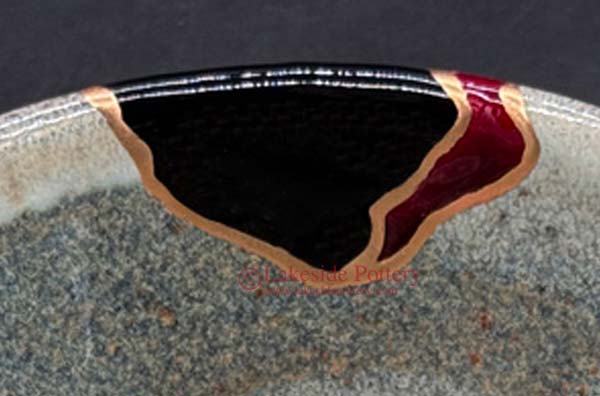
Kintsugi is the Japanese art of repairing broken pottery, but it is more than a method of restoration. In its traditional form, it is also a discipline of materials, timing, and restraint. Traditional Kintsugi uses urushi, a natural lacquer, while many modern studios also work with polymer-based materials that create a similar visual result with different handling properties.
This article offers a clear introduction to urushi, the mixtures used in Kintsugi, and the curing conditions that determine whether a repair succeeds or fails. Because wet urushi can cause strong skin reactions, careful handling and protective measures are essential throughout the process.
1. The Nature of Urushi
Urushi is a natural lacquer made from the sap of the lacquer tree, Toxicodendron vernicifluum, native to East Asia. For centuries, it has been valued for its beauty, durability, and ability to form a hard, resilient surface on ceramics, wood, and decorative objects.
Unlike paint, urushi does not dry simply by losing moisture. It cures through a chemical process that depends on humidity, temperature, oxygen, and the thickness of the applied layer. That makes it both remarkable and demanding: the material responds less to speed than to conditions.
2. A Material That Changes With Use
In Kintsugi, urushi is rarely used as a single, unchanged lacquer. Instead, it is mixed and adapted for different stages of repair, with each formulation serving a distinct purpose.
- Mugi-urushi is the adhesive used to bond broken pieces together.
- Sabi-urushi is a fine filling paste used to level small chips and surface flaws.
- Kokuso is a thicker rebuilding material used where losses are deeper and structural support is needed.
- Other mixtures are used for coating, smoothing, and preparing the surface for the final decorative layer.
Each of these mixtures behaves differently. Additives influence curing speed, adhesion, shrinkage, gloss, and flexibility, which means that even a familiar recipe can produce different results depending on the ratio, climate, and technique. In practice, every new batch deserves a test before it is used on actual work.
3. The Importance of Safety
Urushi is beautiful, but it is not benign. It can cause strong skin reactions, even in small amounts, and sensitivity varies from person to person.
Possible reactions may include:
- Redness
- Itching
- Swelling
- Rash
- Blisters
- Delayed skin eruption after contact
Prevention:
- Avoid direct skin contact with wet urushi.
- Wear protective gloves and long sleeves.
- Keep tools and work surfaces clean.
- Wash immediately if contact occurs.
Additives may alter how the material behaves, but they do not remove the allergy risk.
4. How Additives Change the Material
Additives are used to change how urushi handles, cures, fills, flows, and finishes. Each additive can help the process, but too much can create problems.
- Water is often used to pre-knead powders and improve handling consistency, but too much can slow curing and weaken the result.
- Oils can improve flow, gloss, and working time, though overuse may lead to dust pickup or sagging.
- Rice or wheat pastes add adhesion and flexibility, making them useful for bonding and reinforcement, but too much can make the mixture weaker or slower to cure.
- Powdered materials such as tonoko and jinoko add body and help create layers that can be shaped and sanded after curing. Used too heavily, they can shrink or crack.
In Kintsugi, as in many traditional craft practices, the difference between success and failure is often found in restraint.
5. Curing: Where the Real Work Happens
Urushi does not simply dry; it cures. That curing process depends on four main factors:
- Humidity
- Temperature
- Oxygen
- Layer thickness
If any one of those is off, the repair may set unevenly, remain soft underneath, or fail to harden properly.
Most work cures well at about 20-25 C, or 68-77 F, with enough humidity to support the chemical reaction. Too little moisture in the air can slow curing dramatically. Too much heat can make the surface set before the interior is ready. Thick layers are especially risky, because the outside may harden while the inside stays soft.
For this reason, urushi is usually applied in thin layers. Thin coats cure more evenly, reduce internal stress, and give the artist better control over the final surface.
6. Reading the Stages of Cure
A layer of urushi may feel dry long before it is fully cured. A surface that is set can sometimes be handled carefully, but a fully cured layer is the one ready for sanding and finishing. Depending on thickness and conditions, that full cure may take days or even weeks.
This is why urushi sometimes seems to improve and then fail later. A surface that appears stable may still hold softness beneath the skin, revealing itself only when handled, pressed, or sanded. The lesson is simple: appearance is not proof of readiness.
7. The Curing Environment
Traditional urushi work depends on a controlled curing space, often called a furo or muro. A furo is usually a smaller box or enclosure, while a muro is a larger cabinet or room. Both are designed to regulate humidity and temperature during curing.
- Shime-buro is a humid curing box used for fresh layers.
- Kara-buro is a drier environment used after the surface has set or when a slower, more stable hold is needed.
These spaces are not luxury equipment; they are part of the logic of the material itself.
8. Troubleshooting Common Problems
When urushi does not cure properly, the first thing to inspect is the environment. In many cases, the problem is not the lacquer itself but the conditions surrounding it.
Environmental causes:
- Air that is too dry
- Temperatures that are too low
- Insufficient airflow
- Old material
Surface problems:
- Brush marks can remain when the surface sets too quickly to level out.
- Colored urushi may look dull or muddy if the layer is too thick.
- Colored urushi may also look dull if the pigment load is too high or the curing is too fast.
Structural problems:
- Weak or crumbly repairs usually point to poor mixing, too little binder, or incorrect ratios.
- Bonding failures often come from contamination, poor surface preparation, or inadequate curing.
In other words, the repair is a system, not a single product.
9. Choosing the Right Mixture
Choosing the correct mixture depends on the type of damage and the function of that layer.
- Cracks: Mugi-urushi is typically used first to bond the broken edges.
- Small chips and surface flaws: Sabi-urushi is used for fine filling and smoothing.
- Deeper losses or missing sections: Kokuso is preferred because it builds volume and structure.
- Reinforcement: Cloth can be bonded with urushi adhesive when extra strength is needed.
Cloth reinforcement helps stabilize the repair and distribute stress across a weak area.
10. Knowing When It Is Ready
Experienced urushi workers learn to test rather than guess. A layer is ready for sanding when:
- It no longer feels tacky with gloves.
- It does not dent under light pressure.
- It sands into powder rather than sticky residue.
If it gums up, it needs more time.
There is no advantage to rushing this stage. Stable conditions matter more than exact timing, and patience usually produces a better result than forcing the material ahead of schedule.
|
|
|