Why Do Some Pottery or Sculpture Breaks Keep Failing After DIY Repairs, Even When a Strong Adhesive Is Used?
This question most often comes up after DIY repair attempts. Many people assume that if a repair fails, the solution is simply to use a stronger glue. In practice, repeated failure usually has little to do with adhesive strength and much more to do with the mechanics of the break itself. Certain breaks, especially narrow or load-bearing ones, are structurally vulnerable and will continue to fail when repaired with adhesive alone, regardless of how strong the glue is.
Limited Surface Area in Narrow Breaks
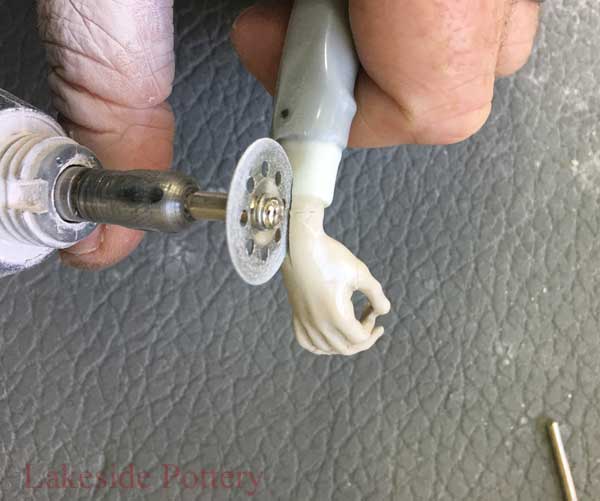
Breaks with a narrow cross section provide very little bonding surface for adhesives. Handles, legs, arms, spouts, swords, and other thin elements concentrate stress at a small joint area, making adhesive-only repairs inherently weak regardless of glue strength.
Stress and Leverage at the Break Line
Narrow elements act like levers. Even light handling or a minor bump at the end of a handle or limb can translate into significant force at the break line. These bending and twisting forces are far more damaging than straight pull forces and can defeat even high-strength epoxies.
Expansion, Movement, and Fatigue Over Time
Temperature changes, humidity, and normal handling cause microscopic expansion and contraction. Over time, this repeated movement fatigues the adhesive joint. In thin repairs, there is no additional structure to absorb or distribute this stress, so failure eventually occurs.
Why Repeated Regluing Makes the Problem Worse
Each failed repair slightly degrades the joint geometry. Old adhesive residue, small material losses, and imperfect realignment reduce effective contact area. As a result, the same break becomes increasingly prone to repeated failure.
When Internal Reinforcement Is Required
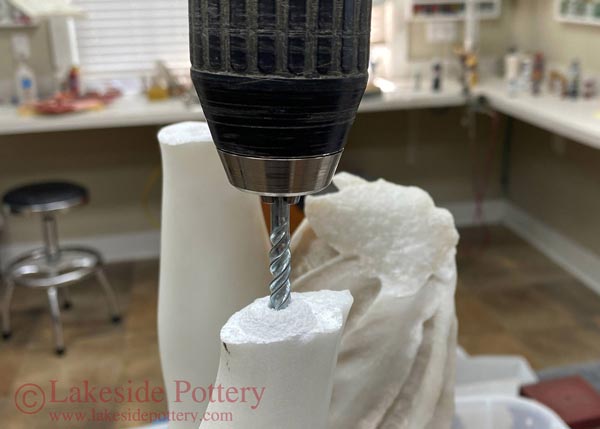
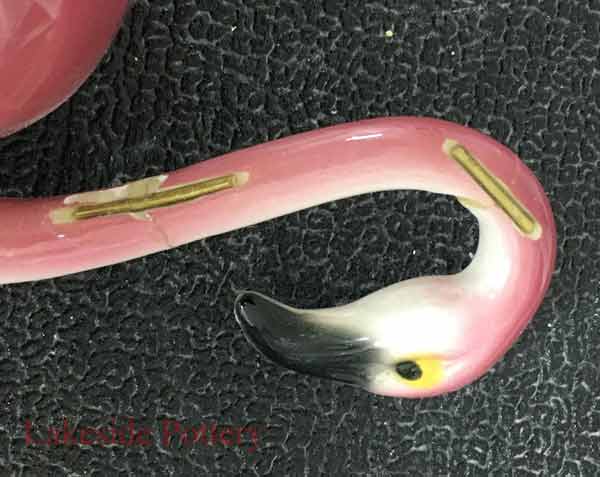
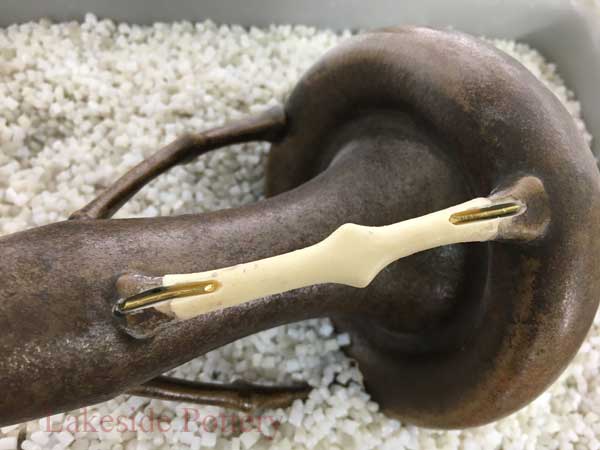
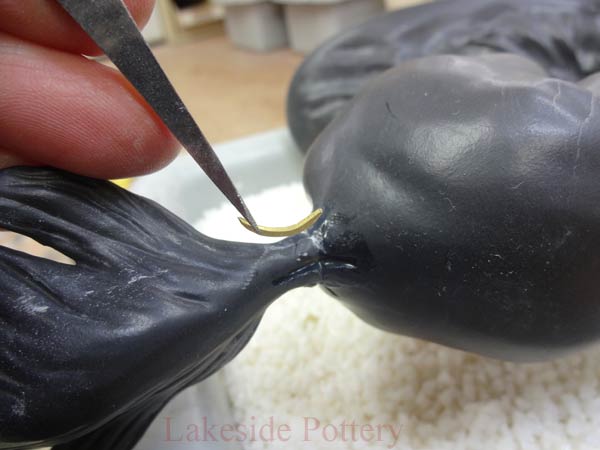
For narrow or load-bearing breaks, durable repair often requires internal metal reinforcement. Pins or pegs installed across the break act as a hidden structural support, transferring stress away from the adhesive and distributing it through the reinforced element.
Why Reinforcement Requires Professional Skill
Proper pinning requires precise drilling, correct pin selection, accurate alignment, and careful planning to avoid introducing new stress points. When done correctly, reinforcement transforms a repeatedly failing repair into a stable, long-lasting restoration.
The Type of Adhesive Used Is Also a Factor
While structural forces are usually the primary reason DIY mending fails, the type of adhesive used can significantly influence how quickly a repair breaks again. Not all glues behave the same under stress, movement, or long-term load.
Many DIY attempts rely on fast-setting or consumer-grade adhesives that are convenient but poorly suited for narrow or load-bearing ceramic breaks. Cyanoacrylate (super glue), for example, can create a very rigid bond that performs well in pure tension but fails under shear, peel, or repeated micro-movement. White glues and craft adhesives lack the strength and durability required for ceramics and often soften with moisture or heat.
Epoxy vs. Super Glue And When to Use Reversible Mending Adhesives
Even epoxies vary widely in formulation. Some cure too rigid, making them brittle under leverage, while others lack sufficient structural strength for thin break cross sections. In addition, incorrect mixing ratios, insufficient cure time, or poor surface preparation can significantly weaken the bond.
That said, no adhesive can compensate for a break with insufficient surface area or high leverage. Adhesive choice may delay failure, but it cannot eliminate the underlying mechanical problem. In narrow breaks such as handles, legs, arms, spouts, or thin decorative elements, proper reinforcement using pins or pegs is often required regardless of the adhesive selected.