Why Do Matte Finishes Make Colors Appear Lighter or Less Rich?
One of the most common questions we receive is why a painted area may appear slightly different after a matte protective coating is applied, especially when the original color is black or another dark color.
The answer has less to do with the paint itself and more to do with how matte finishes interact with light.
The Same Black Color Can Look Very Different
The two surfaces below were coated with the same black color. The difference is the sheen level of the protective clear coating. Notice how the glossy surface appears darker, richer, and deeper, while the matte surface appears softer and lighter. The color itself has not changed. What changes is how light interacts with the surface.
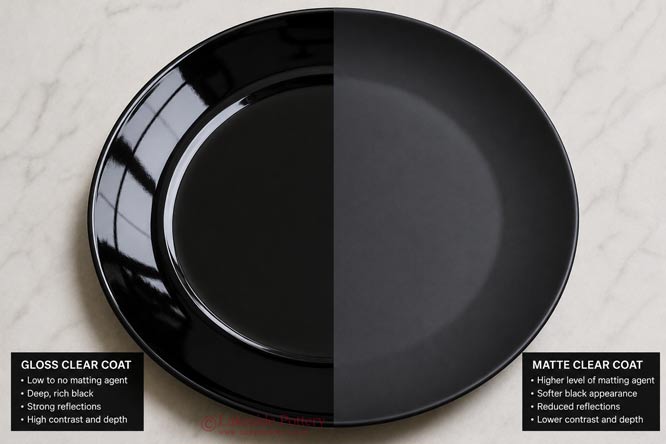 The same black coating viewed through different sheen levels. Glossy finishes enhance depth and richness, while matte finishes create a softer appearance.
Why Is a Protective Coating Needed?
In most restoration projects, a protective clear coating or clear glaze is applied over the painted area.
This coating serves several important purposes:
- Helps protect the applied paint from wear and handling.
- Makes the surface easier to clean.
- Improves durability.
- Increases resistance to ultraviolet (UV) light exposure.
- Helps preserve the appearance of the restoration over time.
The final appearance of the repaired area is influenced not only by the paint color but also by the sheen level of this protective coating.
How Matte Finishes Affect Color
A matte finish changes the way light reflects from a surface.
A glossy surface reflects light in a more controlled manner, allowing colors to appear deeper, richer, and more vibrant. A matte surface scatters light in many directions. This reduces glare and reflections, but it can also make colors appear softer and less intense.
The underlying color has not changed. What changes is how our eyes perceive that color.
Why Matte and Glossy Surfaces Look Different
The difference between matte and glossy finishes is primarily a matter of light reflection. Glossy surfaces reflect light in a more controlled manner, creating stronger highlights and greater visual depth. Matte surfaces scatter light in many directions, reducing glare but also reducing the visual intensity of the color.
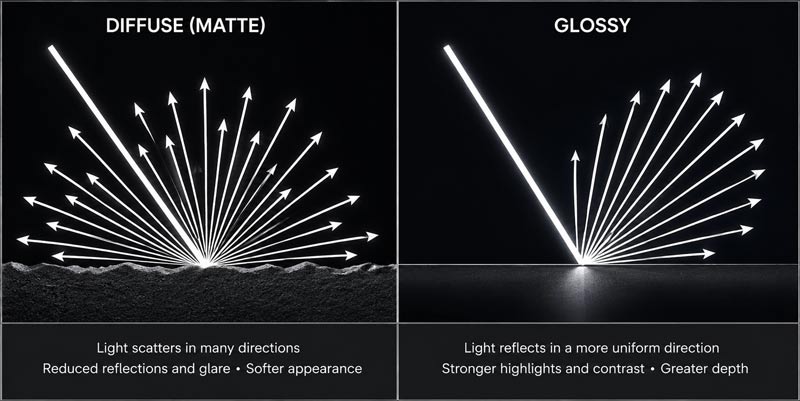 Light reflection on matte and glossy surfaces. Matte finishes diffuse light in many directions, while glossy finishes reflect light more uniformly, producing stronger contrast and greater perceived color depth.
Why Is the Effect Most Noticeable with Black?
Black provides the easiest example.
A glossy black surface often appears deep, rich, and almost liquid in appearance. When a matte coating is applied, the surface diffuses light rather than reflecting it cleanly. As a result, the black may appear softer and sometimes slightly gray or dusty, particularly under bright lighting.
Because black absorbs most of the light that reaches it, even a small amount of additional light scattering can noticeably reduce the sense of depth.
Does This Happen Only with Black?
No. The same effect occurs with all colors:
- Matte red may appear less saturated than glossy red.
- Matte blue may appear calmer and less brilliant.
- Matte green may seem more muted.
- Matte brown may appear softer and less rich.
Dark colors simply make the difference easier to see.
Why Are Dark Colors More Affected?
Dark colors absorb more light than light colors.
When a matte coating scatters some of that light, the visual impact is greater. With lighter colors such as white, cream, beige, or pale gray, the effect is usually less noticeable because those colors already reflect a large amount of light.
In general, the darker the color, the more noticeable the effect becomes. Deep blacks, dark blues, dark greens, and dark reds tend to show the greatest visual difference between gloss, satin, and matte finishes.
Can Too Much Matting Cause Additional Color Changes?
Yes.
Matte finishes are created by adding matting agents that increase light diffusion. If a matting agent is used too heavily, it can introduce an additional visual effect beyond reducing shine.
Excessive matting can make a color appear slightly cloudy, hazy, or less transparent. This can reduce the richness and depth of the finish, particularly on darker colors.
For this reason, in our restoration work we rarely use the maximum possible level of matting. Instead, we aim for a balance that reduces glare while preserving as much color depth and clarity as possible.
Why Use a Matte Finish at All?
Matte finishes offer several practical advantages:
- Reduce glare and reflections.
- Hide fingerprints and smudges.
- Help conceal minor surface imperfections.
- Create a softer, more natural appearance.
- Provide a more uniform look under different lighting conditions.
For many objects, these benefits outweigh the slight reduction in color intensity.
What About Satin Finishes?
A satin finish is often a good compromise between matte and gloss. It reduces glare while still preserving much of the depth and richness of the underlying color. For this reason, satin finishes are frequently used on sculptures, decorative objects, and restoration projects where both appearance and practicality are important.
The Bottom Line
Protective clear coatings are an important part of most restoration projects because they help protect the paint, improve durability, make surfaces easier to clean, and increase UV resistance.
The sheen level of that coating also affects how color is perceived. Matte finishes scatter light, reducing glare but also making colors appear somewhat softer and less intense. If excessive matting is used, colors can also take on a slightly cloudy appearance.
These effects occur with all colors but become increasingly noticeable as colors become darker. Black provides the clearest example, but the same principle can be observed in everyday objects such as river rocks.
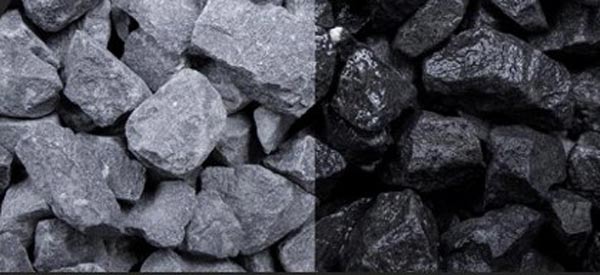 The same river rocks shown dry (left) and wet (right). The rocks themselves have not changed color. When wet, the smoother, glossier surface reflects light differently, making the rocks appear darker, richer, and more vibrant.
This familiar wet-versus-dry river rock effect illustrates the same phenomenon seen with protective coatings. A glossier surface tends to enhance depth and richness, while a matte surface scatters light and produces a softer appearance.
When selecting a finish for a restoration project, the choice between gloss, satin, and matte is often a balance between color depth, glare reduction, durability, and the desired visual appearance of the final piece.
|